
ChatGPT now shows ads, and your clients have noticed. Some want to know if they should be there. Others want to know why a competitor’s name just showed up under an answer about their category. Either way, your agency needs a confident answer, not a shrug.
The short answer: ChatGPT Ads are sponsored placements that appear alongside ChatGPT’s answers for adult users on the Free and Go plans. Advertisers buy them through OpenAI’s self-serve Ads Manager on a cost-per-click, cost-per-thousand-impressions, or conversion-optimized basis, with a minimum daily budget of $25. Agencies can’t open accounts on a client’s behalf. The client creates the account and invites the agency in. For most clients, the right move is a structured test with clear success criteria, not a budget shift away from search.
The rest of this guide covers everything an agency needs to run the channel well: how ads get matched to conversations, what clients actually pay, how to manage access across many client accounts, how to measure and report results, what the real performance data says, and the mistakes that burn test budgets fastest.
At a glance
ChatGPT Ads in 60 seconds
Who sees ads
Adult users on the Free and Go plans. Paid plans stay ad-free.
Where
More than 60 countries, with self-serve buying in most major markets.
How you pay
CPC, CPM, or conversion-optimized bidding in a second-price auction.
Minimum spend
$25 per day. No minimum commitment.
Targeting
Context hints, location down to postal code, and custom audiences. No keyword bidding.
Agency access
The client creates the account and invites the agency. No manager account.
Data you get
Aggregate results only. No prompts, conversations, or search terms.
Benchmarks
None official yet. Judge tests against the client’s break-even CPA.
What ChatGPT Ads Are and How They Actually Work
Here’s the simplest way to picture it. Imagine asking a knowledgeable store clerk for advice. The clerk gives you an honest answer, and next to the counter sits a clearly labeled “sponsored” display related to what you just asked about. The display doesn’t change the clerk’s answer. It just sits beside it, hoping to be useful.
That analogy gets you most of the way. It breaks down in one important place, and that place is where agencies win or lose. There are no aisles to bid on. You don’t buy a keyword or a demographic. You describe the situations where your client belongs. The system decides when a conversation matches. The sections below break down where ads appear, how matching works, and what you can and can’t see as an advertiser.
Where the Ads Appear Inside ChatGPT
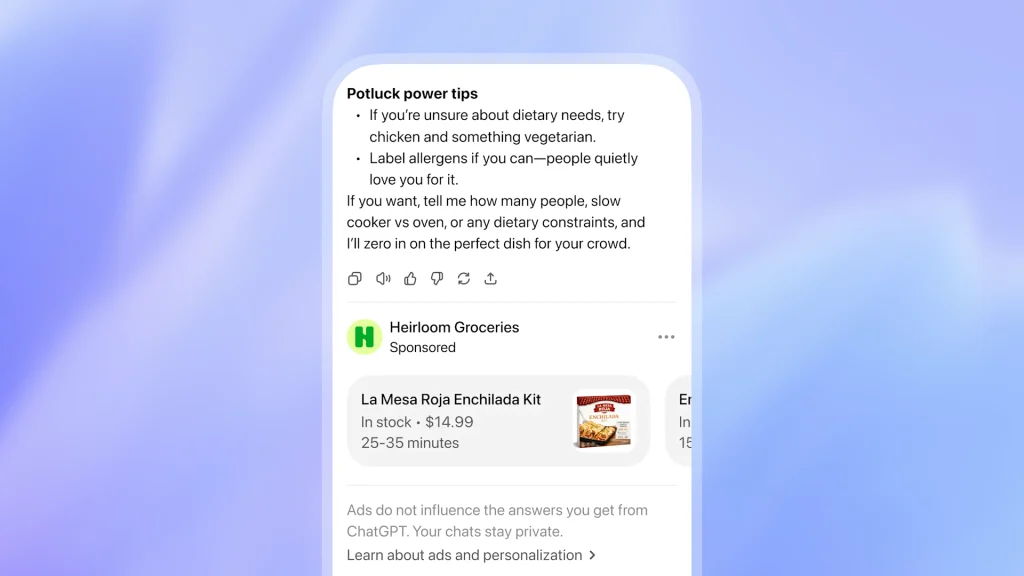
According to OpenAI’s launch announcement, ads are labeled as sponsored and visually separated from the organic answer. The standard unit is a card with a title, a short description, a square image, a logo, and a link. Retail clients can also run product-feed ads that pull in product details from a catalog.
OpenAI is also testing a visual format that appears while users generate images. TechCrunch reported that this format is starting in the US with a limited group of advertisers, so treat it as an opportunity to watch rather than one to sell clients on yet.
How ChatGPT Decides Which Ad to Show
Two things happen every time an ad is eligible to appear. First, the system figures out which ads are relevant to the conversation. OpenAI says it matches ads using the topic of the current conversation and, depending on the user’s country and settings, signals such as past chats and past ad interactions. On your side, the inputs are your ad group’s context hints, the ad copy, and the landing page.
Second, relevant ads compete in an auction. The OpenAI Help Center describes it as a relevance-weighted, second-price auction. In plain terms, the highest bid doesn’t automatically win, because a more relevant ad can beat a richer one. And when you do win, you pay roughly what it takes to beat the next competitor, not your full maximum bid. If you’ve managed Google Ads Quality Score, the logic will feel familiar.
What Advertisers Can and Can’t See
This is the adjustment that surprises most PPC teams. OpenAI states that advertisers never see users’ conversations, chat history, or personal details, and that ads don’t influence the answers ChatGPT gives. You get aggregate performance data, such as impressions, clicks, spend, and conversions.
That means there’s no search term report. You won’t see the exact prompts that triggered your client’s ad. You can’t mine queries the way you would in Google Ads. Your optimization loop runs on context hints, creative, landing pages, and conversion data instead.
Why It Isn’t Search Ads or Social Ads
It helps to place ChatGPT Ads between the two channels your team already knows.
| Search ads | Social ads | ChatGPT Ads | |
|---|---|---|---|
| What you target | The words a person typed | Who the person is | What the conversation is about |
| Main targeting input | Keywords and match types | Demographics, interests, lookalikes | Context hints, location, custom audiences |
| Query-level data | Search term report | Not applicable | None |
| Where the ad sits | Above or beside results | Inside a feed | Next to an AI-written answer |
The practical takeaway: your client’s ad shows up when the conversation is about their problem, not when a specific phrase appears. That rewards agencies that understand the client’s buyer deeply. It punishes agencies that paste in a Google keyword list and walk away.
Who Sees ChatGPT Ads and Who Never Will
The audience is huge, but it isn’t the whole ChatGPT user base. Knowing exactly who is in and who is out will save you from pitching the channel to the wrong client.
The Eligible Audience
OpenAI reports that ChatGPT reaches 1.2 billion people every week. Ads are shown to adult users on the Free and Go plans. Users on Plus, Pro, Business, Enterprise, and Education plans don’t see ads, according to OpenAI’s announcement.
Not every eligible user sees ads every day, either. Similarweb’s panel data found that by September 2026, 43.4% of eligible US users had seen at least one ChatGPT ad, compared with 45.7% in the UK and 27.8% in Mexico.
The audience
Who sees ChatGPT ads, and who never will
1.2B
people use ChatGPT every week, but only part of that audience is eligible for ads
43.4%
of eligible US users had seen at least one ChatGPT ad by September 2026
✓ Sees ads
Adults on the Free plan
Adults on the Go plan
In supported countries only
✗ Never sees ads
Plus and Pro subscribers
Business, Enterprise, and Education seats
Users predicted to be under 18
Ad-free conversations
Health
Mental health
Politics
Sources: OpenAI, OpenAI ad principles, Similarweb
Contexts Where Ads Never Appear
OpenAI also limits where ads can show, even for eligible users. Its stated principles exclude users predicted to be under 18 and keep ads away from conversations about sensitive topics such as health, mental health, and politics. If your client’s buyers mostly arrive through those kinds of conversations, the available inventory will be thin.
What This Means for B2B and Premium Clients
Here’s the nuance most guides skip. The people most likely to pay for ChatGPT, including many professionals who use it all day at work, are exactly the people who don’t see ads. As Search Engine Journal points out, ChatGPT Ads only reach part of the ChatGPT audience.
That doesn’t rule out B2B. A procurement manager might use a company Enterprise seat at work and a free personal account at night. But it does mean you should expect a different audience mix than the “1.2 billion users” headline suggests. You should validate lead quality early, before scaling spend.
Where You Can Run ChatGPT Ads and How to Buy Them
Availability is broad enough now that most agencies can start a test this week. The two questions to settle first are which of your clients’ markets are covered and which buying route fits your agency.
Countries Where Ads Are Available
OpenAI says ChatGPT Ads are available in more than 60 countries. The Ads Manager availability page lists the markets where self-serve buying is open, including the US, Canada, the UK, most of the European Union, Australia, New Zealand, Japan, South Korea, India, Brazil, Mexico, and several markets in the Middle East and Southeast Asia.
Check that page before every new client kickoff. The country list grows often. An international client may have markets that are open for buying through OpenAI’s sales team before they open for self-serve.
The Three Ways to Buy
Most agencies will use the first route. It’s worth knowing all three so you can answer when a client’s enterprise team asks.
- Self-serve Ads Manager. Campaigns are built and managed at ads.openai.com. This is the realistic path for independent agencies and small to mid-sized clients.
- OpenAI’s sales team. Larger advertisers can work with OpenAI directly on managed campaigns.
- Agency and technology partners. OpenAI named holding companies including Dentsu, Omnicom, Publicis, and WPP, plus tech partners such as Adobe, Criteo, Kargo, Pacvue, and StackAdapt. Havas Media was added later, according to OpenAI.
If your agency already buys through one of those platforms, ask your rep about ChatGPT inventory. It may let you manage the channel alongside your existing programmatic workflow.
How Much ChatGPT Ads Cost Your Clients
ChatGPT Ads has a low barrier to entry and no fixed price. You set a daily budget and a bid, and the auction decides what you pay. The details below cover the minimums, the bidding options, and what agencies are actually paying.
Minimum Budgets and How Pacing Works
The OpenAI Help Center sets the minimum daily campaign budget at $25, with equivalents in other supported currencies. There’s no minimum commitment beyond that.
One pacing rule trips people up. Your daily budget works as an average across a seven-day period. The system can spend up to twice the daily amount on a single day when it sees more opportunity. Weekly spend won’t exceed seven times the daily budget. Explain this to clients before launch so a $50 day on a $25 budget doesn’t trigger a panicked email.
Bidding Options by Campaign Objective
Your bid type follows the objective you pick, based on OpenAI’s campaign setup documentation.
| Objective | How you bid | Best for |
|---|---|---|
| Reach | Cost per thousand impressions (CPM) | Awareness and launch visibility |
| Clicks | Cost per click (CPC) | Traffic and early learning |
| Conversions | Optimized toward a conversion event, charged per click, with an optional bid cap | Leads and sales once tracking is in place |
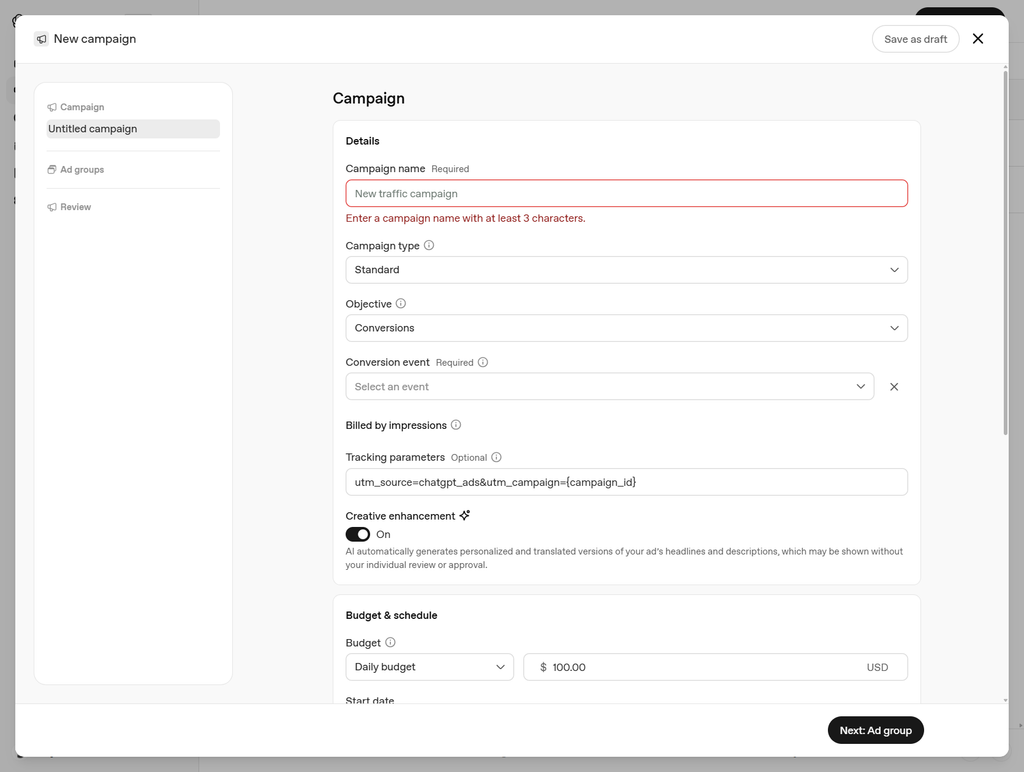
The Help Center recommends a starting maximum CPC of $3 to $5. Treat that as a starting point, not a forecast. As Search Engine Journal explains, that recommendation often gets repeated as a benchmark, even though OpenAI hasn’t published one.
What Agencies Are Actually Paying
Real costs vary widely by market and industry. Here’s what published tests show.
- John Horn, CEO of StubGroup, wrote in Search Engine Land that his team sees average CPCs of $2 to $5 across industries.
- Search Engine Journal found CPCs ranging from about $3 to $22 across publicly shared tests. One multi-country test reported $5.10 in the UK, $10.62 in the US, $17.59 in Australia, and $22.89 in New Zealand.
- A B2B campaign covered in the same SEJ piece paid $9.29 per click and $64.34 per thousand impressions.
A Quick Way to Size a Test Budget
Work backward from the number of conversions you need to make a decision, not from the minimum budget. Say a client’s realistic CPC is $6 and their landing page converts at 2%. Getting 30 conversions, a reasonable floor for judging a channel, takes about 1,500 clicks, or roughly $9,000.
That math explains why so many early tests end in “inconclusive.” A $25-a-day test produces about 4 clicks a day at that CPC. After a month, you’d have around 125 clicks and two or three conversions, which isn’t enough to tell signal from noise. If the budget can’t reach a decision point, either narrow the test to the client’s highest-value offer or measure an earlier signal, like qualified demo requests, and say so upfront.
Interactive calculator
How much budget does your ChatGPT Ads test need?
Enter your client’s expected numbers to see the spend and time needed to reach a confident decision.
Clicks needed
0
Total test budget
$0
Time to decision
0 days
Clicks per day
0
The minimum daily budget in ChatGPT Ads is $25. Estimates assume a steady CPC and conversion rate, so treat them as planning ranges, not guarantees.
How Agencies Get Access to Client Accounts
This is where ChatGPT Ads differs most from Google and Meta for agencies. There's no manager account sitting above your client accounts. You can't create accounts for clients yourself. Getting the setup right on day one avoids ownership headaches later.
Why the Client Has to Own the Account
The OpenAI Help Center states that an agency can be invited after the client creates its advertiser account. It also says agencies can't create advertiser accounts on a client's behalf. As John Horn noted in Search Engine Land, OpenAI doesn't yet have an equivalent to Google Ads manager accounts or Meta Business Manager.
This is actually good hygiene. The client owns the account, the payment method, and the data from the start. If the relationship ends, nothing has to be transferred. You simply lose access.
The Setup Sequence, Step by Step
Walk your client through these steps on a short call. It usually goes faster than waiting on email back-and-forth.
Account setup
The client owns the account. The agency gets invited in.
Create the advertiser account
At ads.openai.com, using a company email the client controls long-term.
Complete the profile and verification
Set country, time zone, and currency deliberately, matched to the client's other ad accounts.
Add a payment method
Billing stays in the client's name, so your agency never floats ad spend.
Invite the agency team
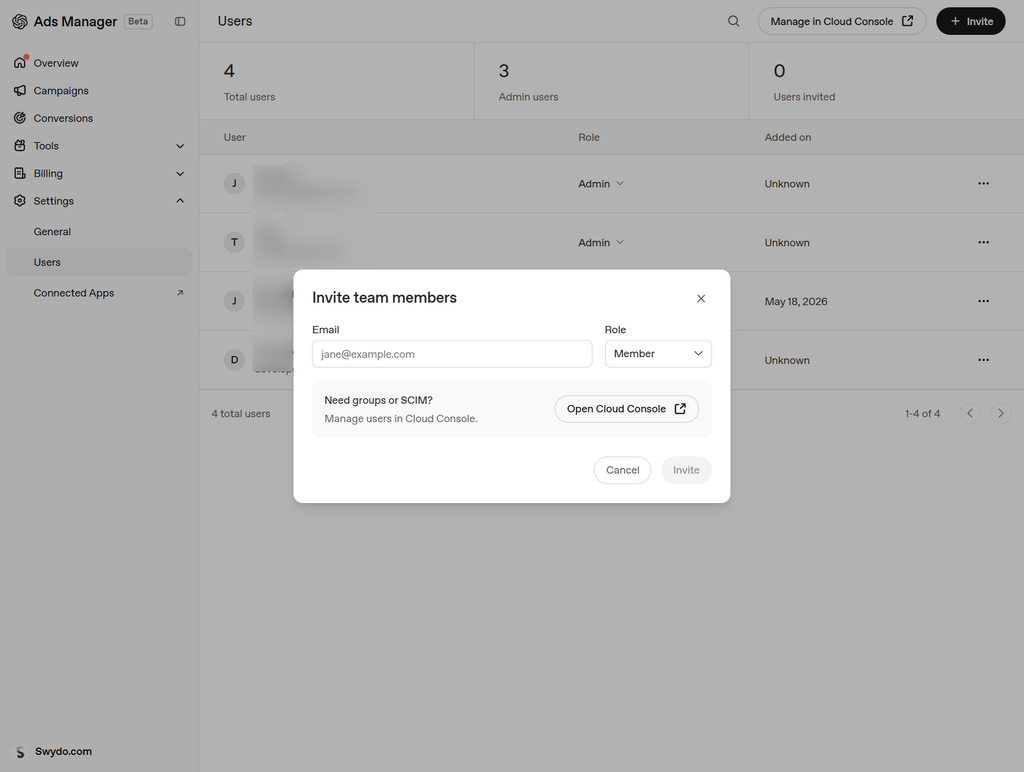
From the account's user settings, with an Admin, Member, or Viewer role for each person.
Accept and confirm access
Check permissions before any campaign work begins.
Keep one Admin on the client side at all times. If the only Admin is an agency employee who later leaves, the client can lose access to its own account.
Source: OpenAI Help Center
Choosing the Right Role for Each Person
Ads Manager uses three account roles. Assign them the way you would in any other ad platform, with the least access each person needs.
| Role | Who should get it | Why |
|---|---|---|
| Admin | The client's account owner and your agency lead | Manages users and account settings |
| Member | Your media buyers | Builds and edits campaigns day to day |
| Viewer | Analysts, account managers, client stakeholders | Reads performance without touching campaigns |
Keep at least one Admin on the client side at all times. If the only Admin is an agency employee who later leaves, the client can end up locked out of its own account.
Managing Many Clients Without a Manager Account
One login can belong to multiple advertiser accounts. You switch between them inside Ads Manager. The Help Center notes a limit: once a user belongs to 10 or more advertiser accounts, that user can't create new ones but can still be invited to more. Since clients create their own accounts anyway, this rarely blocks agencies.
For larger teams, a few tools make multi-client work more manageable.
- Bulk upload lets you build or edit campaigns from a spreadsheet, following OpenAI's launch campaign guidance.
- The ChatGPT Ads Manager plugin lets you review and manage campaigns from inside ChatGPT or Codex, according to the Help Center.
- The Global Admin Console gives organizations on an OpenAI enterprise tenant central control over who has Ads access, as described in OpenAI's admin documentation.
Offboarding Without Drama
Because the client owns everything, offboarding is mostly about access. Export a final performance report, document campaign settings and context hints in a handoff file, then have the client remove your team's users. Add these steps to your standard offboarding checklist now, so nobody has to remember them later.
How to Build Your First ChatGPT Ads Campaign
The interface will feel familiar, but the craft is different. Most of your leverage comes from how you group intents and how you write context hints, so spend your time there rather than on bid tweaks.
The Campaign Structure
Ads Manager uses a three-level structure, as laid out in OpenAI's campaign documentation.
- Campaign. Sets the type (standard or product feed), the objective, locations, optional custom audiences, the budget, the conversion event, and the schedule. Location targeting can go as narrow as region, metro area, or postal code.
- Ad group. Sets the bid, the default landing page, and the context hints that describe when your ads should show.
- Ad. Holds the headline, description, image, and destination URL.
The rule of thumb: one ad group per distinct buying situation. If a client sells both payroll software and HR consulting, those are different conversations with different buyers. They belong in separate ad groups with their own hints and landing pages.
Writing Context Hints That Actually Match
Context hints are short descriptions of the topics and situations where your ad belongs. OpenAI's documentation is clear that they guide matching rather than act as exact-match rules, so think in terms of meaning, not phrasing.
Here's how that looks for a hypothetical project management SaaS client targeting agency owners.
| Weaker hint | Stronger hint | Why it's better |
|---|---|---|
| project management software | choosing a project management tool for a creative agency | Adds the buyer and the decision moment |
| best PM tool | comparing Asana, Monday, and ClickUp for client work | Matches comparison conversations where your client can win |
| task tracking | tracking billable hours across multiple client projects | Ties to the pain your client's product solves |
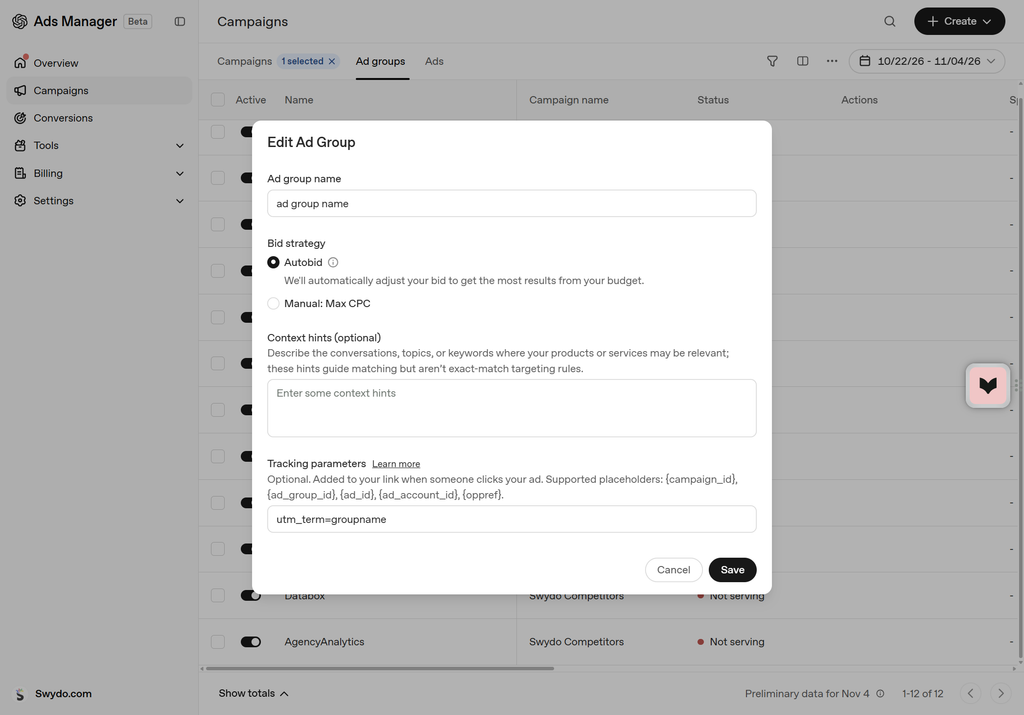
Test both formats. John Horn shared a case in Search Engine Land where keyword-style hints outperformed question-style hints, which runs against what many people assume. Run them in separate ad groups so the results don't blur together.
If you qualify, use exclusions as well. OpenAI introduced Negative Phrases for qualifying advertisers, which help keep ads away from conversations that look related but aren't a fit.
Creative Specs and Copy That Earns the Click
OpenAI's launch campaign guidance gives these limits.
| Element | Recommended | Maximum |
|---|---|---|
| Headline | 16 to 24 characters | 50 characters |
| Description | 32 to 48 characters | 100 characters |
| Image | Square PNG or JPG, at least 256 by 256 pixels |
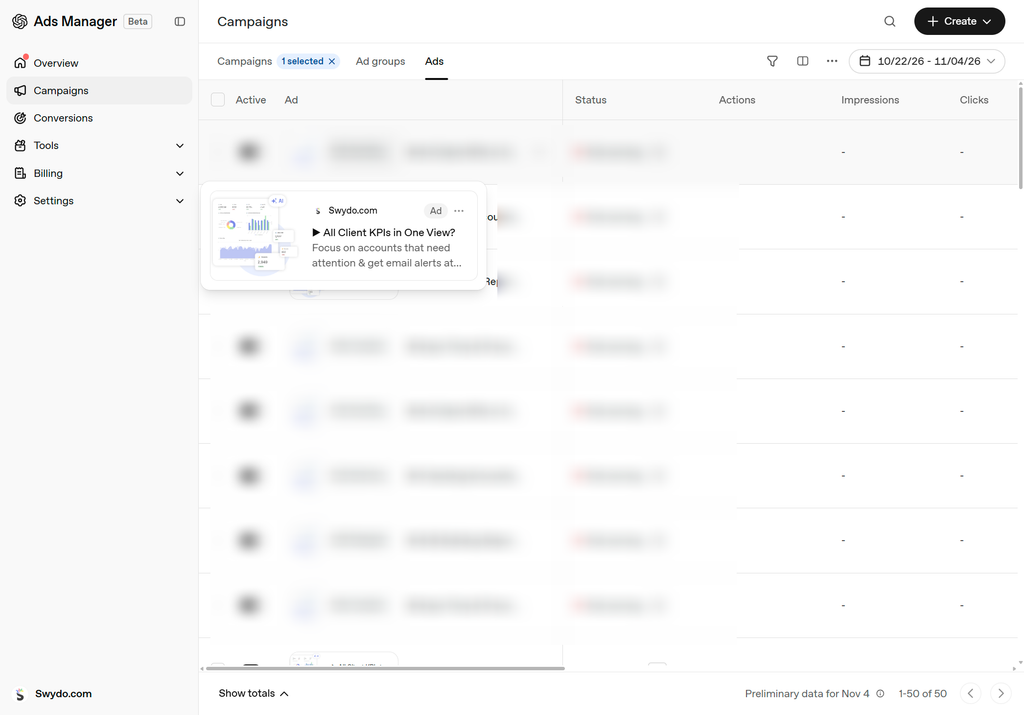
Make sure the landing page doesn't block OpenAI's crawlers, since the system reads it to understand relevance.
On copy, don't recycle search or social ads. A Graphite and Similarweb analysis of more than 95,000 US ChatGPT ads found that top advertisers wrote 98% new copy for the channel and used a small set of landing pages. The same analysis found ads that appear early in a conversation tend to earn higher click-through rates. The user is still exploring, so copy that helps them take a next step works better than a hard sell.
A Simple First Test Setup
If you want a default to start from, this setup works for most clients.
- One campaign on the Clicks objective while conversion tracking proves itself, then switch to Conversions.
- Two to four ad groups, each built around one buying situation.
- Five to ten context hints per ad group, mixing keyword-style and situation-style phrasing.
- Two or three ads per ad group, each testing a different angle, such as outcome, proof, or offer.
- One dedicated landing page per ad group that continues the conversation the user was having.
Measuring and Reporting ChatGPT Ads for Clients
Measurement is where agencies earn their fee on this channel. The platform gives you less diagnostic data than Google Ads. Your tracking setup and your reporting story carry more weight. Set both up before the first dollar is spent.
Conversion Tracking With the OpenAI Pixel and Conversions API
OpenAI offers two ways to send conversion data back to Ads Manager: the OpenAI Pixel, which runs in the browser, and the Conversions API, which sends events from the server. Use both when you can. The server-side feed catches conversions the browser misses because of ad blockers or privacy settings.
The partner ecosystem is already deep. OpenAI lists data integrations with Hightouch, Tealium, and LiveRamp, attribution partners including AppsFlyer, Triple Whale, Northbeam, DV Rockerbox, Branch, Adjust, and Singular, and incrementality testing partners Haus, Measured, and WorkMagic. If a client already uses one of these tools, ChatGPT Ads can usually slot into their existing attribution view.
Separating Paid ChatGPT Traffic From Organic ChatGPT Traffic
This is the reporting trap that catches almost everyone. ChatGPT also sends organic referral traffic when it mentions or links to a brand in its answers. If paid clicks aren't tagged, analytics tools can lump them in with that organic traffic, and your client's report will understate the ads and overstate organic AI visibility.
The fix is simple: add UTM parameters to every ad URL. A Graphite study found that with UTMs in place, 92% to 96% of ChatGPT Ads clicks registered as paid sessions in Google Analytics 4. A clean convention looks like this:
utm_source=chatgpt&utm_medium=paid&utm_campaign={campaign_name}&utm_content={ad_group_name}
Then create a custom channel group in GA4 that routes chatgpt plus paid into a "Paid AI" channel, kept separate from organic AI referrals.
Tracking setup
ChatGPT sends you two kinds of traffic. Keep them apart.
Paid lane
User clicks a sponsored ad
→
URL carries utm_medium=paid
→
GA4 routes it to "Paid AI"
→
Reported as the paid ChatGPT channel
Organic lane
ChatGPT mentions or links the brand in an answer
→
Arrives as a chatgpt.com referral
→
GA4 routes it to "Organic AI"
→
Reported as organic AI visibility
Skip the UTMs and the lanes merge. Paid clicks land in organic AI, so the ads look weaker and organic AI visibility looks stronger than it really is.
With UTMs in place, 92% to 96% of ChatGPT Ads clicks registered as paid sessions in GA4. Source: Graphite
Know What the Platform Won't Tell You
Set expectations before the first report goes out. You won't get prompt-level or search-term data. Search Engine Land notes that reporting breaks down by country even when your targeting is narrower. There's no equivalent to Google's Auction Insights or impression share either.
That makes on-site behavior more important. Engagement time, pages per session, form completion, and downstream lead quality in the CRM become your main diagnostic signals.
Pulling ChatGPT Ads Into Cross-Channel Client Reports
Clients don't want another login. They want ChatGPT Ads in the same report as Google, Meta, and LinkedIn, so they can compare it with everything else.
Swydo connects to ChatGPT Ads natively. Add OpenAI Advertising from a client's data sources, and impressions, clicks, cost, CPC, CTR, and CPM flow into the same reports and dashboards as Google Ads, Microsoft Ads, Facebook Ads, and LinkedIn Ads. The integration ships with a preset ChatGPT Ads report template, so your first client report doesn't start from a blank page.
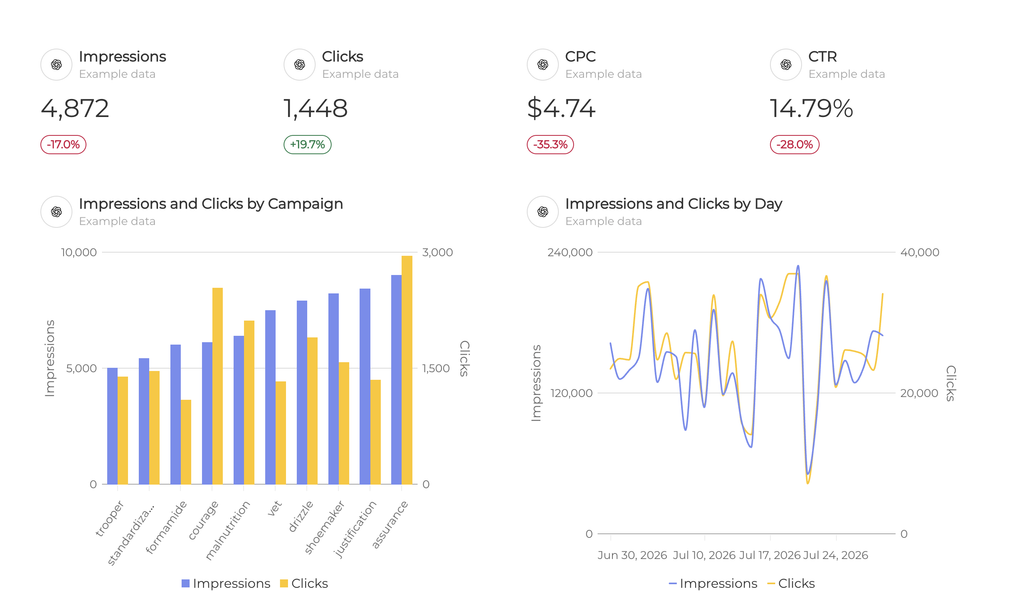
For conversion results, add GA4 to the same report. Your UTM-tagged ChatGPT Ads sessions and conversions already land there, so clients see delivery and outcomes side by side.
Asking About ChatGPT Ads Performance Inside ChatGPT or Claude
There's a fun twist here: the quickest way to review ChatGPT Ads results might be asking an AI assistant. The Swydo MCP connector links your Swydo account to ChatGPT, Claude, and other tools that support MCP. You can ask about one client or your whole portfolio in plain language and get answers from live reporting data, not a pasted export. Permissions carry over, so the AI only sees clients you can already access in Swydo.
A few prompts that work well for this channel:
- "Which clients had a ChatGPT Ads CPC above $8 last week, and how does that compare with their Google Ads CPC?"
- "Compare ChatGPT Ads CTR with Microsoft Ads CTR for [client] over the last 30 days."
- "Write a three-sentence summary of ChatGPT Ads performance for [client]'s monthly report."
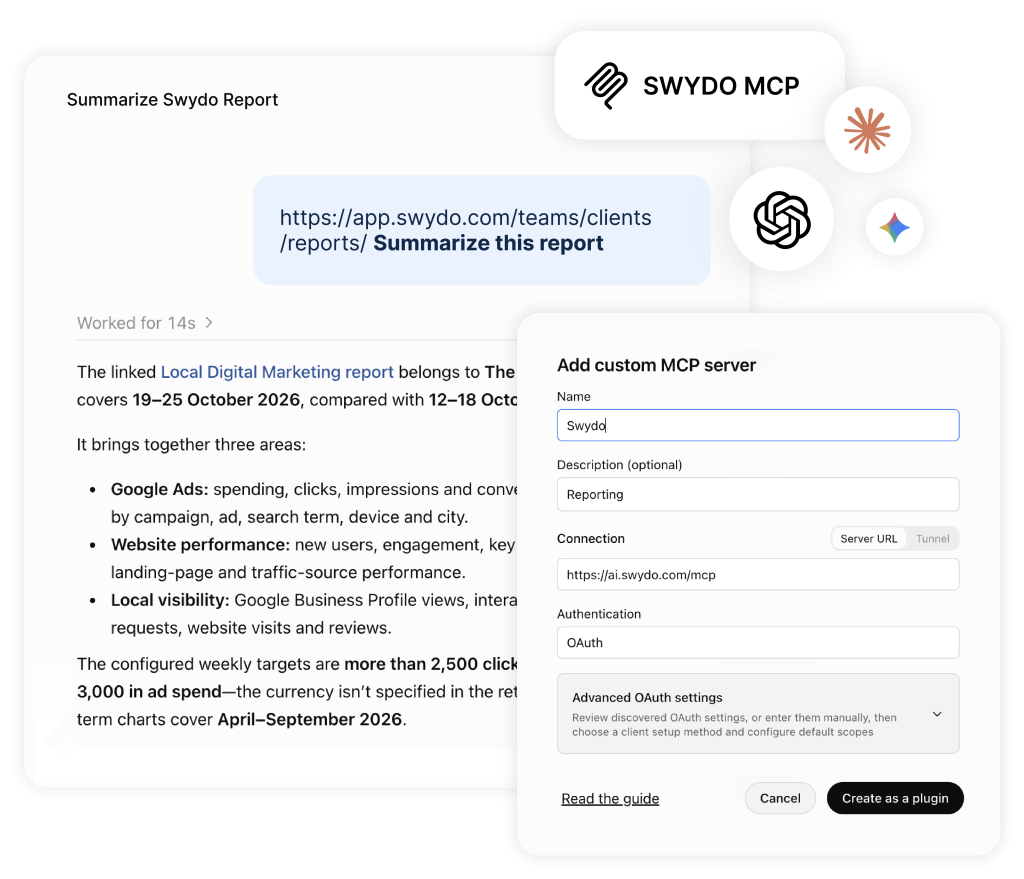
This is most useful during a test, when you're checking spend pacing and early signals across several clients at once.
The KPIs to Put in Front of Clients
Report in layers, with business outcomes on top and platform metrics underneath as diagnostics.
| Layer | Metrics | What it answers |
|---|---|---|
| Business outcome | Cost per acquisition, pipeline or revenue, return on ad spend | Is this channel paying for itself? |
| Conversion quality | Conversion rate, lead-to-opportunity rate, new versus returning customers | Are these the right people? |
| Traffic health | Click-through rate, cost per click, engagement time | Is the targeting and creative working? |
| Delivery | Impressions, spend, budget pacing | Is the campaign running as planned? |
Lead with the top two layers. A strong click-through rate paired with zero qualified leads isn't a win, and showing the layers together keeps that honest.
For formulas, benchmarks, and the one metric each campaign objective should be judged on, see our ranking of the most important ChatGPT Ads metrics.
ChatGPT Ads Benchmarks and What They Really Mean
Start with the most honest fact in this whole guide. OpenAI's own FAQ says the platform doesn't yet have performance benchmarks across advertisers, industries, or campaign types. Every number below is either panel data, a single advertiser's result, or a vendor-published case study. Each one is useful, as long as you know which kind you're looking at.
Click-Through Rates by Market
Similarweb's analysis, built with Graphite, measured clicks per ad-bearing ChatGPT response across all advertisers in each market.
Benchmark data
ChatGPT Ads click-through rate by market
Clicks per ad-bearing ChatGPT response, across all advertisers in each market.
Brazil
1.91%
Mexico
1.55%
Japan
1.53%
South Korea
1.21%
Canada
0.75%
United Kingdom
0.74%
United States
0.73%
Australia
0.67%
New Zealand
0.60%
Above 1% Below 1%
Brazil's CTR is about 2.6x the US rate. If a client sells internationally, test markets outside the US instead of assuming English-speaking markets will lead.
Source: Similarweb with Graphite. Panel data across all advertisers; not comparable to a single campaign's CTR or to Google Search CTR.
Two cautions before you quote these to a client. First, this is a market-wide average across every advertiser, so a well-targeted campaign can beat it and a sloppy one can fall short. Second, it isn't comparable to a Google Search CTR, because the user didn't type a query looking for a vendor. The useful insight is relative: markets like Brazil and Mexico show noticeably higher engagement than English-speaking markets, which matters for clients with international reach.
Reported Results From Real Campaigns
The published case results so far are mixed, which is exactly what you'd expect from a young channel.
| Advertiser or test | Result | Source |
|---|---|---|
| WeightWatchers | Attributed cost per acquisition 15.3% lower than its blended paid search benchmark (measured by DV Rockerbox) | OpenAI |
| Unnamed ecommerce brand | 3x return on ad spend over 28 days | OpenAI |
| High-order-value ecommerce (Common Thread Collective) | $9,620 spent, 0.94% CTR, estimated 3.3x to 6.8x ROAS | Search Engine Journal |
| B2B campaign | About CAD $7,000 spent, 0.7% CTR; only 5 of 146 identified organizations matched the ideal customer profile | Search Engine Journal |
| StubGroup site comparison | 0.21% conversion rate from ChatGPT Ads versus 3.71% from Google Ads | Search Engine Land |
| Small agency test (Choice OMG) | $415 spent, 60 clicks, zero buyers | MediaPost |
Notice the pattern. The strongest results come from advertisers with mature attribution setups and enough spend to measure properly. Many of them are published by OpenAI or its measurement partners. The weakest come from small or short tests and from B2B lead generation, where audience quality is the sticking point. Australian agencies told AdNews they saw sub-1% CTRs and lower conversion rates than other channels.
How to Use Benchmarks With Clients
Don't promise a number. Instead, agree on the client's own break-even point, such as the maximum cost per acquisition they can afford, and judge the test against that. Benchmarks are for sanity checks, like spotting a CTR far below the market average that points to a targeting problem. They aren't a forecast for any individual account.
Ad Policies, Restricted Industries, and Brand Safety
OpenAI's ad rules are stricter than most platforms in some areas and still being refined in others. Read the current OpenAI Ad Policies before you pitch any client in a regulated industry, because what's allowed depends on both the category and the country.
Regulated Industries Need a Closer Look
The categories agencies ask about most are finance, health, and legal. Under OpenAI's policies, ads in these areas are reviewed case by case in the US and are generally prohibited outside the US. Legal services can advertise in the US when the provider is licensed in the relevant jurisdiction. OpenAI also reserves the right to decline ads for reasons tied to its own competitive position. A client building a competing AI product should expect extra scrutiny.
If a client sits in one of these categories, build approval time into the launch plan. Don't promise a go-live date until the first ads clear review.
Brand Safety and Suitability Controls
Some brand safety protections are built into the product. Ads don't appear near conversations about health, mental health, or politics. They aren't shown to users predicted to be under 18, according to OpenAI.
You also get some controls of your own. OpenAI has announced Negative Phrases for qualifying advertisers, plus brand suitability pilots with DoubleVerify and Integral Ad Science. For clients whose brand teams require third-party verification on every channel, ask whether they can join those pilots before committing budget.
10 Mistakes That Waste Client Budgets on ChatGPT Ads
Most failed tests on this channel fail for predictable reasons. Here are the ones we see most often, and how to avoid each.
- Treating the $3 to $5 bid guidance as an expected CPC. It's a starting bid. Forecast with the client's market and industry in mind, and expect real CPCs to land higher in some countries.
- Creating the account in the agency's name. It isn't supported, and it creates an ownership problem the day the relationship ends. The client creates and owns the account.
- Launching without UTMs and conversion tracking. Untagged clicks blend into organic ChatGPT referrals, and the ads look like they did nothing. Tag every URL and install the Pixel before launch.
- Pasting in a Google keyword list as context hints. Hints work on meaning. Describe the buyer's situation and decision moment, and test keyword-style phrasing against it rather than assuming.
- Cramming several intents into one ad group. The system can't match well when one ad group covers three different products. Split by buying situation.
- Reusing search or social ad copy. People are mid-conversation, not mid-search or mid-scroll. Write copy that helps them take the next step in what they were already doing.
- Judging the channel on a tiny test. A few hundred dollars over two weeks can't produce enough conversions to decide anything. Size the budget to reach a decision point, or measure an earlier signal.
- Comparing panel CTR to a campaign's CTR or to Google Search CTR. Market averages, single campaigns, and search ads measure different things. Compare your client against their own break-even targets.
- Ignoring lead quality in B2B. Clicks and form fills can look healthy while the companies behind them are the wrong size or industry. Check leads against the ideal customer profile in the CRM within the first two weeks.
- Promising that ads will boost organic AI mentions. OpenAI says ads don't affect ChatGPT's answers. Sell paid and organic AI visibility as separate efforts with separate goals.
Is ChatGPT Advertising Worth It for Your Clients?
For the right client, yes, as a structured test. For the wrong client, it's an expensive way to learn something you could have predicted. The scorecard below helps you sort clients quickly. The test plan after it gives you something concrete to pitch.
A Quick Fit Scorecard
The more boxes a client checks in the left column, the stronger the case for a test.
Client fit scorecard
Is this client ready for a ChatGPT Ads test?
Score: 0 of 6
Check the statements that apply to your client.
How to Structure a Test Clients Will Trust
A good test answers one question: does this channel produce customers at a cost the client can accept, beyond what they'd get anyway? Build it like this.
- Agree on the success metric upfront. Use a business outcome, such as cost per qualified lead or cost per acquisition, with a clear target.
- Size the budget to the decision. Use the back-of-the-envelope math from the cost section to estimate the spend needed for roughly 30 conversions.
- Run long enough to learn. Four to eight weeks gives the system time to learn and gives you a few rounds of creative and hint changes.
- Measure incrementality when budgets allow. A geographic holdout, where some regions see ads and comparable regions don't, shows whether ChatGPT Ads drive new demand or simply claim credit for demand you'd have captured anyway. Partners such as Haus, Measured, and WorkMagic support this kind of test, according to OpenAI.
- Set a go or no-go review date. Decide in advance what result means scale, adjust, or stop.
A Pitch You Can Adapt
Keep the pitch short and honest. Something like this works well:
"ChatGPT now shows ads next to its answers, and people in your category are asking it for recommendations. We'd like to run a focused six-week test with a budget of [amount], tracked against your target cost per acquisition of [amount]. If it beats that target, we scale. If it doesn't, you've spent a capped amount to learn whether this channel works for you before your competitors figure it out."
Clients respond well to a capped downside and a clear decision rule. It positions your agency as the team that tests new channels carefully, not the one that chases every shiny new platform.
How ChatGPT Ads Compare With Google and Other AI Ad Platforms
Clients will ask how this fits next to what they already run. The honest answer is that ChatGPT Ads complements search rather than replacing it. It's one of only a few places where you can buy ads inside an AI assistant today.
ChatGPT Ads Versus Google Search Ads
| Google Search Ads | ChatGPT Ads | |
|---|---|---|
| Intent signal | Explicit query, often ready to buy | Conversation, often earlier in research |
| Targeting | Keywords, audiences, location | Context hints, location, custom audiences |
| Query visibility | Search term report | None |
| Measurement maturity | Deep, with years of tooling | Growing quickly through partners |
| Best role in the mix | Capturing existing demand | Reaching people while they're still deciding |
John Horn's comparison in Search Engine Land shows the difference in practice: ChatGPT Ads visitors spent less time on site and converted at a much lower rate than Google Ads visitors on the same site. That doesn't make the channel useless. It means it often reaches people earlier, so judge it on that basis and give it a fair attribution window.
For the full side-by-side on costs, click-through rates, targeting, and tracking, plus a 90-day plan for testing ChatGPT without hurting the campaigns that already work, see our guide to ChatGPT Ads vs Google Ads.
Other AI Platforms Agencies Ask About
The AI ad landscape is smaller than the headlines suggest.
- Google AI Mode. Google is testing new ad formats inside AI Mode, including conversational ad experiences. These run through existing Google Ads campaigns, according to Search Engine Land's coverage of Google Marketing Live. For many clients, this is the easiest AI placement to access because the account already exists.
- Microsoft Copilot. Ads in Copilot are bought through Microsoft Advertising, so they fit into existing Microsoft search workflows.
- Perplexity. Perplexity stopped testing advertising, as Search Engine Land reported. There's no Perplexity ad product to buy right now.
That makes ChatGPT Ads the largest stand-alone ad platform inside an AI assistant. It's also the only one that needs a new account, new targeting skills, and new reporting setup, which is exactly why clients need an agency for it.
Do ChatGPT Ads Affect Organic AI Visibility?
No, and it's worth being very clear with clients about this. OpenAI states that ads don't influence the answers ChatGPT gives, and John Horn notes in Search Engine Land that running ads doesn't change whether a brand is mentioned organically. Paying for the sponsored card won't earn your client a spot in the answer itself.
Why Paid and Organic Belong in the Same Plan
The two still work well together, just not in the way clients sometimes hope. Organic visibility, often called generative engine optimization or GEO, depends on how the brand shows up across the web: reviews, comparisons, credible coverage, and clear product pages. Ads buy guaranteed placement in conversations where the brand isn't yet showing up organically.
A practical way to combine them is to use organic gaps to guide paid targeting. If ChatGPT rarely mentions your client when people ask about their category, those conversation themes make strong context hints for an ad group. Over time, as organic visibility improves, you can shift budget away from topics where the brand already appears in the answer.
Reporting Both Without Double Counting
Keep the two in separate channels in your reports. Tagged ad clicks go into a paid AI channel, and untagged ChatGPT referrals go into organic AI. Show them side by side so the client sees the full picture of how AI assistants send them business, without either effort taking credit for the other.
ChatGPT Ads for Agencies FAQ
Direct answers on costs, setup, targeting, reporting, and client fit
ChatGPT Ads are sponsored placements that appear next to ChatGPT's answers, labeled as sponsored and kept separate from the response. Advertisers buy them in OpenAI's Ads Manager, and the system matches ads to the topic of the conversation rather than to keywords. The answer itself stays the same whether an ad runs or not.
Create an advertiser account at ads.openai.com, complete business verification, add a payment method, then build a campaign with a budget, a bid, context hints, and at least one ad. The minimum budget is $25 a day. If an agency will run the campaigns, the business creates the account first and invites the agency in.
The standard ad is a card below the answer with a headline, a short description, a square image, the brand's logo, and a link. Retail advertisers can also run product-feed ads built from a catalog, and OpenAI is testing a visual format that appears while users generate images.
No. ChatGPT Ads run in OpenAI's own Ads Manager, with a separate account, billing, and reporting. Ads in Google's AI Mode are bought through Google Ads, and Copilot ads go through Microsoft Advertising, so each AI placement needs its own setup.
In more than 60 countries, with self-serve buying open in most major markets, including the US, Canada, the UK, most of the EU, Australia, Japan, India, Brazil, and Mexico. Check OpenAI's availability page before every new launch, because the list keeps growing.
All signs point that way. OpenAI says its ads business reached a $1 billion annualized run rate in under 200 days, with CPC and outcome-based bidding now used by most campaigns. Scale isn't the same as proven performance, though, so test before committing big budgets.
Not right now. Perplexity stopped testing advertising, so ChatGPT is the largest stand-alone AI assistant where you can buy ads today. The other main option is Google's AI Mode, which runs through existing Google Ads campaigns.
The minimum is $25 a day, with no minimum commitment. Beyond that there's no fixed price: you set a budget and a bid, and an auction decides what you pay. You can bid per click, per thousand impressions, or toward conversions.
OpenAI suggests a starting bid of $3 to $5 per click, but that's setup guidance, not an average. Published tests show real CPCs from about $3 to $22, and location changes the price a lot:
| Market | Reported CPC |
|---|---|
| United Kingdom | $5.10 |
| United States | $10.62 |
| Australia | $17.59 |
| New Zealand | $22.89 |
Not always. ChatGPT Ads uses a relevance-weighted, second-price auction, so a more relevant ad can beat a higher bid. When you win, you pay about what it takes to beat the next ad, not your full maximum. Better context hints and landing pages can lower your costs.
Because the daily budget is an average over seven days. The system can spend up to twice the daily amount on a busy day, but weekly spend won't go over seven times the daily budget. A $50 day on a $25 budget is normal, not a billing error.
Enough to reach about 30 conversions, which is the minimum for a confident decision. At a $6 CPC and a 2% conversion rate, that's roughly 1,500 clicks, or about $9,000. A $25-a-day budget at that CPC buys only about four clicks a day, so plan for four to eight weeks and a larger budget, or measure an earlier signal like demo requests.
No. The client creates its own advertiser account and then invites the agency. OpenAI doesn't support agencies creating accounts on a client's behalf. That keeps the account, billing, and data in the client's name, so offboarding is just removing access.
No. There's no equivalent to a Google Ads manager account or Meta Business Manager. Instead, one login can belong to many advertiser accounts, and you switch between them in Ads Manager. A user in 10 or more accounts can't create new ones but can still be invited.
Three: Admin manages users and settings, Member builds and edits campaigns, and Viewer reads performance only. Give Viewer to client stakeholders and analysts. Always keep at least one Admin on the client side so the client never gets locked out of its own account.
Yes. OpenAI offers an Advertiser API, bulk upload for building campaigns from a spreadsheet, and a ChatGPT Ads Manager plugin for reviewing campaigns inside ChatGPT. Reporting tools can also connect directly, so agencies don't need to export CSVs every week.
OpenAI doesn't publish a fixed review time, and ads in finance, health, and legal get case-by-case review in the US. Build buffer days into every launch plan, and don't promise a client a go-live date until the first ads clear review.
Adult users on the Free and Go plans in supported countries. Plus, Pro, Business, Enterprise, and Education users don't see ads, and ads never appear for users predicted to be under 18 or next to conversations about health, mental health, or politics, according to OpenAI. Similarweb's panel data shows 43.4% of eligible US users have seen at least one ad.
You describe where your ad belongs with context hints, and the system matches them to conversations by meaning. You can add location targeting and custom audiences, which need at least 25,000 matched users. There are no demographic or interest audiences like on social platforms.
Context hints are short descriptions of the topics and situations where your ad should show. They guide matching but aren't exact-match rules. "Choosing a project management tool for a creative agency" works better than "project management software" because it names the buyer and the decision moment.
Yes. Location targeting goes down to region, metro area, or postal code, which works well for local services and multi-location brands. Use a separate ad group for each service area when offers or landing pages differ, so results stay readable by location.
Not in the traditional sense. There's no keyword bidding or match types. You write context hints instead, and qualifying advertisers can add Negative Phrases to keep ads out of conversations that look related but aren't a fit. Test keyword-style hints against situation-style hints, since one early test found keyword-style performed better.
Finance, health, and legal face the tightest rules: case-by-case review in the US and generally prohibited outside it. Licensed legal services can advertise in the US. Under its ad policies, OpenAI can also decline ads that conflict with its own competitive position, so AI product makers should expect extra scrutiny.
No. Advertisers see aggregate results such as impressions, clicks, spend, and conversions. They never see conversations, chat history, or personal details, and there's no search term report, so on-site behavior and lead quality become your main diagnostic signals.
Impressions, clicks, spend, click-through rate, average CPC and CPM, and conversions once tracking is set up. Ecommerce advertisers can also see attributed sales and ROAS. You won't get search terms, impression share, or auction insights, and reporting breaks down by country even when targeting is narrower.
Install the OpenAI Pixel, add the Conversions API for server-side events, and tag every ad URL with UTM parameters. Attribution platforms like Triple Whale, Northbeam, and AppsFlyer also integrate, so clients already using them can add ChatGPT Ads to their existing view.
Tag every ad URL with UTMs, such as utm_source=chatgpt and utm_medium=paid, and route that combination to a "Paid AI" channel in GA4. Without tags, paid clicks blend into organic ChatGPT referrals. With tags, 92% to 96% of ad clicks registered as paid sessions in one study.
Pull it into the same report as the client's other channels. Swydo's native ChatGPT Ads integration brings impressions, clicks, cost, CPC, CTR, and CPM into reports alongside Google Ads, Meta, and LinkedIn, and GA4 adds the conversions. The Swydo MCP connector also lets you ask ChatGPT or Claude about live results across all clients.
Not official ones. OpenAI hasn't published benchmarks, so the best reference is panel data from Similarweb and Graphite, which measured click-through rates across all advertisers:
| Market | CTR |
|---|---|
| Brazil | 1.91% |
| Mexico | 1.55% |
| Japan | 1.53% |
| United Kingdom | 0.74% |
| United States | 0.73% |
Use these as sanity checks, and judge every test against the client's break-even CPA.
Yes for the right client, as a structured test. The best fits sell considered purchases (software, travel, home services, higher-priced ecommerce) and already track conversions well. Results so far range from a 15.3% lower CPA than paid search for WeightWatchers to $415 spent with zero buyers in a small agency test.
Neither replaces the other. Google Search captures people ready to buy, while ChatGPT reaches people earlier in their research. In one same-site comparison, ChatGPT Ads traffic converted at 0.21% versus 3.71% for Google Ads, so budget it as an addition and give it a longer attribution window.
They can be, but check lead quality early. Many professionals use paid ChatGPT plans at work, and those plans don't show ads. In one B2B test, only 5 of 146 identified organizations matched the ideal customer profile, so validate leads in the CRM within two weeks before scaling.
No. OpenAI states that ads don't influence answers, and organic mentions depend on the brand's presence across the web. The two still work together: conversation topics where the brand is missing organically make strong context hints for paid campaigns.
The evidence is mixed. Ipsos found 63% of US adults say ads in AI search results would reduce their trust, while a Zappi survey found 82% of AI users see AI-assistant ads as at least as trustworthy as Google Search ads. OpenAI reports no impact on its own trust metrics. Helpful, specific copy is the safest approach.
Price the first test as a fixed project fee covering setup, tracking, and six to eight weeks of management, then fold the channel into the paid media retainer once it proves itself. Percent-of-spend pricing rarely covers the work early on, because setup and measurement take more time than the spend reflects.
Show every client whether ChatGPT Ads earns its budget, right next to Google, Meta, and LinkedIn.
Start Your Free Trial Today