
PPC agency challenges are the operational, financial, and strategic problems that stop pay-per-click agencies from achieving profitable growth and consistent client retention.
In 2026, those challenges have gotten worse. 53% of PPC professionals say the job is harder than it was two years ago. 20% of clients are actively open to swapping agency work for AI. And the in-house rate jumped from 44% to 73% in a single year, based on the same 1,306-respondent global survey.
If you own or run a PPC agency right now, pressure is coming at you from every direction.
Your platforms have become black boxes. Your clients wonder if ChatGPT can do your job. Your margins haven’t budged in a decade. And the person you spent six months training? Already on LinkedIn looking at their next move.
This guide breaks down every major challenge you face today. Backed with data. Packed with context. Free of vendor-driven fluff.
Whether you run five accounts as a solo consultant or lead a team of 50, this is the reality check your agency needs right now.
These are the numbers that shape every challenge in this article. Take a good look before you read on:
The PPC Agency Reality Check
Eight numbers shaping every challenge in this article
Now — what’s actually behind these numbers, and what can you do about each one?
Five Shifts That Changed the Game
Every challenge in this article traces back to at least one of these five shifts. Miss them, and the rest of this guide won’t land the way it should.
- Manual control is gone. Google’s Power Pack (Performance Max, Demand Gen, AI Max for Search), Meta’s Advantage+ expansion, and Microsoft’s Copilot have crossed the tipping point. You don’t adjust bids and pick keywords anymore. You design systems that feed AI better data than your competitor’s agency does. That’s a completely different skill set. And a completely different business.
- Platform trust keeps dropping. 62% of PPC pros point to black-box platforms as their number one challenge. This isn’t confusion. It’s informed frustration. Google’s auto-apply recommendations are, in the words of the State of PPC report, “firmly distrusted across the board.” You know these platforms well. You just can’t see inside them anymore.
- In-house is the new default. When 73% of companies keep PPC internal, the assumption has flipped. You used to be the default choice. Now you’re the option that needs to justify its existence.
So — are you making that case clearly enough?
- AI hype has cooled off. AI dropped from the #1 professional priority to #3. The average PPC pro saves 5.2 hours a week with AI tools.
Useful? Sure. But the real disruption isn’t AI that replaces you. It’s AI that makes your clients feel like they can handle it themselves.
- Growth took a back seat to efficiency. Google CPCs are up roughly 13% year-over-year, Meta CPMs up 19%+, and ROAS declined in 13 of 14 industries on Google Ads. Every dollar has to work harder now. That means every dollar of your agency fee needs to justify itself more clearly than it did last year.
Why Client Acquisition Has Become So Expensive
Client acquisition has been the top challenge for marketing agencies for years running, and it hasn’t loosened up. Industry surveys consistently put it at the top of the list, ahead of time management, cash flow, or talent retention.
But the problem goes deeper than competition. The cost to win a new client has roughly tripled since 2013. And one new win costs 5–7x more than what it takes to keep a client you already have.
So why has it gotten this expensive?
Part of it is sheer volume. US digital ad agencies grew from about 4,400 in 2011 to over 19,800 by 2022. Kirk Williams, founder of ZATO Marketing, put it bluntly:
“There are so. Many. Agencies out there right now. Even in my small network, every time I turn around, another friend is announcing their intent to ‘go it alone.'”
But saturation is just the backdrop. The real problem is differentiation.
When a prospect visits your website and three competitors’ websites, can they tell you apart? If your homepage says “we manage Google Ads and drive results for businesses,” you’ve said nothing. Every agency says that. Your prospect just saw the same promise four times and picked the cheapest one.
That’s why 84% of agencies that still operate now identify as specialists. And specialization isn’t just about industry vertical. It’s about methodology.
Have you named your process? Do you have a documented framework a client can’t get anywhere else?
The agencies that win the hardest pitches right now don’t sell “PPC management.” They sell a proprietary system and show exactly how that system produced results for businesses like the prospect’s. That’s also the difference between getting more clients and chasing them.
Ask yourself this: if your agency name was swapped for any competitor’s on your own pitch deck, would the prospect even notice?
The Real Reason Your Clients Leave (It’s Not Performance)
Specialized PPC agencies face 45–55% annual client churn regardless of size. That’s worse than any other agency type.
And the part that stings most? The number one reason clients walk away isn’t poor performance or high fees.
It’s perceived indifference.
That finding comes from a study by Haus Advisors, which found that agencies lose clients even with 92 NPS satisfaction scores. Why? Because satisfaction and dependency are two completely different things.
“Agencies positioned as problem owners lose clients to budget cuts at roughly half the rate of agencies positioned as project vendors.” — Haus Advisors
Think about where your agency falls on that spectrum.
A project vendor says “you hired us to manage Google Ads, and we’re managing Google Ads.” A problem owner says “you hired us because your cost per acquisition was unsustainable — here’s what we’re doing about it and what we recommend next.”
Same work. Completely different relationship.
Even small things reinforce which side you’re on. A monthly report that lands in a client’s inbox under your agency’s brand, on your domain, with your insights front and center, feels like a deliverable from a partner. A raw export from Google Looker Studio with no commentary feels like homework. The presentation isn’t the value — but it shapes how the value gets received.
Which one sounds more like you?
The data backs this up across every retention metric:
Your highest-risk window is the first 90 days. Agencies that put real effort into client onboarding — realistic KPIs, documented business models, a clear communication cadence — consistently keep clients longer.
A well-structured onboarding process that takes 10 extra hours can generate years of retained revenue. Are you putting in those 10 hours?
Concentration Risk: The Version of Churn That Actually Kills Agencies
There’s one form of churn nobody likes to talk about. And it’s the one most likely to end your agency.
Emina Demiri-Watson went on the PPC Live podcast in early 2026 and described firing a client that represented 70% of her agency’s revenue.
The number got there slowly. It always does.
One client grows a little faster than the others. You lean into the good relationship. You hire against that revenue. By the time you notice the concentration, you’ve built an agency that one angry email can destroy.
If you pulled your revenue by client today, what percentage does your biggest client represent?
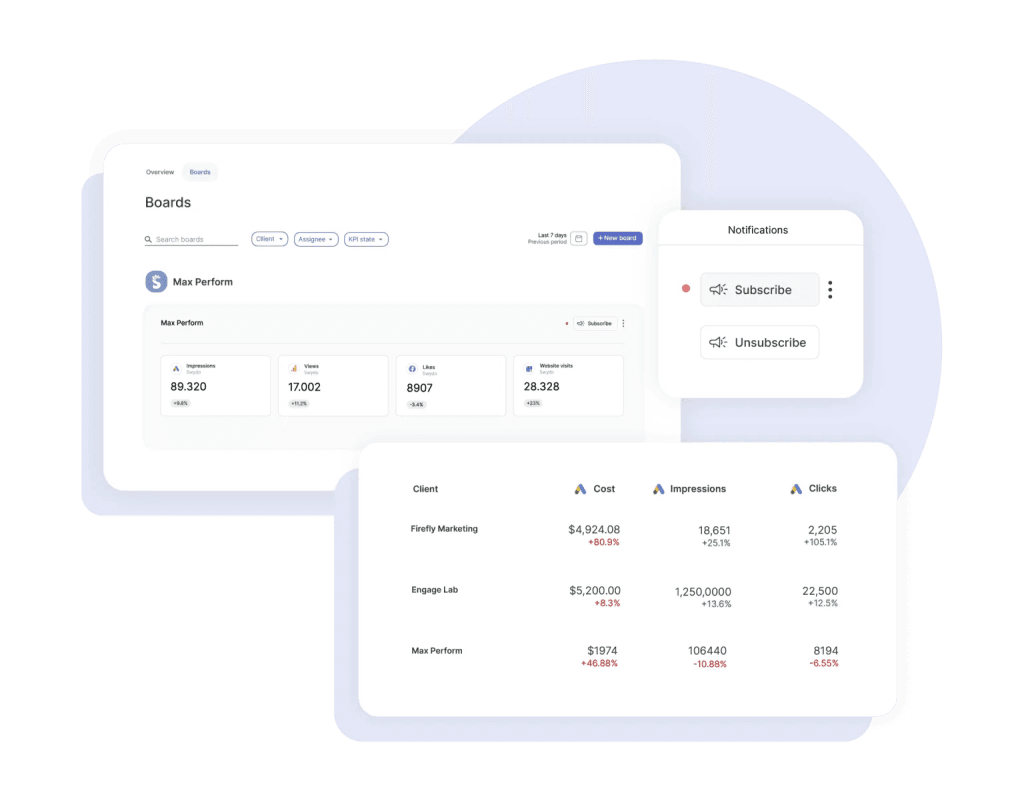
If any single client is more than 25% of your revenue, you don’t really have a client. You have a partnership with a termination clause. And most agency dashboards don’t flag this until it’s already dangerous. A cross-client metrics view — one screen that shows revenue, performance, or pacing across every client at once — makes the concentration visible before it becomes an emergency. You can’t manage a risk you can’t see on one page.
This is also where stronger client retention playbooks pay for themselves. Reducing churn on your top accounts buys time to grow the smaller ones into a balanced book.
Red Flags That Tell You a Client Isn’t Worth the Trouble
Not every client is worth the fight. The best agency owners have a qualification filter — and they actually use it. Watch for these:
- Clients who slash budgets but still demand aggressive growth targets
- Clients who withhold analytics access or won’t share their sales data
- Frequent CMO or leadership turnover, because each change resets your relationship to zero
- Clients whose sales process is broken but who blame you for “bad leads”
- Clients who treat your team as order-takers rather than strategic partners
Kirk Williams captured that last one well: “The brand operator has far more ability to scale a brand than the Google Ads agency. I dislike being expected to solve a problem I can’t.”
If the leads are qualified but the sales team isn’t converting them, that’s not a PPC problem. And if you absorb that blame, you just delay the inevitable churn.
Why Every Traditional Fee Model Is Broken Right Now
Every traditional agency pricing model has a flaw. And AI has made each flaw worse.
Percentage of ad spend punishes you for good work. Optimize so well that the client needs less budget? Your revenue drops.
Hourly rates punish you for speed. If AI helps your team do in two hours what used to take ten, do you bill for two and watch revenue crater?
Flat retainers lead to scope creep. Every client request either gets absorbed (and kills your margin) or triggers an awkward renegotiation.
Performance-based fees sound ideal until you realize the attribution data can’t be trusted.
Kirk Williams abandoned performance-based fees early and publicly warns others:
“Attribution is a HUGE problem for the profit-shared pricing model. If I’m going to base my commission on profit, I want those numbers to be real. They’re COMPLETELY MADE UP.” — ZATO Marketing
The State of PPC 2026 shows no dominant model. Flat fees at 20%. Custom pricing at 20%. Hourly at 18%. Various percentage models split the rest. The industry hasn’t settled on a replacement because no single model works for every client type.
Then there’s the chronic undercharge problem. Average monthly PPC agency fees range from $1,000 to $5,000, while average monthly ad budgets sit around $14,083.
Dan Wardrope of Flexxable describes the trap well. If your clients are local businesses at $500–$1,000 a month, you can’t afford good talent. Quality drops. Clients churn faster. You need more clients to fill the gap.
It’s a cycle that only moves in the wrong direction.
So what’s actually working right now?
The healthiest agencies use different fee structures for different client types. A flat retainer for small business clients who need predictability. A retainer-plus-performance hybrid for mid-market. A strategic advisory fee for enterprise clients where the value is in the thinking, not the button clicks.
The shift that matters most: price for the outcome you deliver, not the hours you spend or the budget you touch.
And one data point that should give every undercharging agency owner pause. Agencies that raised their rates in the last year grew faster than those that didn’t. Agencies that reduced fees saw 6% revenue declines on average.
The race to the bottom does not end with you winning. It ends with you closing.
What Each Major Ad Platform Throws at You Right Now
Google Ads
Black-box pressureMeta
Creative velocity winsTikTok
Instability riskMicrosoft Ads
Underused channelLinkedIn Ads
Long sales cycleEach platform is headed in a different direction. If your agency runs campaigns across all five, the complexity compounds every quarter.
Here’s what’s actually happening on each one. And why it matters for your business.
Google Ads
Google’s entire system now revolves around the Power Pack — Performance Max, Demand Gen, and AI Max for Search. AI Max rolled out to all advertisers in Q3 2025 and produces roughly 14% more conversions at the same CPA.
But despite two years of updates, 48% of PPC pros still point to lack of control and 45% to lack of transparency as their top Performance Max frustrations.
Average CPC is now $5.26. Average cost per lead across industries is $70.11. Broad match, which Google pushes hard, ranks 4th most-used but 4th least-satisfying match type. And ads now appear inside AI Overviews and AI Mode — two surfaces that didn’t even exist a year ago.
What does this mean for your agency?
The tasks you used to bill for — bid adjustments, keyword management, match type work — are absorbed by the platform. Your value now lives upstream: strategy, data architecture, creative tests, and cross-platform coordination. The Google Ads metrics that matter to clients in 2026 are conversion-quality and CAC measures, not impression share or quality score.
If your senior buyer is still spending their day in Keyword Planner, their skill set has drifted away from where Google is heading. That’s a training conversation worth having this month. Not next year.
Meta (Facebook and Instagram)
Meta is systematically removing manual audience selection. That’s not a prediction. It’s their stated product direction.
Advantage+ now covers Sales, App promotion, and Lead generation campaigns. Detailed targeting exclusions disappeared in June 2025. Interest categories were consolidated into broader groups. Jon Loomer documented 83 distinct changes to Meta’s ad platform across 2025. That’s more than one change every five days.
But here’s the part most agencies still underestimate. Andromeda — Meta’s retrieval engine launched in 2025 — changed the platform’s economics in a counterintuitive way.
A study of 3,014 advertisers across 73 countries found something surprising. Large advertisers ($172K+/year) saw ROAS drop from 8.7 to 8.0 during the Andromeda rollout. Mid-sized advertisers went up from 10.5 to 11.0.
Why?
Large advertisers couldn’t produce creative fast enough. Brand approval chains, compliance reviews, and agency coordination couldn’t keep up with a system that rewards creative velocity. Brands testing 20+ new ads per month see 65% higher ROAS than those testing fewer than 10.
Your competitive advantage on Meta has shifted entirely to creative strategy, first-party data quality, and Conversions API setup. The Facebook Ads metrics that predicted performance two years ago aren’t the same ones predicting it now — creative-level diagnostics matter more than audience-level signal.
How many net-new creative assets are you shipping per client, per month, right now? If it’s not in the 8–16 range minimum, Meta is probably underperforming for reasons that have nothing to do with your targeting.
TikTok
The TikTok saga consumed most of 2025. The platform went dark for 14 hours in January 2025, faced four deadline extensions, and finally completed its US divestiture in January 2026.
During that brief outage, Meta CPMs spiked 10% overnight — a preview of what happens when 170 million users suddenly can’t reach a major ad platform.
US TikTok ad revenue is projected at $17.17 billion in 2026, so the platform is absolutely worth your attention. But marketers are braced for continued instability, drawing parallels to what happened after X’s ownership change.
The practical move for your agency: cap any single platform at 20–30% of a client’s total budget. Have a documented contingency plan for budget reallocation. And tell your clients you have one. The TikTok Ads metrics you report on should make instability visible — not hide it behind monthly aggregates.
Microsoft Ads
Only 60% of PPC pros actively run Microsoft Ads despite CPCs that come in 30–70% cheaper than Google. This is the biggest missed opportunity in paid search right now, and most of your competitors skip it too.
The standout feature is Copilot integration. Ads within Copilot deliver 73% higher CTRs and 76% higher conversion rates than traditional search ads.
For B2B clients, LinkedIn Profile targeting within Microsoft’s PMax campaigns is a capability that no other platform offers. Tracking the right Microsoft Ads metrics early matters here, because Microsoft data tends to look thin until you set up the right comparison views.
Do you run Microsoft Ads for your clients? If not — why not?
LinkedIn Ads
LinkedIn is the most expensive major ad platform, full stop. CPCs run $8–$20 for B2B SaaS targeting. CPLs land between $60 and $150+. Those numbers terrify clients who compare them to Google pricing.
But LinkedIn achieved 113% ROAS for B2B in 2025, which outperforms Google Search at 78% and Meta at 29%.
The catch? Time. The average B2B customer journey takes 211 days with 76 touchpoints. First ad impression to revenue averages 320 days. You simply can’t evaluate LinkedIn on a 30-day report cycle.
The agency challenge here is almost entirely about client education. If you can get your clients to think in quarters instead of weeks, LinkedIn becomes one of the most powerful B2B channels available. If you can’t, it’ll always look “too expensive.” That reframe starts with the LinkedIn Ads KPIs you put in front of them — pipeline-stage indicators, not first-touch clicks.
Reddit: The Surprise Winner of 2026
Reddit is the platform almost nobody planned for and most agencies still treat as experimental.
Q4 2025 ad revenue hit $690 million, up 75% year-over-year. Reddit Max — the AI-automated campaign product — reports 17% lower CPA and 27% higher conversion volume than standard campaigns.
Agencies that built Reddit capability in 2024–2025 are capturing the wave. The capability gap is still open. If you’re looking for a platform where your early expertise will still be a differentiator six months from now, this is it.
Your Clients Think AI Can Replace You
20% of your clients consider AI a substitute for some of your work. That’s nearly double the 12% who think about switching to a different agency.
Right now, AI is a bigger competitive threat to your agency than other agencies are.
So what does AI actually do well in PPC today?
It generates ad copy variations quickly. It writes scripts for routine optimizations. It drafts report narratives and spots patterns in large datasets. These are real time-savers.
But over 50% of professionals report unreliable output quality. AI still falls short on things like your client’s business context, or why a campaign that “should” work just… doesn’t. And it can’t tell when the data itself lies.
Frederick Vallaeys, former Google AdWords Evangelist, frames it well: “AI is radically altering the digital marketing landscape. But there’s no need to panic — the best results happen when machines and humans work together.”
Then there’s the harder problem. Autonomous AI tools — groas.ai, Ryze AI, Adspirer — now sell end-to-end Google Ads management for $49 to $499 a month. Your prospect saw that before they got on the call with you.
The agencies that lose clients to in-house teams are the ones whose work looks like something a marketing manager could replicate with ChatGPT and a few YouTube tutorials. The agencies that keep clients have built things AI can’t copy. Proprietary data pipelines. Cross-platform attribution models. Strategic advisory relationships where the client values the thought process, not just the output.
Sem Tielemans of Producthero visited over 100 agencies and delivered the sharpest take at EPIC25:
“Campaign execution is increasingly commoditized. Agencies must become ‘growth architects,’ not account managers. Those offering ‘same value at lower cost’ will lose to clients doing it themselves with AI.”
So ask yourself: are you using AI to deliver the same work cheaper? Or are you using it to free up capacity for higher-value work that justifies a higher fee?
Your answer to that question determines whether AI is your competitor or your advantage.
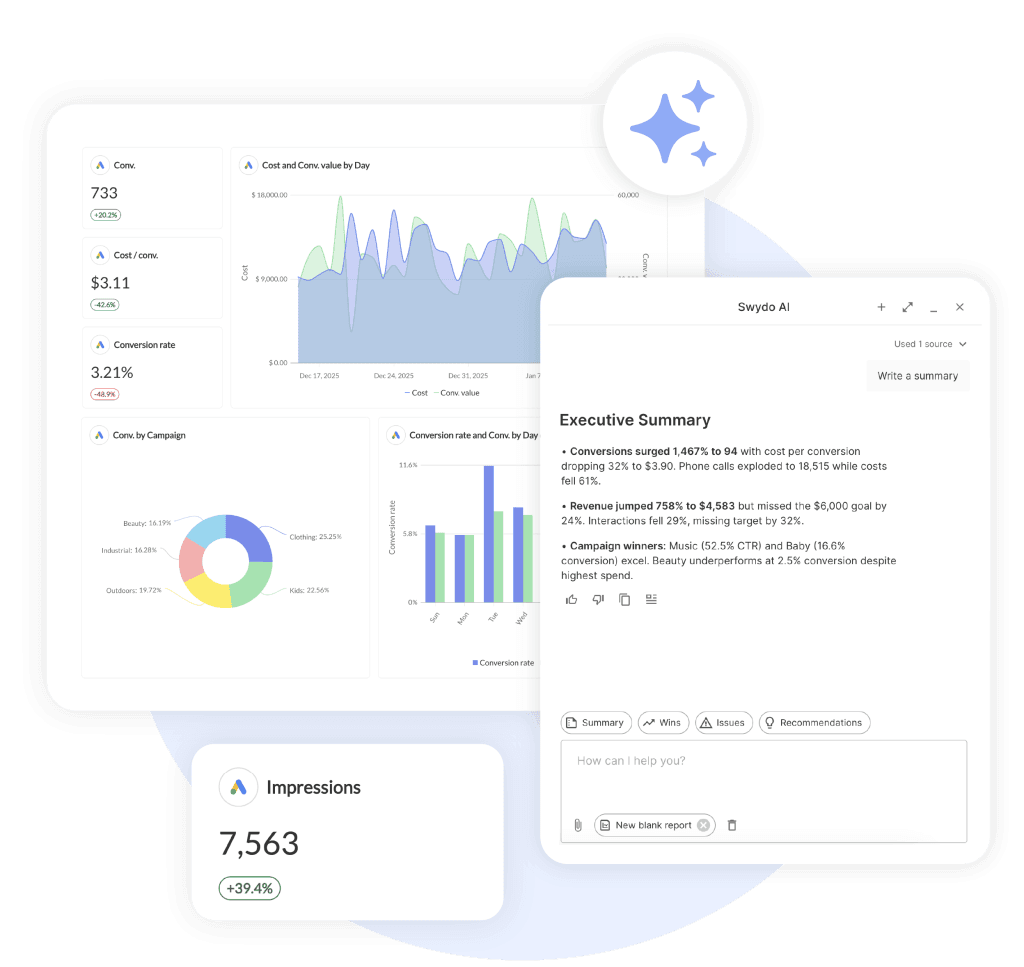
Why Measurement Accuracy Has Gotten Worse, Not Better
53% of PPC professionals say measurement is less accurate than it was two years ago.
This is the challenge underneath every other challenge on this list. When you can’t measure what works, you can’t prove ROI to clients, you can’t make confident budget calls, and you can’t show why your agency is worth the fee.
Three forces drive this problem.
About a third of all web traffic is already cookieless. Safari and Firefox block third-party cookies by default, regardless of what Google does with Chrome.
Consent Mode v2 setups are riddled with errors — 67% have technical issues, with most that default to “granted” before users actually choose.
And Google’s conversion modeling requires 1,000+ weekly conversions for accuracy, which leaves out most small and mid-market advertisers.
What does this mean for you in practice?
Server-side tracking through Meta’s Conversions API and Google’s Enhanced Conversions is now baseline. Not optional. Not advanced. The minimum you need for trustworthy numbers.
The agency-favorite stack is Stape.io for templates and multi-region hosting. Google Cloud Run for cheapest self-hosted sGTM. TAGGRS for EU/GDPR-focused clients. Addingwell by Didomi for privacy-sensitive setups. Typical setup runs two to four weeks per client. Hosting costs $10 to $400 a month.
If your agency can set up and maintain these systems for clients, you have a strong differentiator. If you can’t, you’re flying blind and hoping the platform reports are accurate. They often aren’t.
The Attribution Conversation That’s Killing Client Relationships
Here’s what’s happening in client meetings right now.
A CMO looks at Google Ads and sees one number. Opens GA4 and sees a different number. Pulls the CRM and sees a third. Then turns to you and asks which one is right.
The honest answer is “all of them, depending on the question.” Which rarely survives a QBR.
The phrase that’s been going around among practitioners captures it: “Google and Meta trained the industry to grade their own homework.” The fix usually starts with educating clients on the marketing attribution models behind those numbers — first-touch, last-touch, data-driven — so the discrepancies stop looking like errors and start looking like the methodology choices they actually are.
The agencies having fewer attribution fights in 2026 mostly did the same thing. They reframed measurement entirely.
- Marketing Mix Modeling moved from enterprise-only to accessible. Google’s Meridian is open-source and free. The Scenario Planner add-on launched in February 2026. 53.5% of US marketers now use MMM. For clients spending more than $100K a month, it’s becoming table stakes.
- Incrementality testing beats last-click every time a client questions results. A geo holdout test takes two weeks and a few thousand dollars in experimental budget. It gives you a defensible, platform-agnostic answer to “is this actually working?” It’s the cheapest relationship insurance you can buy.
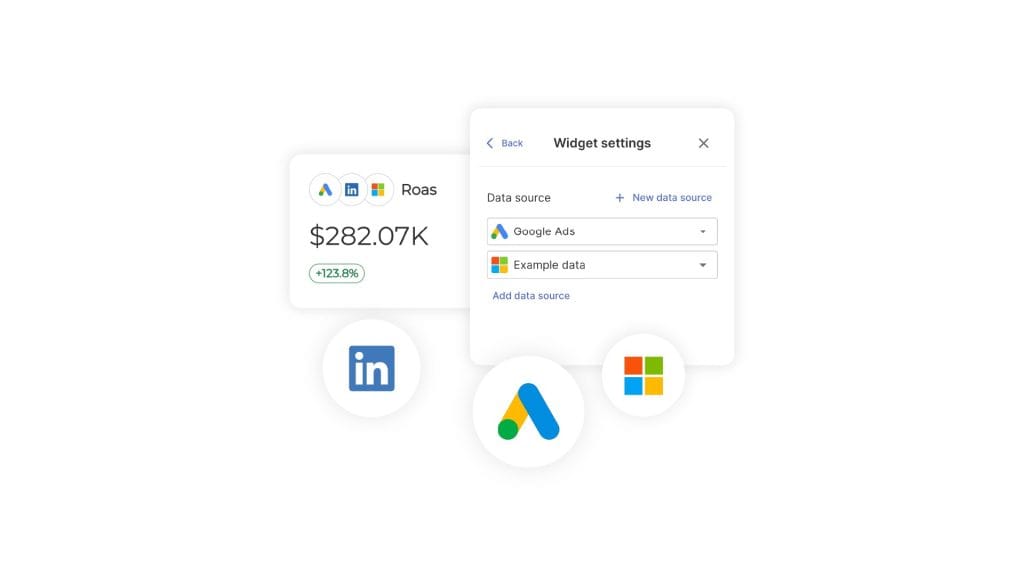
- Unified metrics like Media Efficiency Ratio (MER) replace fragmented ROAS. MER is total revenue divided by total ad spend across all channels. It matches what your client’s CFO actually cares about. It forces the conversation up from channel-by-channel defense to strategic allocation. The hard part used to be the math — pulling Google, Meta, LinkedIn, and CRM revenue into one number that updates without manual exports. Reporting platforms like Swydo let you blend data sources directly inside a single widget, so MER lives in the report rather than in a spreadsheet someone has to rebuild every Monday.
Does your team have someone who can set up a server-side GTM container, connect it to Meta CAPI, and run a geo holdout test? If the answer is no, close that gap this quarter.
The Meta Account-Suspension Crisis Is Still Going
This is the platform issue most agency articles don’t cover. And it’s the one most likely to blow up your client relationships overnight.
Meta rolled out LLaMA-based AI moderation in May and June 2025. The result was a wave of wrongful suspensions.
A change.org petition has gathered over 52,000 signatures. NBC Connecticut handled 178 account-restoration requests in 2025 alone.
Meta Verified subscribers, paying $14.99/month specifically for support access, get the same template responses as free users.
For you, this isn’t an inconvenience. It’s a client-relationship event.
A client’s entire spend disappears overnight. You have no one to call. The client expects an explanation and a fix. And you can provide neither.
Three defensive practices have become standard among agencies that have made it through this without losing clients:
- Never run a client’s Meta spend through your agency’s Business Manager. Always use client-owned BMs with agency admin access. When Meta suspends a BM, the ban follows the BM. If it’s yours, you’ve lost one client and every other client running through the same infrastructure.
- Monitor Account Quality weekly, or daily via automation. Issues often surface hours before a full suspension. A process that catches them can sometimes intervene in time. This is also where monitoring dashboards with threshold-based alerts earn their keep — the moment a key metric crosses a line you’ve defined (sudden CPM spike, frozen spend, conversion drop to zero), someone gets notified before the client does.
- For high-spend clients, look into rented ad accounts with direct Meta reps. Some providers have lines to Meta that even Meta Verified doesn’t offer. Quality varies a lot. Vetting matters.
Do you have a written playbook for what happens in the first 24 hours if a client’s Meta account goes down tomorrow morning?
If not, that’s a Monday task.
Why Your Team Feels Overwhelmed (and the Numbers That Prove It)
94% of advertising executives say scaling operations is their top challenge. Look at the numbers and you’ll understand why.
Your average strategist handles 33 client accounts across 4+ platforms. Routine AdOps tasks eat 39.75 hours per person per month — that’s 25% of the entire year spent on repetitive campaign work. Multi-platform workloads surged 58% year-over-year. And 71% of agencies say manual processes put campaigns at risk.
What kind of risks?
Wrong creative uploaded to the wrong campaign. Audience targeting mistakes that burn budget for days before someone catches them. Overspent budgets. Inconsistent reports across platforms. A senior strategist hired to grow the business who spends her day tab-hopping to catch CPA spikes instead.
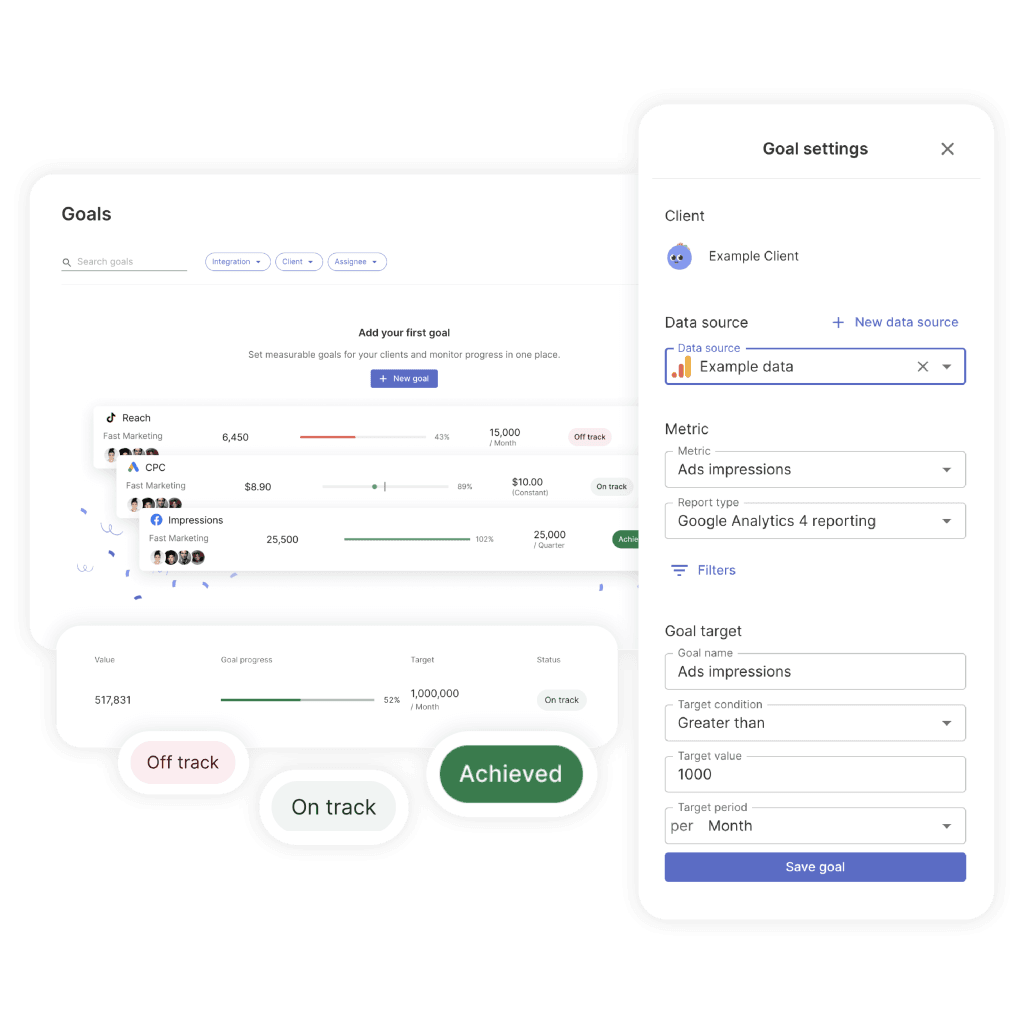
Meanwhile, 87% of agencies still pace budgets manually. Seven out of eight agencies check budget allocation across platforms by hand every day — when scripts and automation could do it in minutes. Setting goals with on-track and off-track pacing states — directly tied to live data — replaces the daily spreadsheet check. The strategist sees red, yellow, or green at a glance instead of recalculating mid-month spend manually.
Why?
The fix isn’t complicated. It’s just not glamorous.
Write down your processes. The average account now runs 5.4 scripts (up from 3.8). New account launches take 6.75 hours on average. Cut that to 3 hours through templates and automated setup workflows and you’ve doubled your onboarding capacity without a single new hire.
Marketing reporting itself is one of the most obvious places to stop reinventing the wheel. If your team is rebuilding the same monthly PPC report from scratch for every client, that’s hours back on the table. Linked report templates — where you build the master once and every client report stays in sync when you update it — turn a recurring 4-hour task into a 4-minute one. Same idea applies to onboarding workflows, QA checklists, and post-mortem documents.
And here’s a bright spot: 22% of PPC professionals now “vibe code” — they build custom tools with AI help but without traditional programming skills. Your strategists don’t need to become developers. They need to describe what they want automated and let AI write the script.
That capability didn’t exist 18 months ago. It does now.
How to Find, Keep, and Develop PPC Talent in a 30% Turnover Industry
Advertising has the second-highest employee turnover rate of any industry at roughly 30% per year. Only tourism is worse.
Average tenure at 7-figure agencies is just 2.1 years. At 8-figure agencies it’s 3.4 years. And 54% of agency workers say lack of advancement opportunities is why they leave.
The skill set you need has shifted hard.
Kirk Williams shared his top five hire criteria at ZATO: excellent communication, attention to detail, problem solving, initiative and accountability, and self-awareness. Notice what’s not on that list — nothing about Google Ads certification or platform-specific knowledge.
Platforms change too fast. What doesn’t change is the ability to think clearly and communicate well.
This creates a painful catch-22. AI makes teams about 20% more efficient, which means fewer entry-level positions. But the experienced strategic talent you actually need — people who do what AI can’t — is harder to find than it’s been in years. Nine in ten in-house teams report difficulty with qualified PPC candidates.
What about outsourcing?
It’s tempting. But Dan Wardrope at Flexxable flags the risk: “People outsource to contractors on Upwork. What happens is they start making mistakes — wrong ad copy, the client finds out, then you start getting into trouble.”
Outsourcing can work. But only with tight quality checks. It’s a managed process, not a shortcut.
The data point that matters most: 8-figure agencies spend $7,500 per employee per year on training. That investment produces longer tenure. Longer tenure produces better client relationships. Better client relationships produce higher retention.
It’s not a cost. It’s the mechanism that makes everything else work.
What do you spend on training right now?
Burnout and Mental Health Are Not Optional Conversations
One of the most upvoted threads in the history of r/PPC isn’t about bid strategies or campaign structure. It’s about mental health.
PPC Hero’s president wrote the most honest piece ever published on this topic:
“People who manage PPC accounts are all headed for burnout. The nature of the industry is immediate and constant feedback, reporting on the value of every move we make, and the overwhelming truth that more can always be done.”
Pete Bowen, a 17-year PPC veteran, was just as direct:
“I know I shouldn’t let campaign performance affect my happiness, but I do. I know several highly skilled people who’ve gotten out of PPC because the stress wasn’t worth the reward.”
PPCChat’s dedicated burnout discussion revealed something important. The burnout rarely comes from the technical work itself. It comes from client contradictions — like when they demand growth while they cut budgets.
It comes from scope creep that nobody addresses. From professional isolation. From the relentless pace of platform changes that makes yesterday’s expertise feel outdated today.
Julie Bacchini, with 20+ years in PPC, put it simply:
“The pace of change in the last few years, coupled with COVID and everything since, has made it easier to feel burnt out or isolated or just plain tired.”
This isn’t about ping pong tables or pizza Fridays. It’s about structural fixes.
Put clear scope boundaries in every contract. Create documented escalation paths so junior staff don’t absorb abuse from difficult clients. Protect learning time so your team doesn’t study platform changes at midnight. And have honest conversations about workload — if someone handles 40 accounts across five platforms, the problem isn’t their time management. It’s your staffing model.
How many accounts does each person on your team manage right now? Do you actually know the number?
Why Agency Margins Have Been Stuck at 15% for a Decade
The average digital agency profitability figure has held flat at a 15% net margin since 2015 across 45,000+ agencies tracked by Promethean Research.
A full decade of technological change. And that number hasn’t moved an inch.
The range, though, is enormous. Eight-figure agencies hit 25–32% margins. Specialists reach 40–75%. Generalists hover around 15–20%.
The gap between the best and the rest gets wider every year.
Where does the money leak?
47% of firms lose up to $500,000 per year on hours they work but never bill. Half a million dollars of value delivered and never charged for. Only 43% of agencies track forecasted revenue. These aren’t small oversights — they’re the difference between a profitable agency and one that slowly bleeds out while the P&L looks “fine.”
Cash flow makes it worse. You pay employees and tools monthly. Your clients pay 30–60 days late. And if any single client represents more than 20% of your revenue, you have concentration risk that could be fatal. Lose that one client and you might not make payroll next month.
73% of 8-figure agencies hold 6+ months of operating expenses in cash reserves. If you run month-to-month, you’re one lost client away from crisis.
That reserve isn’t glamorous. But it’s what separates agencies that weather a downturn from those that become a cautionary tale.
How many months of reserves do you have right now?
Privacy and Compliance Will Quietly Sink You If You Ignore It
This is the boring challenge that can destroy your agency if you get it wrong.
Google was fined €325 million in September 2025 for cookie consent violations. The EU Digital Services Act demands increased transparency. Over 20 US states have their own privacy laws. India’s DPDP Act requires consent in 22+ languages.
For your agency, compliance is an unfunded mandate. Set up Consent Mode v2 correctly. Maintain data processing agreements. Make sure client campaigns comply across jurisdictions. All of this takes expertise and time that clients rarely pay for directly.
The agencies that handle this well have built compliance into their onboarding process as a non-negotiable step. They run a regular PPC audit, verify Conversions API connections, and document everything.
It’s not exciting work. But it builds trust with sophisticated clients and prevents the kind of problems that end client relationships overnight.
When was the last time you audited your clients’ consent setups? If you can’t remember, that’s your answer.
The Three Business Models That Actually Work Right Now
The Technical Specialist
The Productized Operator
The Strategic Partner
Step back from all the tactical pressure and a pattern emerges.
The agencies thriving in 2026 fall into one of three archetypes. Each has different economics and different tradeoffs. The agencies struggling hardest are the ones trying to be all three at once.
The Technical Specialist
Deep expertise in one platform, one vertical, or one specific problem. Priced on judgment, not hours.
Client base kept small on purpose — usually 15 to 30 accounts with 18+ month engagements. Margins in the 20–30% range.
ZATO, Savvy Revenue, and a growing number of e-commerce-specific Meta shops live here.
The tradeoff? Growth is capped by your ability to hire and train senior people. Which is hard and slow.
The Productized Operator
Tightly defined deliverables at fixed prices. Heavy AI leverage. Account managers running 50+ accounts each because the workflow is systematized.
Margins come from volume and automation, not premium pricing.
The tradeoff? You’re competing against autonomous AI tools at similar price points. So the bar for operational excellence is brutal.
The Strategic Partner
Retained less for execution than for judgment. Creative strategy. Measurement architecture. Platform advocacy. Cross-channel orchestration.
Premium pricing, small client counts, deep integration with client leadership.
The tradeoff? This path is basically unavailable if your historical value was execution. Because the skills and the sales motion are fundamentally different.
The Pattern That Should Make You Stop
A 25-person generalist agency charging mid-market retainers for full-service PPC? That’s compressed from every direction.
Specialists beat you on depth. Productized competitors beat you on price. Strategic partners beat you on positioning.
The middle is exactly where agencies are disappearing right now.
So the most important exercise to do this week, honestly, is this.
Which of those three archetypes matches the agency you actually run? Not the one in your sales deck. Not the one you want to be. The one you are.
Then commit. What would it look like if you started acting like that type of agency starting Monday?
What the Best Agencies Do That the Rest Don’t
After a review of data from thousands of agencies, a clear pattern shows up. It’s not complicated. But it takes discipline that most agencies don’t have.
Seven principles separate the agencies that thrive from the ones that struggle:
- Deep niche specialization with a named methodology. Not “we do ecommerce” — but “we have a documented framework for DTC brands that want to go from $1M to $10M in ad spend, and here are six case studies.” The specificity is the moat.
- Multiple fee models matched to client type. Retainers for some. Performance hybrids for others. Advisory fees for enterprise. One model forced onto every relationship doesn’t work.
- Written SOPs for every repeatable process. Onboarding, campaign QA, monthly reports — all documented. This is what lets you scale and keeps quality consistent through team turnover.
- A real client qualification process. An Ideal Client Profile with scoring criteria and a walkaway threshold you actually enforce. The best agencies turn down more prospects than they accept.
- Business-level conversations. Talk in revenue, ROI, CAC, and LTV — not impressions, CTR, and quality score. The PPC metrics that connect to business outcomes are the ones that earn you a strategic seat at the table; the rest just feed monthly status updates.
- Structural dependency, not just satisfaction. Quarterly reviews, technical roadmaps, and “next problem” pipelines that build ongoing partnerships. Make it so that a client who leaves doesn’t just lose a vendor — they lose a system.
- AI as leverage for higher value. Not to cut staff and pocket savings. Redirect freed-up capacity toward strategic work that commands higher fees. More analysis, more creative tests, more proactive recommendations — not the same output at a lower cost.
The failure pattern is just as consistent. 42.5% of marketing agencies shut down within five years. They fail through generalist positioning. Chronic undercharging. No documented processes. Execution-only delivery. Revenue concentration in too few clients. And — most painful of all — they get so busy with client work that they forget to market themselves.
Which of those seven principles does your agency follow today? And which ones have you ignored?
What You Should Do Next
You don’t need more information. You need to start somewhere.
Here are the steps that matter most. Pick the one that lines up with where your agency hurts most right now. If you’ve already handled one, move to the next. None of this is sequential. None of it is calendar-based. The point is that you stop reading and start doing.
- Audit your client portfolio. Score every client against your ideal profile. Which ones are profitable? Which ones drain resources? Which ones represent concentration risk? Then start the hard conversations about scope, fees, or parting ways. The longer you wait, the more expensive those conversations become.
- Document your three most important processes. Onboarding, monthly campaign management, and reporting. They don’t need to be perfect. They need to exist outside someone’s head. This is the foundation for every hire, every training plan, and every attempt to scale.
- Refine your niche. Update your website, case studies, and pitch materials to reflect a specific point of view. Start to say no to prospects who don’t fit. Watch how it changes the quality of prospects who say yes.
- Audit your pricing. When was the last time you raised rates? If it’s been more than 18 months, you’re probably leaving money on the table. The agencies that grew last year were the ones that charged more, not the ones that worked harder.
- Fix your measurement stack. Server-side tracking. Meta CAPI. Enhanced Conversions. Run a geo holdout test on your highest-spend client this quarter. If your team can’t do this, that’s the gap to close — not a future tactic.
- Cap concentration risk. If a single client is more than 25% of your revenue, build a plan to either grow the rest of the book or diversify away from them. You don’t have to fire anyone tomorrow. You do have to stop hiring against revenue you can’t replace.
The PPC agency model isn’t dead. But the version built on manual campaign management, percentage-of-spend fees, and platform-level execution? That version is already gone.
What replaces it is more strategic, more valuable, and harder to commoditize.
So here’s your last question.
If a prospect asked you today, “Why should I pay your agency instead of buying a $299/month AI tool?” — what’s your answer?
If that answer isn’t sharp and specific, that’s the real work. Everything else in this article is just context for that one conversation.
The industry already changed. The question is whether your agency has changed with it.
PPC Agency Challenges FAQ
Direct answers to what PPC agency owners are actually asking
The five biggest challenges are black-box ad platforms (cited by 62% of PPC pros as their #1 problem), AI making clients believe they can do the work in-house, flat 15% margins that haven’t moved in a decade, client acquisition costs that have tripled, and 45–55% annual client churn at specialized agencies.
Underneath all of them sits a single shift: manual control is gone. Bid adjustments and keyword management are absorbed by AI-driven platforms like Performance Max, Advantage+, and Copilot. Agencies that still bill for that work are competing with a $49/month AI tool. Agencies that survive sell strategy, data architecture, and measurement systems instead.
No, but the old version is gone. The model built on manual campaign management, percentage-of-spend fees, and platform-level execution can’t compete with AI tools that cost $49–$499 a month. What replaces it is more strategic, more valuable, and harder to commoditize.
The in-house rate jumped from 44% to 73% in a single year, and 42.5% of marketing agencies shut down within five years. The agencies thriving are specialists with named methodologies, productized operators with heavy AI leverage, or strategic partners selling judgment instead of execution. Generalist mid-market agencies in the middle are the ones disappearing fastest.
The average digital agency net margin is 15%, and it hasn’t moved since 2015 across 45,000+ tracked agencies. But the range is enormous: 8-figure agencies hit 25–32%, specialists reach 40–75%, and generalists hover at 15–20%.
Two hidden leaks explain most of the gap. 47% of firms lose up to $500,000 a year on unbilled hours, and only 43% of agencies track forecasted revenue. Cash flow makes it worse—you pay tools and staff monthly while clients pay 30–60 days late. The agencies that survive downturns hold 6+ months of operating expenses in cash; the ones that don’t become cautionary tales.
Neither model works universally. Percentage of ad spend punishes you for efficiency—optimize so clients need less budget, and your revenue drops. Hourly rates punish you for speed when AI compresses 10-hour tasks into 2 hours. Flat retainers invite scope creep. Performance fees rely on attribution data that isn’t trustworthy.
The healthiest agencies use different fee structures for different client types: flat retainers for small businesses that need predictability, retainer-plus-performance hybrids for mid-market, and strategic advisory fees for enterprise where the value is the thinking. Industry data shows no dominant model—flat fees, custom pricing, and hourly each take about 20% of the market. Price for the outcome, not the hours or the budget you touch.
Yes, if you haven’t raised them in 18 months. Agencies that raised rates last year grew faster than those that didn’t. Agencies that reduced fees saw 6% revenue declines on average.
Average monthly PPC fees sit at $1,000–$5,000 while average client ad budgets run around $14,083—most agencies are chronically undercharging. Low fees create a cycle that only moves down: you can’t afford good talent, quality drops, clients churn faster, you need more clients to fill the gap. The race to the bottom doesn’t end with you winning. It ends with you closing.
The Technical Specialist has deep expertise in one platform or vertical, prices on judgment, keeps 15–30 clients on 18+ month engagements, and hits 20–30% margins. The Productized Operator sells fixed-price deliverables with heavy AI leverage; account managers run 50+ accounts each on systematized workflows. The Strategic Partner is retained for judgment—creative strategy, measurement architecture, cross-channel orchestration—at premium pricing with small client counts.
The agencies struggling are trying to be all three at once. A 25-person generalist agency charging mid-market retainers for full-service PPC gets compressed from every direction: specialists win on depth, productized competitors win on price, strategic partners win on positioning. Pick a lane and commit.
Specialize and name your methodology. If your homepage says “we manage Google Ads and drive results for businesses,” you’ve said nothing—every agency says that, and prospects pick the cheapest one. That’s why 84% of surviving agencies now identify as specialists.
Specialization isn’t just about industry vertical—it’s about methodology. The agencies winning hard pitches don’t sell “PPC management.” They sell a proprietary framework with case studies showing exactly how that system produced results for businesses like the prospect’s. Test it: if you swapped your agency name for any competitor’s on your own pitch deck, would the prospect notice? If not, that’s the work.
The #1 reason isn’t poor performance or high fees—it’s perceived indifference. Agencies lose clients even with 92 NPS satisfaction scores because satisfaction and dependency are completely different things.
Clients leave when they feel like a line item instead of a priority. A monthly report that lands under your agency’s brand with your insights front and center feels like a deliverable from a partner. A raw export from Looker Studio with no commentary feels like homework. Agencies positioned as problem owners lose clients to budget cuts at roughly half the rate of agencies positioned as project vendors.
Specialized PPC agencies face 45–55% annual client churn regardless of size—worse than any other agency type. Project-based engagements churn at roughly 42% versus 18% for retainer relationships.
Average client tenure on retainers is 56 months. On project work, it’s 24 months. The highest-risk window is the first 90 days—agencies that put real effort into onboarding (realistic KPIs, documented business models, a clear communication cadence) consistently keep clients longer. Ten extra hours of onboarding can generate years of retained revenue.
No single client should be more than 25% of your revenue. If they are, you don’t have a client—you have a partnership with a termination clause. Lose them, and you might not make payroll next month.
Concentration creeps in slowly. One client grows faster than the others, you lean into the relationship, you hire against the revenue, and by the time you notice you’ve built an agency one angry email can destroy. Build a cross-client dashboard that shows revenue and pacing across every account on one screen—you can’t manage a risk you can’t see at a glance.
Walk away from clients who cut budgets while demanding aggressive growth targets, withhold analytics or sales data, churn through CMOs (each leadership change resets your relationship to zero), blame you for “bad leads” when their sales process is broken, or treat your team as order-takers rather than strategic partners.
The last one is the trap most agencies fall into. If the leads are qualified but the client’s sales team isn’t converting them, that’s not a PPC problem—and absorbing the blame just delays the inevitable churn. The best agencies turn down more prospects than they accept.
The cost to win a new client has roughly tripled since 2013, and acquiring a new client now costs 5–7x more than retaining one. US digital ad agencies grew from 4,400 in 2011 to over 19,800 today—the market is saturated.
But the deeper problem is differentiation. When prospects see four agency websites that all promise “results-driven Google Ads management,” they default to the cheapest option. The agencies that win pitches sell a documented, named methodology instead of “PPC management.” That specificity is the moat.
Focus on the first 90 days. Set realistic KPIs at onboarding, document the client’s business model, and establish a clear communication cadence—structured onboarding adds 15–20 percentage points to retention.
Move from project vendor to problem owner. Lead conversations with the business problem you were hired to solve, not the tasks you completed. Reframe reporting around revenue impact, CAC, and LTV instead of impressions and CTR. And consider how the deliverable looks: a branded monthly report with your insights feels like partnership; a raw dashboard export feels like homework.
Performance Max and AI Max for Search absorb the tasks agencies used to bill for—bid adjustments, keyword management, match type optimization. AI Max produces roughly 14% more conversions at the same CPA, but 48% of PPC pros still cite lack of control and 45% cite lack of transparency as top frustrations.
Agency value has moved upstream: strategy, data architecture, creative testing, and cross-platform coordination. The Google Ads metrics that matter to clients now are conversion quality and CAC—not impression share or quality score. If your senior buyer still spends their day in Keyword Planner, their skill set has drifted from where Google is heading.
Meta rolled out LLaMA-based AI moderation in mid-2025, triggering a wave of false-positive suspensions. A change.org petition has over 52,000 signatures, and even Meta Verified subscribers paying $14.99/month get the same template responses as free users. For an agency, this isn’t an inconvenience—it’s a client-relationship event.
Three defenses are standard. Never run client Meta spend through your agency’s Business Manager—use client-owned BMs with agency admin access so a suspension follows the client, not your entire book. Monitor Account Quality weekly, or daily via automation. And have a written 24-hour playbook ready before you need it.
At least 8–16 new creative assets per client, per month. Brands testing 20+ new ads per month see 65% higher ROAS than those testing fewer than 10.
Meta’s Andromeda retrieval engine rewards creative velocity. A study of 3,014 advertisers found large brands ($172K+/year) saw ROAS drop from 8.7 to 8.0 during rollout, while mid-sized advertisers went up from 10.5 to 11.0—the smaller advertisers could ship creative faster. Brand approval chains and agency coordination are now the bottleneck. Audience-level targeting matters less; creative-level diagnostics matter more.
Yes, and most agencies don’t. Only 60% of PPC pros actively run Microsoft Ads despite CPCs that come in 30–70% cheaper than Google. It’s the biggest missed opportunity in paid search.
The standout feature is Copilot integration—ads inside Copilot deliver 73% higher CTRs and 76% higher conversion rates than traditional search ads. For B2B clients, LinkedIn Profile targeting within Microsoft’s Performance Max campaigns is a capability no other platform offers. If you’re not running Microsoft Ads for clients, you’re leaving cheap conversions on the table.
Yes, if your clients can think in quarters instead of weeks. LinkedIn CPCs run $8–$20 for B2B SaaS targeting and CPLs land between $60 and $150+, but LinkedIn achieves 113% ROAS for B2B—outperforming Google Search at 78% and Meta at 29%.
The catch is time. The average B2B customer journey takes 211 days with 76 touchpoints, and first ad impression to revenue averages 320 days. You can’t evaluate LinkedIn on a 30-day report cycle. The agency challenge here is almost entirely about client education—reframe the KPIs around pipeline-stage indicators, not first-touch clicks.
Yes—it’s the surprise winner most agencies still treat as experimental. Reddit’s Q4 2025 ad revenue hit $690 million, up 75% year-over-year. Reddit Max, the AI-automated campaign product, reports 17% lower CPA and 27% higher conversion volume than standard campaigns.
If you’re looking for a platform where early expertise will still differentiate you six months from now, this is it. Agencies that built Reddit capability early are capturing the wave while most competitors are still on the sidelines.
No more than 20–30% in any single platform. When TikTok went dark for 14 hours in early 2025, Meta CPMs spiked 10% overnight—a preview of what happens when a major platform suddenly becomes unreachable.
Build a documented contingency plan for budget reallocation across platforms, and tell your clients you have one. The reporting you deliver should make platform-level instability visible at a glance, not hide it behind monthly aggregates.
Not yet, but 20% of clients are open to swapping agency work for AI—nearly double the 12% who think about switching to a different agency. Autonomous tools like groas.ai, Ryze AI, and Adspirer sell end-to-end Google Ads management for $49–$499 a month. Right now, AI is a bigger competitive threat than other agencies.
The catch: over 50% of professionals report unreliable AI output quality, and AI still fails at client business context, nuanced strategy, and recognizing when the data itself lies. The agencies that lose clients to AI are the ones whose work looks like something a marketing manager could replicate with ChatGPT. The agencies that keep clients build things AI can’t copy—proprietary data pipelines, attribution models, and strategic advisory relationships.
Use AI to free up capacity, not to deliver the same work cheaper. The average PPC pro saves 5.2 hours a week with AI tools. If you redirect those hours into higher-value strategic work, AI is your advantage. If you cut staff and pocket the savings, AI becomes your competitor.
22% of PPC pros now “vibe code”—they build custom tools with AI help but without traditional programming skills. Your strategists don’t need to become developers. They need to describe what they want automated and let AI write the script. That capability simply didn’t exist 18 months ago.
53% of PPC professionals say measurement is less accurate than two years ago. Three forces drive it: about a third of web traffic is already cookieless (Safari and Firefox block third-party cookies by default), 67% of Consent Mode v2 setups have technical issues, and Google’s conversion modeling requires 1,000+ weekly conversions for accuracy—which excludes most small and mid-market advertisers.
This is the challenge underneath every other challenge. When you can’t measure what works, you can’t prove ROI, you can’t make confident budget calls, and you can’t justify your fee. Server-side tracking through Meta’s Conversions API and Google’s Enhanced Conversions is now baseline, not advanced.
Server-side tracking sends conversion data from your own server to ad platforms (instead of from the user’s browser), bypassing ad blockers and cookie restrictions. Yes, you need it—it’s the minimum for trustworthy numbers in a cookieless world.
The agency-favorite stack: Stape.io for templates and multi-region hosting, Google Cloud Run for the cheapest self-hosted setup, TAGGRS for EU/GDPR-focused clients, and Addingwell by Didomi for privacy-sensitive setups. Typical setup runs two to four weeks per client, with hosting costs of $10–$400 a month. If your agency can do this for clients, you have a real differentiator. If you can’t, you’re flying blind.
Reframe the conversation away from channel-level last-click reporting. A CMO who looks at Google Ads, GA4, and the CRM sees three different numbers and asks which is right. The honest answer—”all of them, depending on the question”—rarely survives a QBR.
Three moves help. First, educate clients on attribution models (first-touch, last-touch, data-driven) so discrepancies stop looking like errors. Second, run incrementality tests like geo holdouts—two weeks and a few thousand dollars give you a defensible, platform-agnostic answer. Third, shift reporting to unified metrics like Media Efficiency Ratio (total revenue divided by total ad spend across all channels), which matches what the client’s CFO actually cares about.
Marketing Mix Modeling (MMM) measures the contribution of each marketing channel to overall outcomes using historical data instead of cookies or pixels. It used to be enterprise-only, but Google’s open-source Meridian made it free and accessible. Over half of US marketers now use MMM in some form.
For clients spending more than $100K a month on paid media, MMM is becoming table stakes. If you can set it up and walk a client through the results, you’re having a strategic conversation while competitors are still defending last-click ROAS reports.
Google was fined €325 million for cookie consent violations. The EU Digital Services Act demands transparency. Over 20 US states have their own privacy laws, and India’s DPDP Act requires consent in 22+ languages. Compliance is an unfunded mandate—clients rarely pay for it directly.
Build it into onboarding as a non-negotiable step: set up Consent Mode v2 correctly, maintain data processing agreements, verify Conversions API connections, and document everything. It’s not exciting work, but it builds trust with sophisticated clients and prevents problems that end relationships overnight. If you can’t remember the last time you audited a client’s consent setup, that’s your answer.
Industry average is 33 accounts across 4+ platforms per strategist, but that’s the source of most burnout and quality problems. Routine AdOps tasks eat 39.75 hours per person per month—25% of the entire year on repetitive campaign work.
If someone on your team handles 40+ accounts, the problem isn’t their time management—it’s your staffing model or your automation gap. 94% of advertising executives say scaling operations is their top challenge, and 71% say manual processes are putting campaigns at risk.
Document repeatable processes and automate what’s manual. New account launches average 6.75 hours each—templates and automated setup can cut that to 3 hours, doubling onboarding capacity without a single new hire. 87% of agencies still pace budgets manually when scripts could do it in minutes.
Reporting is the most obvious place to stop reinventing the wheel. If your team rebuilds the same monthly report from scratch for every client, that’s hours back on the table. Linked report templates—where the master updates push to every client report—turn a 4-hour task into a 4-minute one. Same principle applies to onboarding checklists, QA workflows, and post-mortems.
Advertising has the second-highest employee turnover rate of any industry at roughly 30% per year—only tourism is worse. Average tenure at 7-figure agencies is 2.1 years, and 54% of agency workers leave because of lack of advancement opportunities.
The skills you need have shifted. Top hire criteria now emphasize communication, attention to detail, problem solving, and self-awareness—not platform certifications that go stale every six months. 8-figure agencies spend $7,500 per employee per year on training, and that investment is what produces longer tenure, better client relationships, and higher retention. It’s not a cost—it’s the mechanism that makes everything else work.
The burnout rarely comes from the technical work itself. It comes from client contradictions (demanding growth while cutting budgets), scope creep nobody addresses, professional isolation, and the relentless pace of platform changes that makes yesterday’s expertise feel outdated today. The constant feedback loop—where every move is reported on and optimized—wears people down.
Fixes are structural, not cosmetic. Put clear scope boundaries in every contract. Create documented escalation paths so junior staff don’t absorb abuse from difficult clients. Protect learning time so your team isn’t studying platform changes at midnight. And have honest workload conversations—a strategist managing 40 accounts across 5 platforms doesn’t have a time management problem.
It can work, but only with tight quality checks. The most common failure pattern: agencies outsource to Upwork contractors who make mistakes—wrong ad copy, wrong audiences, wrong budgets—the client finds out, and the relationship is over.
If you outsource, treat it as a managed process, not a shortcut. Build QA workflows that catch errors before campaigns go live. Document every account so a contractor isn’t reverse-engineering your strategy. And keep client-facing communication in-house—senior strategy is what clients are paying for.
Start with whichever fix lines up with where you hurt most. The most common high-impact moves: audit your client portfolio for concentration risk and profitability, document your three most important processes (onboarding, campaign management, reporting) so they exist outside someone’s head, and refine your niche so prospects can tell you apart at a glance.
If those are handled, audit your pricing (if rates haven’t moved in 18 months, you’re undercharging), fix your measurement stack with server-side tracking, and cap any single client at 25% of revenue. The principle underneath all of them: stop selling execution and start selling judgment. AI can do execution for $49 a month. It can’t do judgment.