
The choice between Swydo and Whatagraph comes down to two questions: what you’ll pay per client report, and what the tool does after it builds one.
Whatagraph makes great-looking reports. It prices like it — from $229/month billed annually, with the features most agencies want spread across higher tiers. Swydo runs the same core workflow at $69/month with everything on one plan, then adds daily monitoring on top.
This is a decision guide, not a sales pitch. I work at Swydo, so you know where the bias sits. I’ll still tell you exactly when Whatagraph is the better buy — and when neither is.
The Short Version, by Agency Type
Find the row that sounds like you.
| If you’re… | Pick |
|---|---|
| Solo or 1–5 simple clients | Swydo. 10 sources included. Real trial. Whatagraph is hard to justify here. |
| 5–20 clients, standard channels | Swydo, usually by a wide margin. $69 plus a few dollars per source vs $229–$463 tiers. |
| 20+ clients, heavy blending | Swydo on price. Watch Whatagraph’s credit math — blends burn credits fast. |
| Pitching AI chatbots inside reports | Whatagraph’s IQ+ does it (Max tier). |
| Need a real warehouse pipeline | Neither. Supermetrics or Funnel are purpose-built for it. |
| Want alerts when campaigns break | Swydo. Monitoring is built in. |
That’s the whole decision in a table. The rest of this guide shows the math behind it.
| Swydo | Whatagraph | |
|---|---|---|
| Starting price | $69/mo | $286/mo, or $229/mo billed annually (Start) |
| What’s in the entry plan | All features. 10 data sources. Unlimited clients & users. AI, white-label, custom domain, goals, alerts, Slack. | 20 source credits, Essential integrations. White-label, custom domain, alerts, and BigQuery start at Boost; SSO, API, and IQ+ are Max-only. |
| Free trial | 14 days, full access, no credit card | No paid-product trial. Free plan capped at 5 source credits. |
| Monitoring & alerts | Built in — daily checks, goals, email + Slack alerts | Performance alerts from the Boost tier |
| Data source health | Daily connection checks; red-dot alert + email the moment a token expires | Sync status visible in-app |
| AI | 4,000 credits/mo on every plan; client-facing dashboard chat | IQ on paid plans; client-facing IQ+ chat is Max-only |
| Cancellation | Self-serve, anytime | Annual billing, 30 days’ notice, non-refundable |
| Migration help | Free, human-assisted | Manual rebuild |
How the Two Tools Are Built Differently
Swydo is a reporting tool with monitoring on top. Whatagraph is a reporting tool built around visual polish and credit-based pricing.
Both build branded, automated client reports well. The split is what each one adds around the report — and what it charges to get there.
Whatagraph calls itself a marketing intelligence platform. In practice, agencies use it for one thing: turning marketing data into client-ready reports that look sharp. Reviewers back that up.
Swydo does the same reporting job, then keeps watching. Build the report. Schedule it. White-label it. Then set goals, get daily alerts when something breaks, and see every client’s KPIs on one screen.
So the question isn’t “which makes a nicer report.” Both are fine there. It’s what you’ll pay at your size, and what the tool does on a Tuesday morning when a client’s ROAS just tanked.
What You’ll Actually Pay
Sticker prices barely matter. What matters is your client count and how many sources each client runs.
A data source is one connected account. A client on Google Ads, Meta, and GA4 is three sources.
Swydo’s pricing:
- $69/month, or $62 billed annually
- 10 data sources included
- Unlimited clients and users
- $4.50 per source from 11–100, then $3.00, then $2.00
- Reporting frequency doesn’t change the price
- Every feature on one plan
Whatagraph’s pricing:
| Tier | Price (annual) | Source credits |
|---|---|---|
| Free | $0 | 5 |
| Start | $229/mo | 20 |
| Boost | $463/mo | 50 |
| Max | Custom | Custom |
One catch worth knowing before you sign: blends and source groups each consume an extra credit on top of their underlying sources. Agencies hit their cap sooner than the raw client count suggests.
The feature-gating gap is the real story. Here’s what unlocks where:
| Feature | Starts at |
|---|---|
| Essential integrations, basic reporting | Start |
| White-label | Boost |
| Custom report domain | Boost |
| Performance alerts, goals | Boost |
| BigQuery transfer | Boost |
| Custom metrics | Boost |
| SSO / SAML | Max |
| Public API | Max |
| Whatagraph Storage | Max |
| IQ+ (client-facing AI chat) | Max |
So the $229 entry price isn’t the price of the product most agencies want. It’s the price of the starting line. White-label and BigQuery don’t show up until the $463 Boost tier.
What you’ll pay at your agency size
Monthly billing, assuming three data sources per client (GA4 + Google Ads + Meta).
| Agency size | Swydo | Whatagraph |
|---|---|---|
| 5 clients | $92/mo | $286/mo (Start) |
| 15 clients | $227/mo | $579/mo (Boost — Start caps at 20 credits) |
| 30 clients | $429/mo | Custom (Boost caps at 50 credits → Max) |
| 50 clients | $624/mo | Custom (Max only) |
Whatagraph blends and source groups each consume an extra credit, which can push agencies into a higher tier sooner than the client count alone suggests.
The Credit-Cap Trap. Credit pricing has a hidden accelerator. Every blend and source group costs an extra credit — not just the raw connections. An agency that looks like it fits inside 20 credits on paper can blow past it once it starts combining channels. Which is exactly what cross-channel reporting requires. So you upgrade from Start to Boost not because you added clients, but because you did the blending the tool was sold to you for.
Want to plug in your own numbers? The Swydo pricing page has a live calculator, and our breakdown of selecting a report automation tool walks through the math in more depth.
The Features That Actually Decide It
Three things separate these tools in practice: monitoring, AI, and warehouse capability. Everything else — scheduling, white-label, custom domains — both do well once you’re on the right plan.
Don’t let a grid full of green checkmarks distract you. Three things matter. Here they are.
Does It Watch Your Campaigns, or Just Report on Them?
Swydo’s clearest edge. Most reporting tools hand you a report and stop. Swydo keeps watching.
Open Monitoring → Alerts → +New Alert. Pick the client. Pick the metric. Set the trigger window: 1, 7, 30, or 90 days. Done.
Now you’ll know a client’s cost-per-lead doubled before they email you about it.
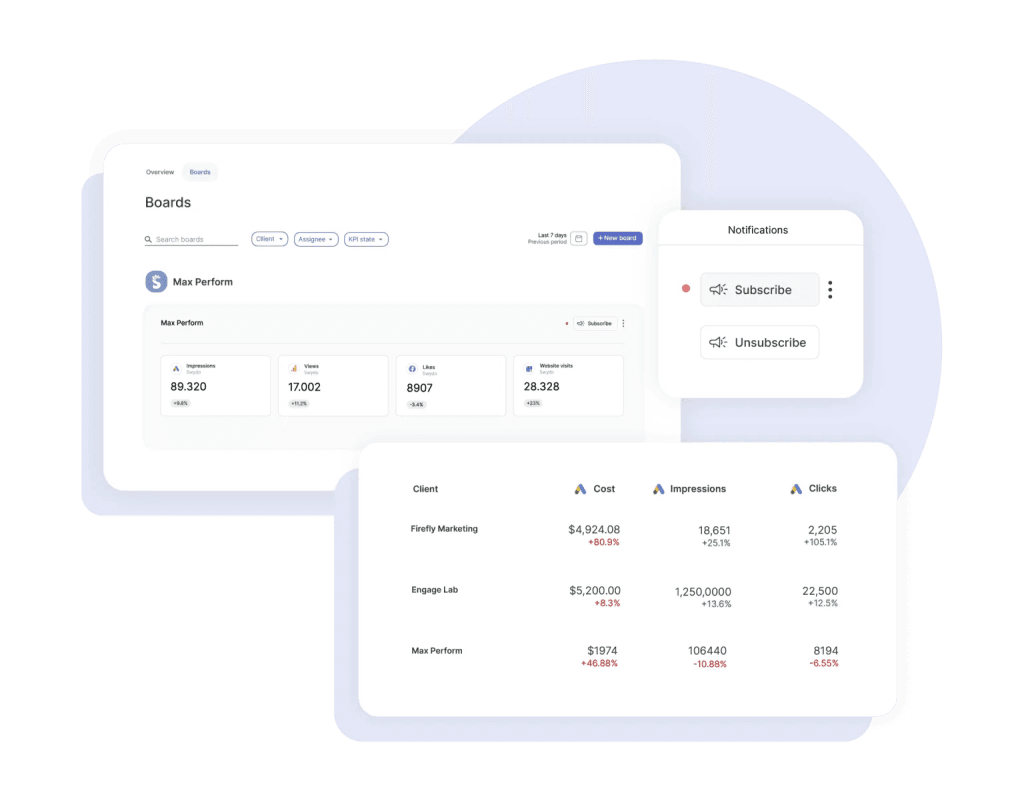
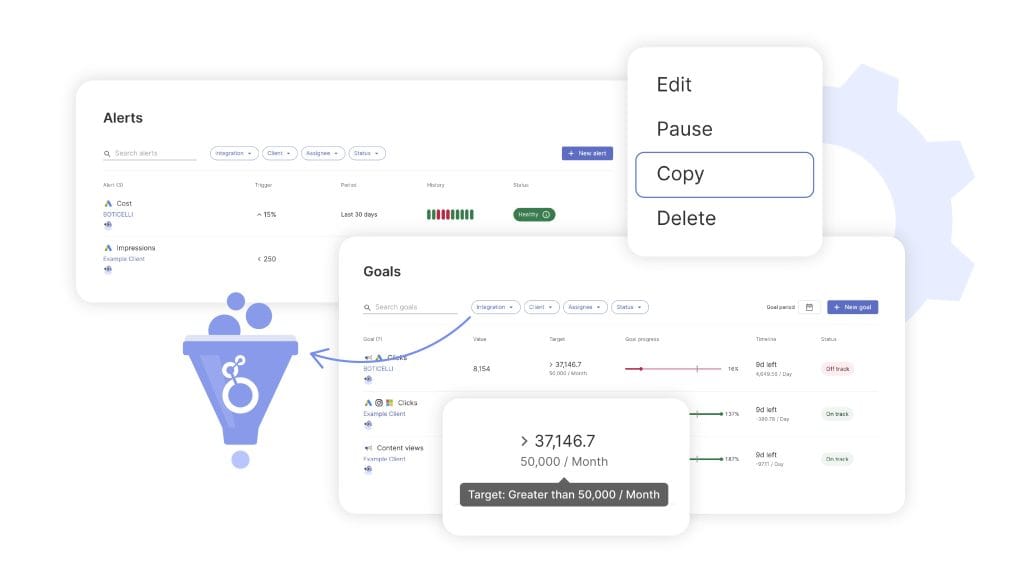
Pair Alerts with Goals and you get pacing too — On Track, Off Track, or Achieved, with a notification at the end of each period. Slack-first team? Alerts post to your channel alongside the email.
And there’s a second layer that quietly matters more than the first: Data Source Health Check Alerts. Swydo monitors every connection daily. The moment a Google Ads token expires, a Meta auth breaks, or a GA4 property goes quiet, you get a red-dot alert in-app and an email — usually before the next report is due to send. The client never sees the blank widget. You fix it first.
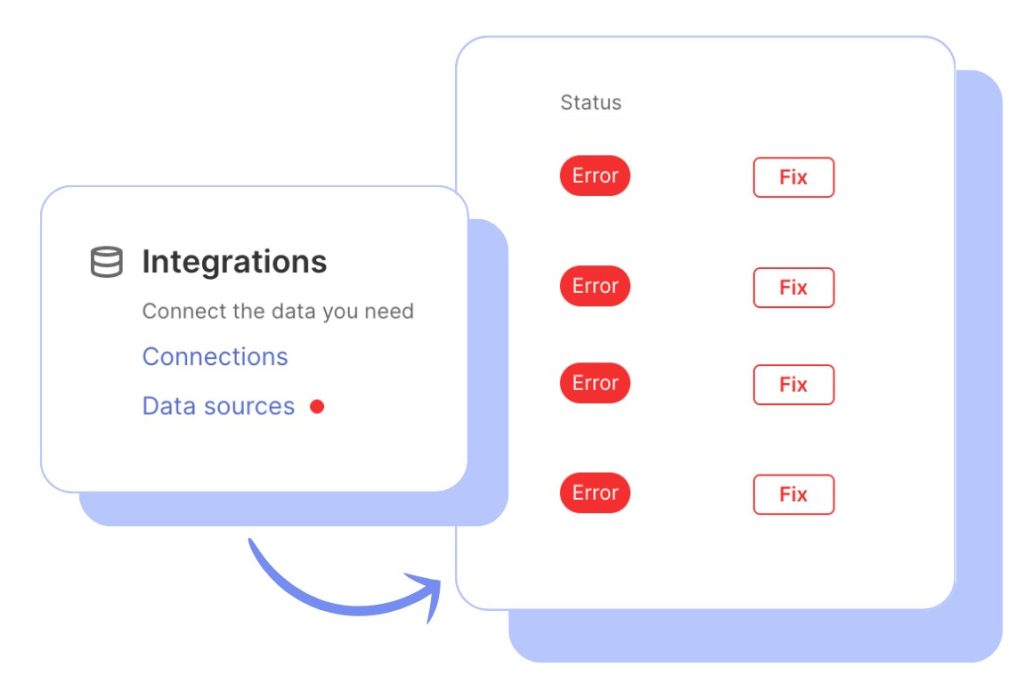
That’s the part most “alerts” features miss. Campaign alerts catch a metric going sideways. Health-check alerts catch the upstream problem that would have made the whole report wrong.
Whatagraph’s alerting arrives at the Boost tier ($463). For agencies whose retention depends on catching problems mid-month, this is the difference that matters most.
Report-and-done vs. report-and-watch
Step 1
Connect dataStep 2
Build reportStep 3
Schedule & sendSwydo adds
Watch & alert dailyBoth tools do steps 1–3 well. The fourth step is the difference. Swydo’s monitoring layer runs daily checks and alerts you by email or Slack the moment a metric crosses a line you set — so you catch problems while you can still fix them. Whatagraph’s alerting arrives at the Boost tier.
Where the AI Shows Up
Both tools ship real AI. For everyday work — summaries, written commentary, “what happened this month” — they’re at functional parity. The difference is where the AI lives.
Swydo AI writes summaries, wins, issues, and recommendations in five core languages: Dutch, English, French, German, Spanish — and more. It runs client-facing chat inside dashboards. And it drops a fresh AI summary into every scheduled report email automatically. Add the summary block to the email once; every future send carries a current summary in the body before the client even opens the report. Every plan gets 4,000 AI credits a month, roughly 40 summaries.
Whatagraph’s flagship is IQ+, which embeds an AI chat inside shared reports so clients can ask their own questions. It’s polished. It’s also Max-only.
If an AI-native, chat-first experience is the core of your pitch, that’s worth seeing in a demo. Just know it isn’t the cheapest route to one. A tool like Databox ships an MCP server connecting metrics straight into Claude or ChatGPT, plus its Genie analyst, and starts lower than Whatagraph Max.
The point isn’t “buy Databox.” It’s that Whatagraph isn’t the obvious pick for the AI-first agency either.
When You Actually Need a Data Warehouse
Whatagraph can push data to BigQuery from its Boost tier, or to its own storage layer on Max. A real capability — but not where Whatagraph is strongest, and an expensive way to buy it.
Supermetrics and Funnel are purpose-built for warehouse pipelines. They cost less and do more for that specific job.
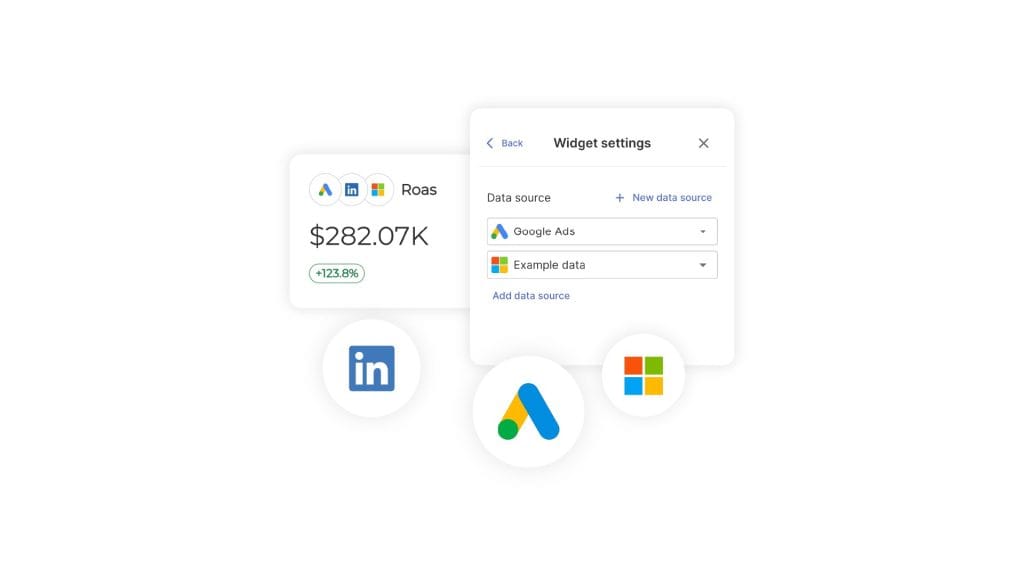
For everyday cross-channel reporting, Swydo’s Combined Data Sources widget blends up to five ad platforms into a single metric — total ROAS across Google, Meta, LinkedIn, Microsoft, and TikTok in one number — across reports, boards, goals, and alerts.
That covers the job most agencies actually have.
What to Watch Before You Sign With Whatagraph
A few things in Whatagraph’s terms surprise agencies after they’ve committed. None makes it a bad tool. They’re worth knowing up front.
- Paid plans bill annually. No real month-to-month on the paid product. Minimum commitment on Start: ~$2,748 for the year.
- Cancellation runs on 30 days’ notice, and payments aren’t refundable. This shows up in the angriest reviews. One Capterra reviewer described asking to cancel days before the bill was due and being told they still owed another 30 days under the policy.
- The trial isn’t really a trial. Free plan capped at 5 source credits. No open trial of the paid product. To evaluate the features you’d actually buy, you usually go through a sales call first.
- Blends and source groups cost extra credits. Covered above, but it belongs on the watch list — the most common reason a Whatagraph bill lands higher than expected.
For contrast: Swydo is a 14-day full-access trial with no credit card, self-serve cancel anytime, and a pause-subscription option for seasonal agencies. Build live reports on your own client data before you pay anything.
What Reviewers Say
Whatagraph’s reviews are solid overall — 4.5 out of 5 across roughly 277 G2 reviews, and 4.4 across 84 on Capterra. People like how the reports look. They praise the support team. A Director of Performance Marketing on G2 called it the best in the market, “especially for the price.”
So this isn’t a hit piece. But read enough reviews and the same note keeps sounding: it’s worth it, and it’s expensive.
A Legal Researcher on Capterra put it in one line — nothing to dislike, “it is expensive but worth it.” A content writer on G2 loved the white-label custom domain and the billable hours it saved her, then admitted that as a solopreneur she can’t afford it long-term.
The tool earns praise and a wince in the same breath.
Swydo sits at 4.6 out of 5 on G2 across 111 reviews, with 90% giving five stars, and 4.5 on Capterra. The thing reviewers raise most isn’t a feature. It’s the support. Fast answers. Helpful follow-ups. Real humans during onboarding.
For a tool you’ll lean on every month, that’s the part that quietly matters.
How to Make the Call in 20 Minutes
Five questions settle it. Answer about your agency as it runs today, not the one you hope to be in two years.
- How many clients, and how many platforms each? Light clients strongly favor Swydo’s per-source model. Biggest factor — start here.
- Do you need alerts mid-month, or just the monthly report? Active monitoring points to Swydo. Report-and-done works on either, but only Swydo includes the watching on its base plan.
- Is beautiful-out-of-the-box the thing you’re buying on? If visual polish is the whole decision and budget isn’t tight, Whatagraph is a fair call.
- Is your real need an AI chatbot or a warehouse? Look past both. Databox for AI-native. Supermetrics or Funnel for warehouse. Whatagraph can do pieces of each — never as the best-value option.
- How easily can you test it and leave it? Swydo: no-card trial and self-serve cancel. Whatagraph: annual billing, 30 days’ notice, sales call to start. Factor in the entry and the exit.
The honest answer is that plenty of agencies would do fine on either. The decision tips on two things: what your client book looks like on the pricing math, and whether you want a tool that watches campaigns or one that reports on them.
Get those right and the rest is detail.
Still weighing the field? Our Whatagraph alternatives roundup covers more, and the best client reporting software guide zooms all the way out.
Swydo vs Whatagraph FAQ
Direct answers to what agencies actually ask before they switch
Both build automated, white-label client reports. The difference is what each one adds around the report. Whatagraph is built for out-of-the-box visual polish and prices by source credits. Swydo runs the same reporting workflow at a lower starting price, then keeps watching your campaigns with built-in goals and alerts. So one is report-and-done with a premium look. The other reports, then monitors.
For most standard agency reporting, Swydo is the better value — same core workflow, lower price, and monitoring built into the base plan. Whatagraph is the better pick if a beautiful report straight out of the box is what you’re selling on and budget isn’t tight. Neither is “better” in the abstract. It comes down to your client-count math and whether you want a tool that watches campaigns or one that only reports on them.
Yes, and it’s where the price gap is widest. Swydo starts at $69/month with 10 data sources plus unlimited clients and users, so a solo operator or a five-client shop isn’t paying enterprise rates. Whatagraph’s entry plan starts around $229/month billed annually, which is hard to justify at that size. If you’re small and your channels are standard, Swydo is the easy call.
Whatagraph, out of the box. Its reports are the showpiece, and that polish is most of what its price premium buys. Swydo’s reports are clean, fully white-labeled, and customizable with 1,000+ Google Fonts and your own colors — they look professional, just less designed-for-you on day one. The honest question is what that extra gloss is worth to you each month.
Swydo starts at $69/month ($62 billed annually) and includes 10 data sources, with unlimited clients and users. A data source is one connected account, so a client on Google Ads, Meta, and GA4 uses three. Past the first 10, each source costs a few dollars, and the per-source rate drops as you scale. Reporting frequency doesn’t change the price.
Whatagraph’s paid plans start at $229/month billed annually for the Start tier, which includes 20 source credits. The next tier, Boost, runs $463/month for 50 credits, and the top Max tier is custom-priced. Here’s the catch most agencies miss: white-label, custom report domains, alerts, and BigQuery export don’t unlock until Boost. So the entry price isn’t the price of the product most agencies actually want.
A source credit is roughly one connected data source — but blends and source groups each cost an extra credit on top of the sources they combine. That’s the part that trips agencies up. Cross-channel reporting is exactly what eats those extra credits, so you can blow past a 20-credit cap and get pushed into a higher tier without adding a single client.
Yes, substantially, for standard setups. Swydo delivers the same core reporting workflow at roughly a quarter of Whatagraph’s entry price, and the gap widens once Whatagraph’s blends and source groups start burning extra credits. Here’s the monthly cost at three data sources per client (GA4 + Google Ads + Meta):
| Agency size | Swydo | Whatagraph |
|---|---|---|
| 5 clients | $92/mo | $286/mo (Start) |
| 15 clients | $227/mo | $579/mo (Boost) |
| 30 clients | $429/mo | Custom (Max) |
| 50 clients | $624/mo | Custom (Max) |
Whatagraph has no trial of its paid product — just a permanent free plan capped at 5 source credits, so you usually book a sales call to test the features you’d actually buy. Swydo has no permanent free plan, but it does offer a 14-day full-access trial with no credit card. You build live reports on your own client data before paying anything.
Not month-to-month. Whatagraph’s paid plans bill annually, need 30 days’ notice to cancel, and payments aren’t refundable — the source of some of its most frustrated reviews. Swydo is self-serve cancel anytime, with a pause-subscription option for agencies that run on seasonal clients. No annual lock-in to get started.
Yes, and for everyday use they’re about even. Both write summaries and answer questions about the data. Swydo includes 4,000 AI credits a month (around 40 summaries) on every plan, writes in Dutch, English, French, German, and Spanish, runs client-facing chat inside dashboards, and auto-drops a fresh summary into every scheduled report email. Whatagraph’s client-facing IQ+ chat is capable but locked to its top Max tier.
Yes, and it’s Swydo’s clearest edge over Whatagraph. Set an alert on any client metric, pick a window of 1, 7, 30, or 90 days, and get pinged by email or Slack the moment it crosses your threshold. Pair it with goals for pacing — On Track, Off Track, or Achieved. You’ll know a client’s cost-per-lead doubled before they email you. Whatagraph has alerts too, but only from its Boost tier.
Yes — that’s the Data Source Health Check, and it often matters more than campaign alerts. Swydo checks every connection daily, so the moment a Google Ads token expires or a Meta or GA4 connection drops, you get a red-dot alert in the app and an email, usually before the next report is due to send. The client never sees a blank widget. Campaign alerts catch a metric going sideways. Health-check alerts catch the upstream break that would’ve made the whole report wrong.
Yes. Swydo’s Combined Data Sources widget blends up to five ad platforms — Google, Meta, LinkedIn, Microsoft, TikTok, and more — into one metric like total ROAS, and it works across reports, dashboards, goals, and alerts, not just reports. One honest limit: custom metrics don’t work inside a combined widget. For most cross-channel client reporting, it covers the job.
Whatagraph can export to BigQuery, but only from its Boost tier — an expensive way to buy it. Swydo doesn’t push to a warehouse; its Combined Data Sources handle cross-channel blending inside the tool instead. If a real warehouse pipeline is your actual need, neither is the best fit. Purpose-built tools like Supermetrics or Funnel cost less and do more for that one job.
Swydo connects directly to the major marketing platforms agencies report on — Google Ads, Meta, GA4, Google Search Console, Microsoft Ads, LinkedIn, TikTok, and dozens more — plus Google Sheets for anything custom. If a client runs on standard paid, SEO, social, or analytics channels, it’s covered. For an unsupported source, a Google Sheets connection fills the gap.
No public REST API — a real gap if you’re planning custom data pipelines. The workaround is a Google Sheets connection paired with Zapier or Make, which covers most custom-data needs. Worth knowing up front: Whatagraph offers a public API, but only on its top Max tier, so neither tool gives you API access on an entry plan.
Yes. Swydo’s team rebuilds your reports for you as part of onboarding, so you’re not staring at a blank screen — migration help is free and human-assisted. The safest move is to test the fit during the 14-day full-access trial first, on your own client data, no credit card needed. Confirm it works the way you need, then switch.
Choose Swydo’s affordable efficiency over Whatagraph’s premium pricing.
Start Your Free Swydo Trial