
Clients pay on time when three things are true: the terms are clear before the work starts, the invoice is easy to act on, and the follow-up runs without you. Most late payments aren’t a cash problem on the client’s end. They’re a friction problem: vague terms, a clunky invoice, and a process that lets “I’ll get to it next week” slide for a month.
This guide walks through how to get all three right. You’ll set terms that hold up, send invoices people actually pay, automate the chasing, and handle it without straining the relationship when a client still drags their feet.
There’s also a section most articles skip: what your legal rights really are when an invoice goes unpaid, because they’re stronger than most agencies and freelancers realize.
The problem is bigger than it feels when you’re staring at one overdue invoice. In a 2025 survey of US small businesses by Intuit QuickBooks, 56% said they were owed money on unpaid invoices, an average of about $17,500 each, and 47% had invoices more than 30 days overdue. Late payment isn’t an edge case. It’s the default you get to design around.
Why Getting Paid on Time Matters
Late payments don’t just delay money. They cost you time, margin, and sometimes the client. Every overdue invoice turns into hours of chasing, an awkward email you didn’t want to write, and cash you’ve already spent (on salaries, ad budgets, contractors) but haven’t collected.
The gap is real and measurable. US small businesses get paid an average of around nine days late, and wait close to a month from invoice to payment. For an agency fronting ad spend or a freelancer with rent due, nine days is the difference between making payroll comfortably and sweating it.
Here’s what on-time payment buys you:
- Predictable cash flow. You can plan hires, ad budgets, and tools when money lands when it’s supposed to.
- Hours back. Chasing invoices is unpaid admin. Every invoice that pays itself is time you bill elsewhere.
- Less awkwardness. Money tension is the fastest way to sour a good client relationship. A clean payment process keeps the relationship about the work.
- Lower risk. The longer an invoice sits, the less likely it gets paid in full. Speed protects you.
The agencies and freelancers who get paid on time aren’t lucky, and they don’t have nicer clients. They’ve just built a system that makes paying easy and not-paying uncomfortable.
Why Clients Pay Late in the First Place
Most clients who pay late aren’t trying to dodge you. They pay late because nothing in your process made paying urgent or easy. Understand the real reasons and you can design them out.
A few patterns show up again and again:
- The terms were never clear. If “Net 30” was buried in an email and never confirmed, the client may honestly assume 60 days is fine. Vague terms get the slowest interpretation.
- There’s no urgency. A due date with no consequence is a suggestion. When nothing happens after an invoice is late, “later” wins.
- Paying is a hassle. If your invoice means logging into a bank portal, copying an IBAN, and typing a reference number, it slips behind every one-click bill the client already has.
- It’s stuck in someone else’s queue. At bigger clients, your invoice sits in an accounts-payable cycle that runs on its own calendar. You’re not being ignored. You’re in line.
- They’re not sure what they’re paying for. When a client can’t quickly see the value you delivered, the invoice feels like a question instead of a confirmation. That hesitation becomes delay.
Almost none of these are about the client being difficult. They’re about your setup. That’s good news: it means you can fix most of them before the first invoice ever goes out.
Set Your Payment Terms Before You Onboard
The time to set payment terms is before the contract is signed, not after the first invoice goes late. This is the first lever, and it’s the one most people skip. Once work has started, you’ve lost your leverage to ask for a deposit or set a firm due date.
Put the money conversation in the onboarding flow, in writing, and out loud. A signed agreement should spell out the total or the rate, the deposit, the billing schedule, the due date, accepted payment methods, the late fee, and what happens if work is canceled.
None of this feels awkward when it’s standard. It only feels awkward when you bring it up for the first time after something’s gone wrong.
Ask for a deposit. A 50% upfront deposit is a common standard for project work, with the balance due on completion or split across milestones. For longer builds, 25-50% upfront keeps you from financing the client’s project out of your own pocket. A deposit does two things: it covers your early costs, and it filters out clients who were never serious about paying.
Screen new clients. A quick look before you sign saves a painful collections process later. For larger engagements, a basic credit check or a couple of reference calls to other vendors tells you how a prospect pays. A client who balks at a standard deposit is telling you something now. Believe them.
Write the clauses that protect you. Two clauses earn their place in every agreement:
- A late-fee clause. State the fee plainly. For example, “Invoices unpaid after the due date add a 1.5% monthly late fee.” A late fee holds up only when it’s in the agreement and reasonable, so get it in the contract, keep it modest, and apply it consistently.
- A kill fee or cancellation clause. When a client can walk away mid-project owing nothing, you’re carrying all the risk. A kill fee fixes that: “Cancellation after first-round approval is billed at 50% of the remaining project fee.” For new or higher-risk clients, an escrow service or a larger upfront deposit does the same job.
Get these on paper before the work starts and most payment problems never happen. The clients who’d have paid late either pay on time or never sign, and either outcome is a win.n.
How to Write an Invoice That Gets Paid
A payable invoice answers three questions instantly: what’s owed, when it’s due, and how to pay, with the “how” being a single click. This is the second lever, easy payment, and it starts with the invoice itself.
The details that get invoices paid faster:
- A specific due date, not just a term. “Due July 15” beats “Net 30.” A calendar date removes the math and the ambiguity. “Due on receipt” is even more direct when the relationship supports it.
- Clear line items. Spell out what each charge is for. A client who understands every line has nothing to question, and questions are what create delay.
- A one-click payment link. This is the single biggest lever on speed. Invoices with an online “Pay Now” button get paid far faster than invoices asking for a manual bank transfer. QuickBooks found online-payment invoices get paid up to four times faster than paper ones. Embed the link. Make paying the easy choice.
- Your terms, repeated. Restate the due date, the accepted methods, and the late-fee policy right on the invoice. The contract is where it’s agreed; the invoice is the reminder.
Then send it right away.
The faster an invoice goes out after the work is done, the faster it comes back. Promptness matters far more than timing tricks. You may have read that sending invoices on a specific morning gets them paid faster.
The data on day-of-week is mixed, and it’s a rounding error next to two things that do matter: invoicing the moment the work is delivered, and matching the client’s accounts-payable cycle. If a client’s AP runs on the 1st and the 15th, get your invoice in a few days ahead of the run.
That beats any “best day to send” rule. matching the client’s accounts-payable cycle. If a client’s AP runs on the 1st and the 15th, get your invoice in a few days ahead of the run. That beats any “best day to send” rule.
Choose Payment Terms and Methods That Get You Paid Faster
The terms and the payment methods you offer shape how fast you get paid, and the right choice depends on the client and the size of the invoice. Two decisions matter here: which payment terms you set, and which payment methods you accept.
Start with terms. Shorter terms get you paid sooner, but the right term depends on the client.
| Payment term | What it means | Best for | The trade-off |
|---|---|---|---|
| Due on receipt | Payment expected immediately | Small projects, new clients, one-offs | Can feel aggressive for large enterprise clients |
| Net 15 | Due 15 days after invoice | Most small and mid-size clients | Slightly tighter than some clients expect |
| Net 30 | Due 30 days after invoice | Larger clients with formal AP cycles | The B2B default — but it’s the slowest |
| 50% deposit + balance | Half upfront, half on delivery | Defined-scope projects | Needs the deposit conversation upfront |
| Milestone billing | Payment at set project stages | Long or phased engagements | More invoices to track |
| Monthly retainer | Fixed recurring fee, billed ahead | Ongoing work | Needs a clear scope to keep work from creeping |
A practical rule: default to Net 15 for small and mid-size clients, and reserve Net 30 for the big clients whose procurement rules require it. When a large client pushes back with “we pay Net 60,” that’s a negotiation, not a law. Counter with a deposit, milestone billing, or a small early-payment discount. You have more room than the pushback implies.
Now the methods, because the way a client can pay affects both how fast they pay and how much you keep. Offer more than one option, and understand what each one costs you.
The move most people miss: steer big invoices toward ACH and keep cards for the small, fast ones. Somewhere around a $670 invoice, ACH’s flat cap saves you real money over a percentage-based card fee.
Offer the card so the client has the easy option, and make ACH the obvious default on anything large. That choice alone keeps hundreds of dollars a year that would otherwise go to processing fees.
Two more levers worth setting:
- An early-payment discount. A small discount for paying early, such as “2% off if paid within 10 days” (the classic 2/10 Net 30), gives clients a concrete reason to move you to the front of the queue. The 2% you give up is cheaper than 30 days of waiting.
- A late fee you actually apply. A 1-1.5% monthly fee (up to around 3% for chronic late payers) is standard. The fee works only when it’s in your contract and you enforce it. An unenforced late fee teaches clients that your due dates are optional.
Make Clients Want to Pay You
Clients pay faster when they can see exactly what they’re paying for. The hesitation that turns into delay (“wait, what did they actually do this month?”) disappears when the value is visible. This is where clear, professional client reporting quietly does more for your cash flow than any reminder ever will.
Picture the difference from the client’s side. One agency sends an invoice with a line that reads “Marketing services: $4,000.” Another sends the same invoice alongside a live dashboard showing the leads generated, the traffic growth, and the return on every dollar of ad spend that month. The first invoice invites a question. The second answers it before it’s asked. Guess which one gets paid first.
This is the one honest place a reporting platform fits a payment problem. Swydo isn’t an invoicing tool, and it won’t chase a payment for you. But it’s the layer that makes your invoices easy to say yes to.
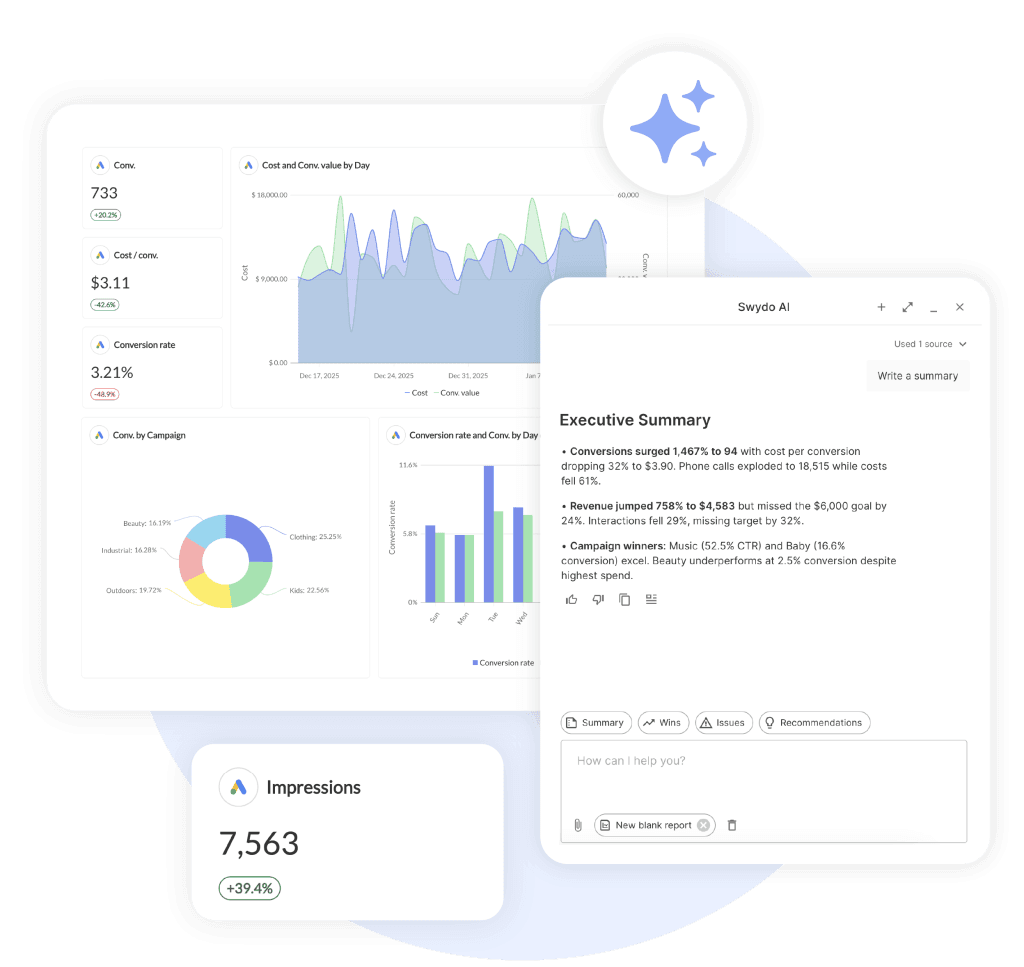
With Swydo, you can give every client a live, branded dashboard that shows the results your work produced, and schedule a clear report, with a plain-language AI-written summary of the wins and what’s next, to land in their inbox before the invoice does.
Because it’s white-label reporting, the whole thing carries your brand, not ours, which reinforces that the client is paying a professional.
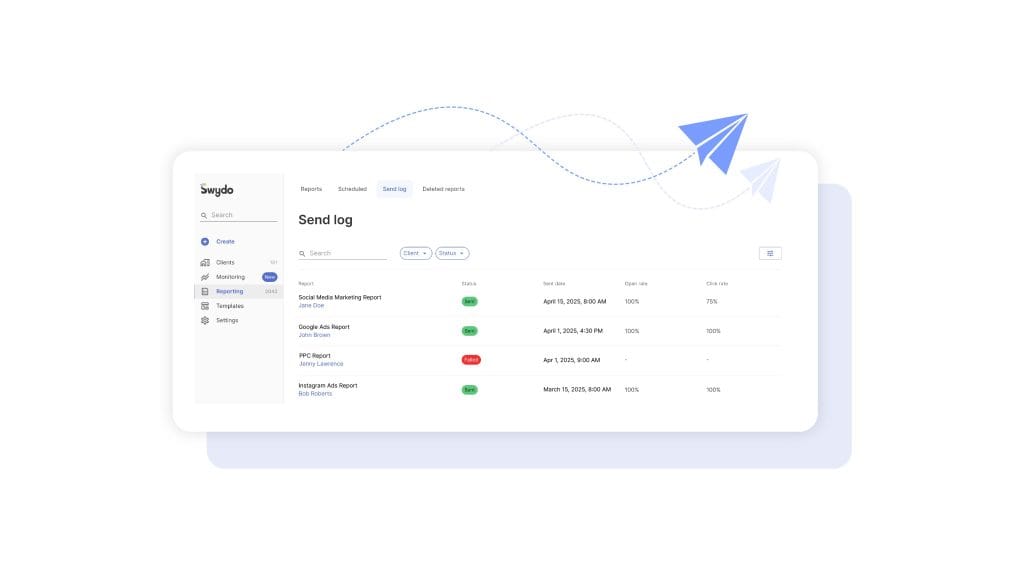
There’s a smaller, underrated benefit too. Swydo’s Send Log shows you whether a client actually opened the report. When you know a client has seen exactly what they’re paying for, your follow-up on the invoice lands differently. You’re confirming, not justifying.
This won’t replace the rest of the system. But it removes one of the most common reasons invoices stall, uncertainty about value, and it costs you nothing extra once your reporting is set up. For agencies already running report automation, this is value you’re leaving on the table if your reports and your invoices arrive separately.
Automate Your Payment Reminders
Automatic reminders, sent before and after the due date, get invoices paid without you writing a single chasing email. This is the third lever doing quiet work, and it’s the highest-leverage habit on this whole list. Manual chasing is the part everyone hates and nobody does consistently. So take yourself out of it.
A reminder sequence that works:
- 7 days before the due date: a friendly heads-up. “Invoice #1024 is due next week, here’s the payment link.” This catches the genuinely forgetful before they’re ever late.
- 1 day before: a short nudge with the link again.
- On the due date: a clear “this is due today” with one-click payment.
- 3 days after: a firmer, still-polite note that the invoice is now overdue.
- 7-14 days after: a direct message referencing the late-fee policy from the contract.
Most invoices get paid somewhere in the first two or three messages, usually by clients who simply forgot. The sequence does the remembering so you don’t have to.
The current version of this is smarter than a fixed calendar. Newer invoicing and accounts-receivable tools can draft follow-ups for you, vary the message based on how overdue the invoice is, retry failed card payments automatically, and reach clients across email and text instead of one inbox.
QuickBooks found that businesses using AI-generated reminders get paid an average of five days faster than those sending standard ones. If your tool offers automated, multi-channel follow-up, turn it on. Five days of cash is worth a checkbox.
Automating reminders won’t fix a client who flat-out won’t pay, and it won’t work miracles overnight. But for the large share of late invoices that are just forgotten, a steady automated sequence is the closest thing to a fix that exists, and it hands you back the hours you’d have spent writing those emails one at a time.
What to Do When a Client Pays Late Anyway
When an invoice goes past due despite everything, a calm and escalating sequence recovers most of the money without burning the relationship. Move up one rung at a time, not from silence straight to a threat, and document every step.
A measured escalation path:
- Days 1-3 overdue: a polite reminder that assumes good faith. People genuinely forget. Give them the easy out first.
- Days 5-10: a firmer follow-up. Reference the due date, restate the amount, and note that the late fee from the contract now applies.
- Days 10-15: a direct conversation. Pick up the phone or send a personal note. Ask plainly when you’ll be paid, and get a specific date. A real conversation often shakes loose an invoice stuck in someone’s queue.
- Day 15+: pause work. If you’re mid-engagement, calmly let the client know new work is on hold until the outstanding invoice is settled. This is your strongest lever short of formal action, and it’s why a deposit matters: it means you’re never working far ahead of what you’ve been paid.
- Day 30+: a formal demand. A written demand for payment, referencing your contract and the late fee, signals you’re serious before you involve anyone else.
- Day 45+: outside help. A collections agency or small-claims court is the last resort. Collections agencies typically take 25-50% of what they recover, so it’s a real cost, but on a large unpaid invoice, getting half of something beats all of nothing.
Stay professional at every rung. The goal is to get paid, not to win an argument. Most invoices resolve well before the bottom of this ladder, and the clients who don’t were the ones the deposit and the screening were built to protect you from.
Know Your Legal Rights When an Invoice Goes Unpaid
You have more legal leverage than you probably think: statutory interest, freelancer-protection laws, and small-claims options that vary by where you and your client are based. Most articles skip this entirely.
Knowing the rules changes how confidently you can chase a stubborn invoice. (This is general information, not legal advice, and rates and rules change, so confirm the current figures for your region before you rely on them.)
| Region | What you can do | The key numbers |
|---|---|---|
United States | No federal law forces private clients to pay on time, and the Prompt Payment Act covers government contracts only. But “Freelance Isn’t Free” laws now give freelancers real teeth in a growing list of places: New York City, New York State, Los Angeles, Seattle, Minneapolis, Columbus, and Illinois. |
NY State: contracts $800+
Pay within 30 days
Double damages + legal fees |
United Kingdom | Charge statutory interest on overdue B2B invoices under the Late Payment of Commercial Debts (Interest) Act, and you’re entitled to it even when it isn’t written into your contract, plus fixed compensation per late invoice. |
8% + Bank of England base rate
+ £40 / £70 / £100 per invoice
Applies automatically |
European Union | The Late Payment Directive caps how long commercial terms can run and entitles you to interest plus compensation on every late invoice, with tighter rules for public-sector clients. |
Public bodies: pay in 30 days
B2B: max 60 days
ECB rate + 8% · €40 min |
You rarely have to use any of this, but knowing it exists changes the tone of your follow-up. “Per our contract and the statutory interest I’m entitled to, the outstanding balance is now…” is a very different message from “just checking in again!” The leverage is yours whether or not you ever take it to court.
Your Get-Paid-on-Time Checklist
Getting paid on time comes down to the three levers (clear terms, easy payment, real consequences), applied every time, not just when an invoice goes late. Run this list on every new client and every invoice.
Before the work starts:
- Signed agreement covering rate, deposit, due date, methods, late fee, and cancellation/kill fee
- Deposit collected (often 50% for projects, 25-50% for longer builds)
- New client screened: credit check or references for larger engagements
- Payment terms confirmed in writing and out loud
On every invoice:
- Specific calendar due date, not just “Net 30”
- Clear, itemized line items
- A one-click online payment link
- The right method nudged: ACH for large invoices, card for small and fast ones
- Sent right after the work is delivered, ahead of the client’s AP cycle
- A clear report or dashboard sent alongside it, so the value is visible
For follow-up:
- Automated reminders set: before the due date, on it, and after
- Multi-channel, AI-assisted follow-up turned on if your tool offers it
- An escalation ladder ready: reminder, late fee, pause work, formal demand, collections
- Your legal leverage for your region known before you need it
Final Thoughts
Getting paid on time isn’t about chasing harder. It’s about building a system that makes paying easy and not-paying uncomfortable, then running it every time. Set clear terms before the work starts. Make your invoices a single click to pay.
Automate the follow-up so you’re never the one writing the awkward email. And show clients the value they’re paying for, so the invoice confirms a decision instead of raising a question.
Do that consistently and late payments stop being something that happens to you. They become a rare exception your process is built to catch.
Getting Paid on Time: Your Questions Answered
Direct answers to what freelancers and agencies actually search for
Net 30 means payment is due 30 days after the invoice date. Net 15 means 15 days, and “due on receipt” means pay now. Shorter terms get you paid sooner, so use the shortest window a client will comfortably accept.
Ask for 50% upfront on most projects, or 25-50% on longer builds. A deposit covers your early costs and filters out clients who were never serious about paying, and the time to set it is before any work begins.
A deposit is an upfront slice of a one-time project fee; a retainer is a recurring fee paid ahead for ongoing work. Both put money in before the work happens, which is the single best protection against late payment.
A kill fee is what a client owes if they cancel a project partway through, often 50% of the remaining fee. It keeps you from carrying all the risk when someone walks away after you’ve already started.
Yes. A signed agreement is what makes your due dates, late fees, and deposit enforceable. Without one, “Net 30” is just a suggestion and you have little to stand on when an invoice goes unpaid.
Make paying a single click and remove every reason to wait: a “Pay Now” link, a specific due date, and an invoice sent the moment the work is done. Online-payment invoices get paid up to four times faster than ones that need a manual bank transfer.
Include a specific calendar due date, itemized line items, accepted payment methods, a one-click payment link, and your late-fee policy. The clearer the invoice, the fewer questions, and questions are what create delay.
Cards are faster for the client but cost you about 2.9% + $0.30; ACH is far cheaper on large invoices, often capped around $5. Offer both, steer big invoices toward ACH, and keep cards for the small, fast ones.
| Method | Typical cost | Best for |
|---|---|---|
| Credit / debit card | ~2.9% + $0.30 | Small, fast invoices |
| ACH / bank transfer | ~0.8% (max ~$5) | Large invoices |
| Digital wallet | ~3.49% + $0.49 | Small or international |
Send it the moment the work is delivered, and a few days before the client’s accounts-payable run if you know their cycle. The day of the week barely matters. Speed and timing to their pay cycle do.
Set clear terms before work starts, take a deposit, make paying one click, and turn on automatic reminders. Most late payments come from friction and vague terms. Remove both and on-time becomes the norm.
Keep it short and specific, and assume they simply forgot. Most have. Reference the invoice number, amount, and due date, and include a one-click link so paying is easier than replying.
“Hi [Name], quick heads-up that invoice #1024 for $2,000 was due on the 15th. Here’s the link to pay, and let me know if you have any questions.”
Move up a calm ladder rather than jumping to a fight: a polite reminder, a firmer note that applies your late fee, a direct phone call, pausing work, a formal written demand, and only last, collections or small claims. Document every step along the way.
Change the channel and the tone: if emails go unanswered, call, then send a formal written demand that references your contract and late fee. Pausing any further work and naming a firm deadline usually gets a reply faster than another polite email.
Send a short sequence (before the due date, on it, and again around 3 and 7-14 days past due), then escalate instead of sending endless reminders. Most invoices get paid in the first two or three messages, usually by people who just forgot.
Yes. Pausing work until an overdue invoice is settled is one of your strongest and most reasonable levers. Add a line to your contract that work pauses on overdue invoices, so it’s expected rather than a surprise.
Separate the complaint from the bill: ask exactly what’s wrong, agree on a fix or a fair partial payment in writing, and keep the undisputed amount due. Clear reporting on what you actually delivered prevents most of these disputes before they start.
Yes, as long as it’s written into your agreement and reasonable. A common rate is 1-1.5% of the overdue balance per month, up to about 3% for repeat late payers. Apply it once the invoice passes its due date, after one clear reminder, and charge it consistently.
It depends on where you and your client are based. In the UK you’re entitled to statutory interest of 8% above the base rate plus fixed compensation automatically; in the EU it’s the ECB rate plus 8 points and at least €40 per invoice; in the US it must be written into your contract to apply.
This is general information, not legal advice. Check the current rules and rates for your own region before relying on them.
In a growing number of US locations, “Freelance Isn’t Free” laws require a written contract and payment within 30 days, and let you claim double damages plus legal fees. The federal Prompt Payment Act only covers government contracts, so it won’t help with a private client, a common mix-up.
Treat it as a last resort. The threat of a formal demand usually does more than the filing. Weigh the cost too: collections agencies often take 25-50% of what they recover, though on a large invoice, getting half still beats nothing.
Yes. A short, written installment plan often recovers more than a standoff. Get the schedule signed, keep your late-fee terms in place, and pause new work until the balance is current.