
Client retention for marketing agencies in 2026 means keeping accounts that face two new pressures at once: AI is compressing what agencies are paid to do, and brands are pulling more work in-house. The agencies winning right now don’t out-spend their competition on new business. They out-deliver on the clients they already have — through structured reviews, transparent reporting, and proactive communication that catches problems before clients do.
This is a playbook of nine strategies that hold up against the 2026 environment, not a 2019 retention listicle dusted off. Each one is paired with the data that backs it, the framework that runs it, and the tools that make it real.
Why Retention Is Harder Now Than Three Years Ago
Three things have changed since most “client retention” articles on the internet were written.
The first is AI’s effect on agency spend. In a Typeface survey of more than 200 senior U.S. marketing leaders, 60% said they spend less on agencies this year as a direct result of AI. Retainers aren’t getting cancelled outright — they’re getting cut down. A $25k/month account becomes $15k. The relationship still exists. The economics don’t.
The second is in-housing. A NewtonX survey conducted for ADWEEK found 32% of brands expect to handle nearly all creative in-house within 12 months, and another 23% expect to bring at least half in-house. The ANA’s most recent member survey on in-housing, conducted every five years since 2008, put 82% of large brands as already running an in-house agency — up from 78% in 2018. The work isn’t disappearing. It’s moving.
The third is industry-wide growth slowdown. RSW/US reports just 39% of agencies grew in 2025, down from 44% in 2024. Promethean Research’s 2026 State of Digital Services Report puts average agency revenue growth at 7.5%, well below historical norms.
So when an existing client cuts scope, hires an in-house team, or freezes spend, you can’t make up the gap by selling harder. The math is brutal: agencies that retain their existing clients well will be fine. Agencies that don’t, won’t.
What the Data Says About Client Retention in 2026
Here are the numbers worth anchoring before you read another retention tip.
Setup’s annual Marketing Relationship Survey, which polls 400+ brand and agency professionals, found something agencies need to sit with. The top reason clients end agency relationships in 2025 wasn’t budget. It was dissatisfaction with delivery — cited by 48% of clients, up 14 points from the prior year. The next three reasons were tied: the agency didn’t understand their business, dissatisfaction with strategic approach, and dissatisfaction with value. Budget cuts ranked seventh.
Meanwhile, agencies surveyed in the same study ranked client leadership changes and budget cuts as the top two reasons relationships end. Delivery ranked seventh on the agency list. That gap between what clients say and what agencies hear has a name now: the delivery gap.
The Delivery Gap
Why clients say they end agency relationships vs. why agencies think they end
Delivery dissatisfaction was the #1 reason clients ended agency relationships — cited by 48% of clients, up 14 points year over year. Agencies ranked delivery seventh.
| Reason for ending the relationship | Clients’ rank | Agencies’ rank |
|---|---|---|
| Dissatisfaction with delivery | #1 | #7 |
| Agency didn’t understand our business | #2 | #8 |
| Dissatisfaction with strategic approach | #3 | #6 |
| Dissatisfaction with value | #4 | — |
| Change in client team’s leadership | #5 | #1 |
| Dissatisfaction with relationship | #6 | #5 |
| Client team had budget cuts | #7 | #2 |
Source: Setup’s 6th annual Marketing Relationship Survey, 400+ brand and agency professionals. Yellow rows highlight the largest perception gaps between clients and agencies.
Predictable Profits’ 2025 Agency Growth Benchmark, drawn from 300+ seven- and eight-figure agencies, shows 8-figure agencies retain 92% of clients annually versus 78% for 7-figure agencies. The difference isn’t talent. It’s process.
And client referrals remain the #1 lead source for digital agencies, ahead of agency websites and networking, according to Promethean Research. Retention isn’t just margin protection. It’s your top-of-funnel.
The 9 Client Retention Strategies
The strategies below build on each other. The first three are about getting the relationship right at the start. The next three are about staying close to the work and the client. The last three are about institutionalizing the relationship so it survives staff turnover, AI disruption, and the inevitable bad quarter.
1. Set Expectations Before the Contract Is Signed
Most client losses are designed in the pitch. The agency promises something it can’t sustainably deliver, the client expects something different than what arrives, and three months in, the relationship is already in trouble. Setup’s research has shown for years that chemistry ranks as the single most important factor clients use to choose an agency partner — ahead of capabilities, creativity, and price. That fit either gets confirmed during the pitch process, or it gets papered over and breaks later.
Fix it by being specific about three things up front:
- What success looks like in 90 days, 180 days, and 12 months. Not “growth.” Specific KPIs with specific numbers.
- What’s in scope and what isn’t. Including what happens when scope grows.
- How and when you’ll communicate. Reporting cadence, response-time expectations, who attends which meetings.
Then write it down somewhere the client can re-read it. A welcome packet, a kickoff doc, a recorded client onboarding session. When a question comes up later — and it will — you have something to point to.
You can also build this into your reporting setup from day one. Open Swydo, go to Reports → Templates, and pick one from the Template Gallery that matches the client’s primary channel. There are 29+ marketing report templates covering PPC, SEO, social, analytics, and CRM. Set the goals inside Monitoring → Goals so the client sees a green/yellow/red status against their own targets, not against industry averages they don’t recognize.
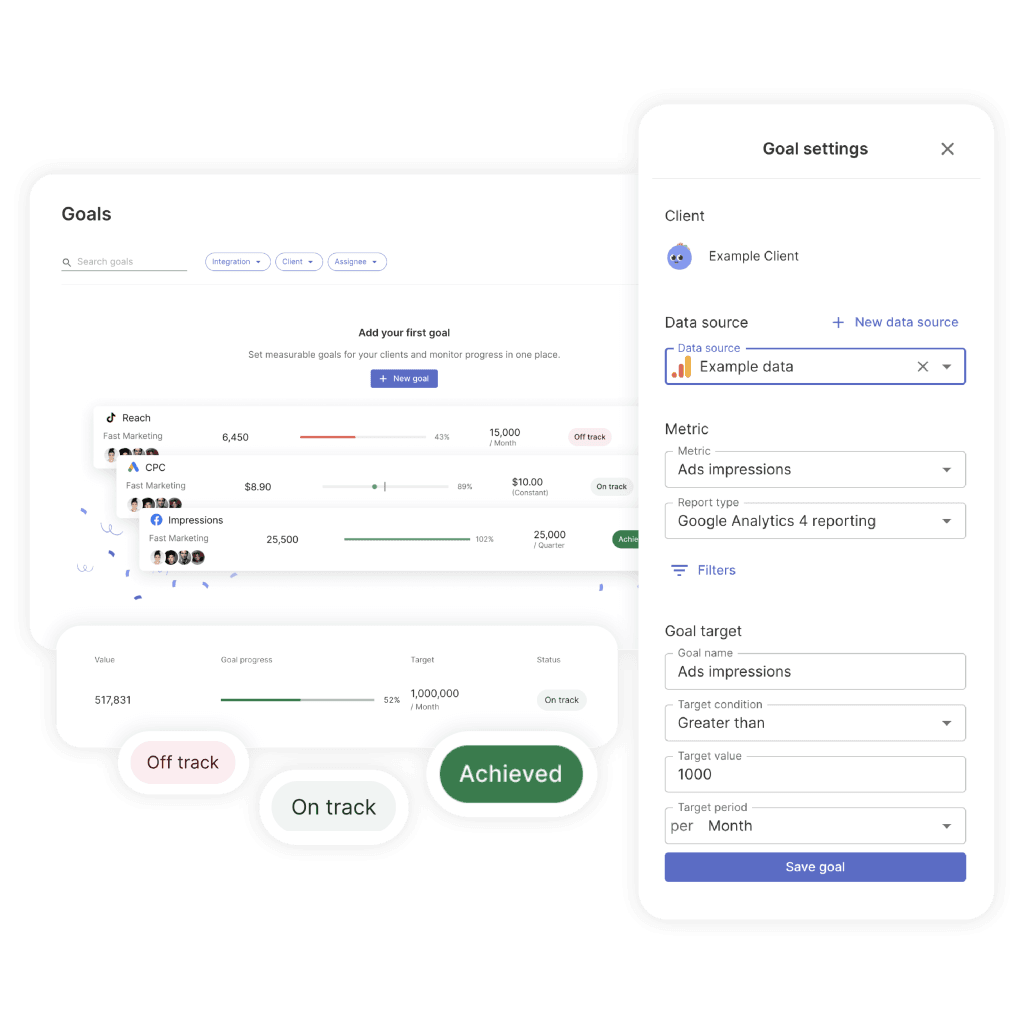
Try it: The 14-day Swydo trial includes 10 data sources, which is enough to set up onboarding goals for two or three new clients without paying for it. No credit card.
2. Communicate Proactively, Not Reactively
If your client is the one bringing up the problem, you’ve already lost ground. Proactive communication is the cheapest retention tactic that exists, and almost no agency does it well consistently.
Build the rhythm into your operations:
- A short weekly check-in (15 minutes, async-friendly) covering “what we did, what we’re doing, what we need from you”
- A monthly performance report tied to the goals you set in strategy 1
- A quarterly business review (see strategy 8)
- An immediate alert when something material changes — good or bad
That last one is where most agencies fall down. A campaign tanks on a Tuesday. You don’t notice until Friday because the monthly report isn’t due until the 15th. By the time the client sees it, they’ve already heard about it from their CMO.
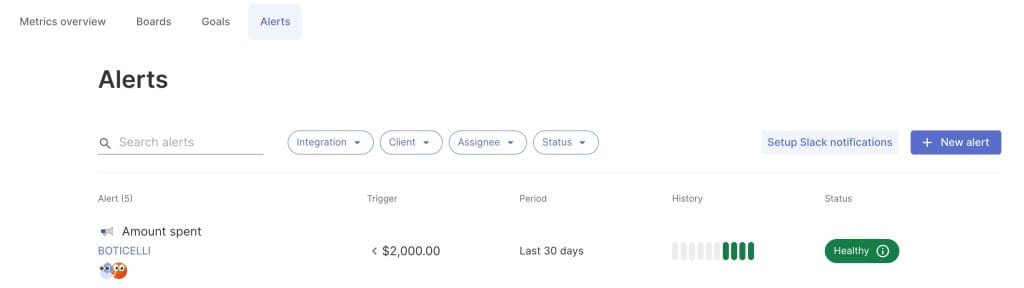
Open Swydo’s Monitoring → Alerts and set a trigger for each client’s primary KPI. Pick a metric (ROAS, CPL, conversion rate), pick a trigger period (1, 7, 30, or 90 days), and pick the threshold. When the metric crosses it, you get a Slack message and an email before the client opens their inbox. You can pause alerts on specific days — Sundays, holidays — so you’re not getting paged on the weekend.
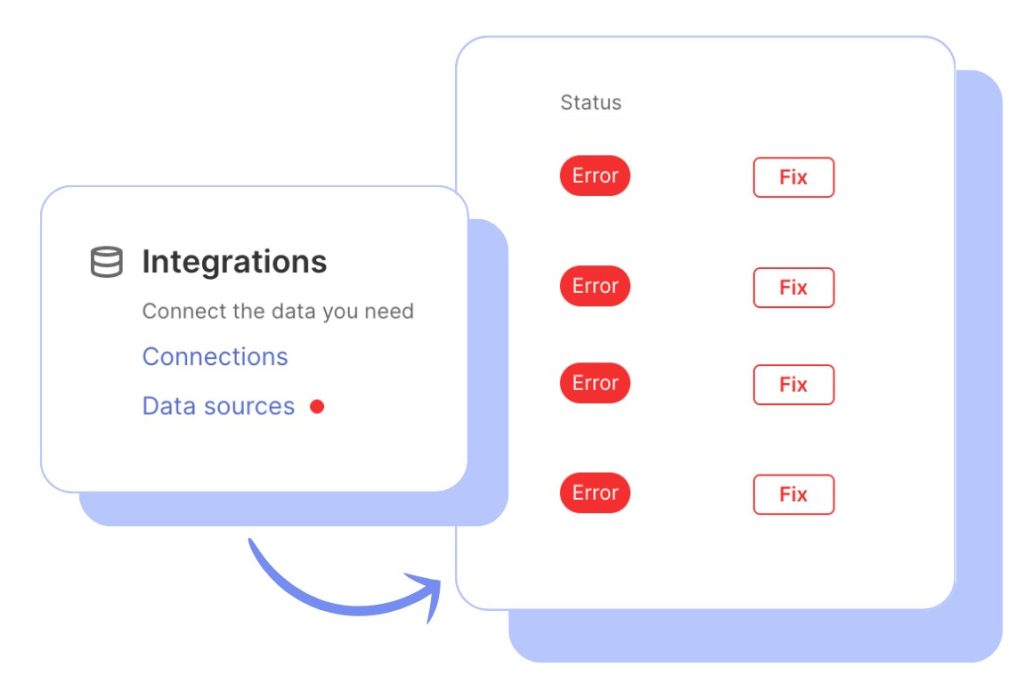
A practical note: monitoring alerts only work if the underlying data connection is healthy. Swydo runs daily connection-health checks and flags broken or expired tokens with a red-dot alert plus an email, so you’re not finding out about a dead Google Ads connection from a confused client.
3. Show Your Value With Reporting That Doesn’t Suck
Reporting is the single biggest retention activity by impact, and almost everyone does it wrong. Either it’s a screenshot dump that says nothing about the business, or it’s a 40-page PDF nobody reads.
Look at it this way. Reporting is the most frequent touchpoint you have with a client — often the only one that lands in their inbox between meetings. If every report makes the value visible, the renewal conversation gets easier. If every report buries it, the renewal conversation gets harder.
A good client report does three things:
- Shows progress against the goals from strategy 1. Not industry averages. Their goals.
- Explains what happened in plain English. What worked, what didn’t, what you’re doing next.
- Gives the client something to do with it. Forward it to their boss. Make a decision. Approve a change.
Build the report once in Swydo’s Report Editor, save it as a Template, and link every client report to that master so updates flow downstream. When the client opens the dashboard, they see Swydo AI’s auto-generated Summary at the top — wins, issues, recommendations — in their language (Dutch, English, French, German, Spanish, and more). The AI runs on 4,000 included credits per month, which covers about 40 summaries — enough for most agencies to roll AI summaries into every monthly send without ever touching a paid tier.
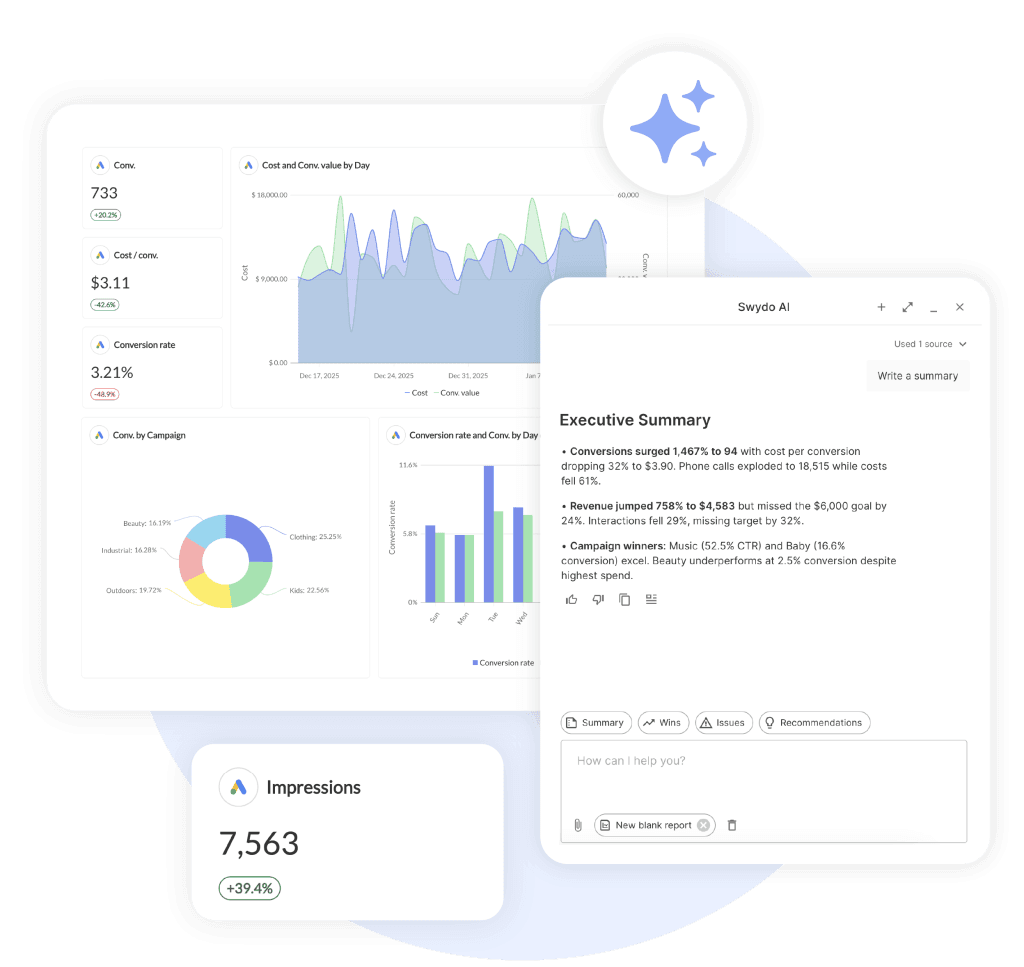
Live online dashboards became Swydo’s default share format in 2024, replacing the static PDF as the primary deliverable. Clients log in whenever they want. You don’t get the “can you re-send the report?” email anymore.
Try it: Connect one client’s Google Ads and GA4 accounts inside the 14-day trial. Build the report once, share the dashboard link, and watch the open-rate data come back through the Send Log.
4. Treat Every Client Like an A-Tier Account (Even the C-Tier Ones)
Personalization doesn’t mean hand-writing every email. It means knowing which clients matter most to your business and structuring your time around that, not around whoever shouted loudest this morning.
Build a simple A/B/C tier system:
- A-tier: High revenue, high strategic value, low friction. Get a senior account lead, monthly strategy calls, custom reporting.
- B-tier: Solid revenue, decent fit. Standard cadence, standard reporting.
- C-tier: Lower revenue, high friction, or both. Either upgrade them or transition them out.
Add a client health score on top of that. Composite score, updated monthly:
- Days payment outstanding (heavier weight if over 30)
- Meeting attendance (% of scheduled calls attended in the last 90 days)
- NPS or CSAT response
- Engagement in strategy conversations (do they show up with questions, or rubber-stamp recommendations?)
A client whose score drops three months in a row is a churn signal. Act on it before they tell you.
Client Health Score
A composite churn-risk indicator built from four leading signals
Acme Co · Updated this morning
Days payment outstanding
Weight: 30%
42 days
Meeting attendance (90 days)
Weight: 25%
92%
Most recent NPS
Weight: 25%
7
Strategy engagement
Weight: 20%
Low
62
/ 100
At RiskScore has dropped 9 points over two months. Trigger an executive check-in this week.
In Swydo, you can build a Monitoring Board per client that combines KPI scorecards, goal progress, and recent activity. Use the Labels feature to tag clients as A, B, or C, and use the Homepage to scan recent reports and connection health across the whole book at once.
5. Build a Relationship That Survives Your Account Manager Leaving
The agency talent picture in 2026 is volatile. The same NewtonX/ADWEEK survey that flagged in-housing also found 54% of agency executives say they’re somewhat or very likely to start their own firm within the next two years. When your account lead leaves, the client relationship goes with them — unless you’ve designed it not to.
Three habits that insulate the relationship:
- Two-person coverage on every account. Senior + junior, or strategy + delivery. Never one point of contact.
- Documented client context. Goals, history, key contacts, what to never say in front of the CMO. Stored somewhere the next account manager can read on day one.
- Executive sponsorship on A-tier clients. A partner or director joins one call per quarter. The client knows the agency leadership cares.
Yes, you can also send a holiday gift. But a thoughtful gift sent by someone who doesn’t know what the client is actually struggling with is worse than no gift at all.
6. Ask for Feedback the Right Way (and Act on It Within a Week)
Most agencies ask for feedback once a year, in a survey nobody fills out. The agencies that retain best ask continuously, in small ways, and respond fast.
Set up a quarterly NPS pulse:
- One question: “How likely are you to recommend us to a peer, on a scale of 0–10?”
- One follow-up question depending on the score
- Email it directly from the senior account lead, not from a tool
Then act on the scores. Retently’s 2026 NPS benchmark shows digital marketing agencies sitting at an industry score of 49, down from 51 in 2025 — solid but trending the wrong way. The agencies that pull ahead use feedback data to increase client retention through what some teams call a “response protocol” — any score below 8 triggers an executive follow-up call within seven days. Not an email. A call.
Promoters (9–10) renew at much higher rates than detractors. The middle (7–8) is where most of your retention work actually happens — those are the clients who’d switch for the right reason and stay for the right one.
A practical version of this: end every Swydo report email with one question, sent via the Email Editor with the AI Summary block. “What’s one thing you’d want to see in next month’s report?” Three out of ten clients will answer. Those answers are gold.
7. Make Renewing or Expanding the Easy Choice
The easiest expansion sale is the one the client doesn’t have to think about. Productize your retainers, set clear upgrade paths, and reduce the friction of saying yes.
RSW/US’s productization research found 62% of agencies now package services into productized retainers, with 86% planning to expand the approach into 2026. The reason is simple: when the client has to decide whether to renew, you don’t want them weighing your invoice against their budget. You want them weighing tier B against tier C.
Three things to put in place:
- Defined service tiers. Three is plenty. Each one is a clear scope, a clear price, and a clear set of deliverables. (If you’re rethinking your overall agency pricing model, this is where to start.)
- A renewal calendar. Every retainer has a 60-day-out check-in to review the past period and propose the next one.
- A simple “what would we do with more budget” conversation. Have it twice a year, before they ask.
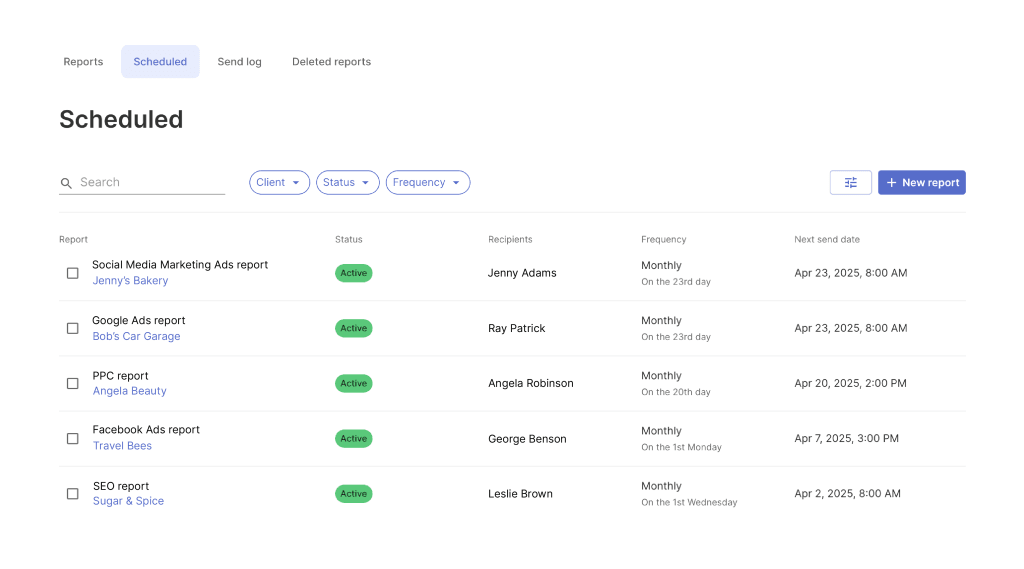
Swydo’s Schedule Overview lets you bulk-edit your reporting schedules so you can adjust cadence by tier — A-tier weekly, B-tier monthly — without opening each schedule one by one.
8. Run Quarterly Business Reviews
Quarterly Business Reviews are the single most underused retention tool in the marketing agency stack. If you don’t already run them, this is the highest-ROI process change you can make in 2026.
A QBR is a 60–90 minute structured meeting, held once per quarter, between your senior team and the client’s senior team. It’s not a status update. It’s a strategy conversation. The agenda runs roughly:
- Last quarter’s results vs. goals (15 min) — what was promised, what was delivered
- What’s working, what isn’t, what we’re stopping (20 min) — the keep/stop/start frame
- Next quarter’s plan and budget (20 min) — including any scope changes
- Client business context (15 min) — what’s changing on their side that we should know about
- Open discussion (10 min) — what else is on their mind
Three rules make it work:
- Both senior teams in the room. Your director and theirs, not just account managers.
- Prep work happens before the meeting. Send the data 48 hours ahead so the meeting is about the conversation, not the slides.
- Action items are documented and tracked. What happens in the QBR drives next quarter’s reporting.
QBRs are particularly effective at addressing the delivery gap. They give the client a structured chance to say “this isn’t landing” before that thought turns into “we should review our agency.” And they give the executive sponsorship described in strategy 5 a natural home — your partner shows up to one meeting per quarter, the client knows leadership is paying attention, and the relationship doesn’t depend on a single account manager.
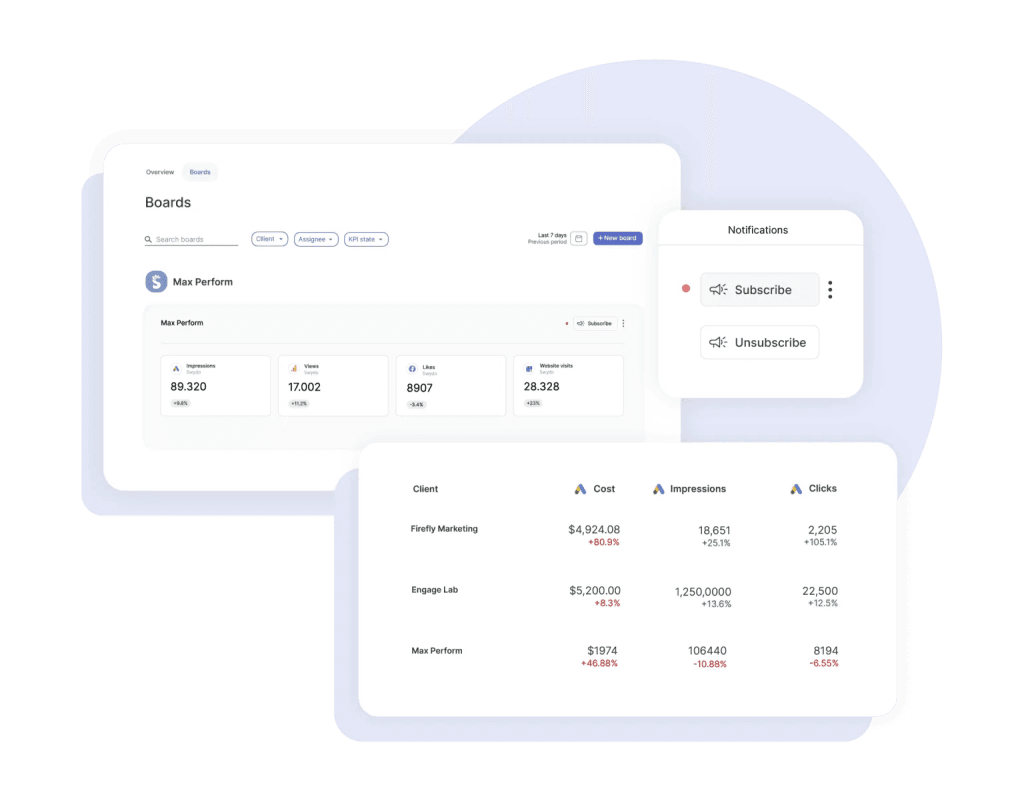
A QBR built in Swydo runs out of a marketing dashboard for that client — a Monitoring Board. Pull up Boards in Present mode for the live discussion, then download the scrollable PDF for the meeting record.
9. Prove Your Value Beyond the Deliverable
This is the strategy that didn’t exist three years ago, and it’s the one that determines whether your agency exists in five.
When 60% of senior marketers are cutting agency spend because of AI, and 32% of brands are moving creative in-house within 12 months, “we make your ads” is no longer enough. The agencies retaining clients in 2026 are positioning themselves as strategic AI partners — teaching the client’s team how to use AI, recommending tooling, building hybrid in-house/agency workflows.
Drew McLellan of the Agency Management Institute has been making this argument across his 2026 trend coverage and AMI’s Agency Edge research: agencies that want to be seen as strategic advisors rather than vendors have to earn that seat by bringing AI expertise to client conversations, not waiting to be invited.
Three concrete moves:
- Offer AI strategy workshops as part of the retainer. Not a separate paid engagement. A built-in benefit.
- Recommend tools your client could use directly. Even if it slightly reduces your scope. The trust dividend pays back tenfold.
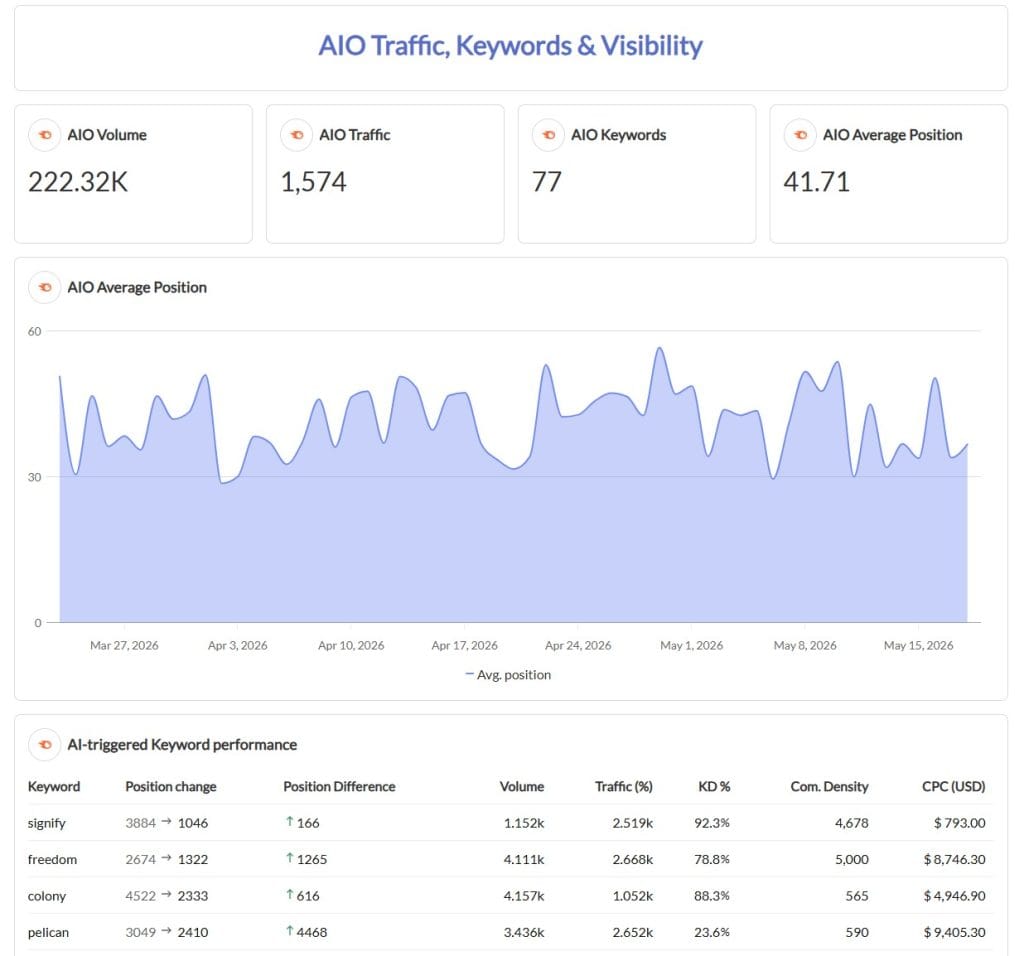
- Report on AI-search visibility. Brand mentions in ChatGPT, Perplexity, AI Overviews. This is the next layer of organic performance and most clients don’t know how to measure it yet.
Swydo’s Semrush integration includes AI Overview ranking metrics directly in client reports, which puts you ahead of clients still trying to figure out where AI-search performance shows up in their analytics.
A note on what this strategy isn’t. It isn’t pretending you have AI expertise you don’t have. Clients can tell. If your agency is genuinely earlier on the AI curve than your clients, say so, name what you’re learning, and bring them along. Honesty about where you are buys more trust than overclaiming.
How These 9 Client Retention Strategies Fit Together
Pull these strategies into a single loop and they look like this:
The R-A-A-R Loop: Report → Alert → Adjust → Renew. Every month you report on the goals you set in strategy 1. Every day Monitoring watches the underlying metrics and alerts you when something moves. Every quarter you adjust through a QBR. Every year (or every renewal cycle) you propose the next tier.
The R-A-A-R Loop
A repeatable retention rhythm for marketing agencies
R
Report
Monthly
Show progress against the goals you set at onboarding. In plain English, with one clear action attached.
→
A
Alert
Daily
Catch material changes the day they happen. You see the dip before the client does, every time.
→
A
Adjust
Quarterly
Run a QBR. Review what worked, stop what didn’t, and reset the plan with the client’s senior team.
→
R
Renew
Annually
Propose the next tier 60 days before renewal. Productized scope, clear upgrade path, no awkward invoice conversations.
The strategies aren’t a list of things to do separately. They’re a system. Each one feeds the next.
Final Thoughts
Client retention in 2026 isn’t a soft skill. It’s a system — structured reviews, transparent reporting, proactive alerts, productized renewals, and an honest answer to the question “what’s your agency for in the age of AI?”
The agencies that get this right keep their clients for years, build referral pipelines that fill the funnel for free, and survive a market where new business is harder than it’s been in a decade. The ones that don’t get squeezed from both sides: clients cutting scope, prospects going direct to AI tools.
If you’d like to see what the reporting and monitoring side of this system looks like on your own client data, the 14-day Swydo trial doesn’t require a card.
Got a strategy that’s worked for your agency? Send it over — I read every reply.
Client Retention FAQ for Marketing Agencies
Quick answers to the questions agencies actually search for
Aim for 85% or higher annually. The top-performing agencies hit 92%.
Industry benchmarks from Predictable Profits’ Agency Growth Benchmark show 8-figure agencies retain 92% of clients annually, while 7-figure agencies retain 78%. The 14-point gap is almost entirely process-driven, not talent-driven. If you’re under 80%, you’re losing clients faster than you can replace them at current new-business costs.
Client Retention Rate = ((Clients at end of period − New clients gained) ÷ Clients at start of period) × 100
Example: You start the year with 40 clients, gain 12 new ones, and end with 45. Your retention rate is ((45 − 12) ÷ 40) × 100 = 82.5%. Calculate it annually for the headline number and quarterly to spot trends earlier. Track revenue retention separately—a client who renews at half their original spend counts as retained for logo numbers but not for revenue.
Retention protects margin, fuels referrals, and costs a fraction of new acquisition.
Client referrals are the #1 lead source for digital agencies, ahead of agency websites and networking (Promethean Research). When you keep clients longer, you also generate more inbound leads for free. Add in that only 39% of agencies grew last year and average growth dropped to 7.5%, and the math is clear: you can’t out-prospect a leaky bucket. Every retained client is roughly 5–7x cheaper to keep than a new one to acquire.
Around 3 years for digital agencies, with top performers averaging 5+ years.
This number varies by service mix—performance media tends to be shorter (18–24 months) because results are easier to compare, while integrated retainers and brand work tend to run longer. The clearest predictor of long lifespan isn’t the service type, it’s whether the agency runs quarterly business reviews and shows progress against client-specific goals rather than vanity metrics.
Track five: retention rate, revenue retention, NPS, client health score, and average client lifespan.
Logo retention tells you how many clients stay. Revenue retention tells you how much they spend when they do. NPS tells you how they feel. A composite health score (built from payment timing, meeting attendance, NPS, and strategy engagement) tells you who’s about to leave. Average lifespan tells you how the system is performing over time. Watch all five monthly. Watching only one is how agencies get blindsided.
The #1 reason is dissatisfaction with delivery — cited by 48% of clients in Setup’s annual Marketing Relationship Survey.
The full top five from the client side: dissatisfaction with delivery (48%), agency didn’t understand our business, dissatisfaction with strategic approach, dissatisfaction with value, and change in client team’s leadership. Budget cuts ranked seventh on the client list, even though it’s what agencies most often blame.
The delivery gap is the mismatch between why clients say they leave (poor delivery) and why agencies think they leave (budget cuts and leadership changes).
Clients rank delivery as the #1 reason they end relationships. Agencies rank it #7. That eight-spot gap means most agencies are solving for the wrong problem—offering discounts or extra perks when the real fix is tighter execution, clearer reporting, and better alignment with the client’s business. Closing the delivery gap is the single highest-ROI shift an agency can make.
No. Budget cuts rank #7 in actual client-stated reasons. Agencies blame budget far more often than clients do.
When clients are happy with delivery, strategic value, and the relationship, they find budget. When they’re not, “budget” becomes the polite exit reason. If an agency hears “budget cuts” repeatedly, the real issue is usually upstream—often a delivery, value, or communication problem the client didn’t feel safe naming directly.
Six signals worth watching: late payments, missed meetings, slower email replies, drop in NPS, “rubber-stamping” recommendations instead of engaging, and new procurement involvement.
Any one of these in isolation isn’t conclusive. Two or more in the same month, or a health score that drops three months in a row, is your action signal. The window between the first warning sign and the actual termination conversation is usually 60–120 days—plenty of time to intervene if you’re watching the right indicators.
In-housing is accelerating: 32% of brands expect to handle nearly all creative in-house within 12 months, and 82% of large brands already run an internal agency.
The work isn’t disappearing—it’s relocating. Agencies that retain in this environment shift from doing all the work to enabling the client’s in-house team: training, tooling, audits, strategic oversight, and the specialized work the in-house team can’t justify hiring for. Resisting in-housing usually accelerates the loss. Partnering with it usually saves the relationship.
Quarterly Business Reviews (QBRs). Nothing else in the agency stack has a higher retention ROI.
A QBR is a 60–90 minute structured strategy meeting between your senior team and the client’s senior team, held every quarter. It surfaces problems before they become exit conversations, gives executive sponsors a natural touchpoint, and resets the plan with both sides committed. Agencies that run them consistently see retention rates 10–15 points higher than agencies that don’t.
A 60–90 minute quarterly meeting between senior teams on both sides, focused on strategy rather than status updates.
A standard QBR agenda: results vs. goals (15 min), keep/stop/start review (20 min), next quarter’s plan and budget (20 min), client business context (15 min), open discussion (10 min). Send data 48 hours ahead so the meeting is about decisions, not slides. Document action items and roll them into next quarter’s reporting so the QBR has consequences, not just conclusions.
Lock down three things before work starts: success metrics, scope boundaries, and communication cadence.
Define specific KPIs for 90, 180, and 365 days—with numbers, not adjectives. Write down what’s in scope and what isn’t, including how scope changes get handled. Set communication expectations: reporting frequency, response-time SLAs, and who attends which meetings. Put it all in a written kickoff doc the client can re-read later. Most churn is designed into the relationship at this stage; getting onboarding right is worth more than any other single intervention.
Combine four weighted signals into one monthly score: payment timing (30%), meeting attendance (25%), most recent NPS (25%), and strategy engagement (20%).
Score each component 0–100, multiply by the weight, sum the result. A client below 70 is at risk; a client whose score drops three consecutive months is actively churning, even if they haven’t said anything yet. The score itself matters less than the trend. Reviewing health scores in your weekly team meeting catches problems weeks earlier than waiting for the client to raise them.
Yes. Use a simple A/B/C system based on revenue, strategic value, and friction.
A-tier clients (high revenue, high fit, low friction) get senior account leadership, monthly strategy calls, custom reporting, and executive sponsorship. B-tier gets standard cadence and templated reporting. C-tier (low revenue or high friction) either gets upgraded into B or transitioned out. Tiering isn’t about ranking clients by importance—it’s about matching attention to value so your best clients aren’t subsidizing your worst.
Address it the first time it happens, in writing, with a price.
Scope creep destroys retention because it makes the original deal feel like a bait-and-switch on both sides—the agency feels exploited, the client feels nickel-and-dimed when limits surface later. Define scope-change handling in the contract: small additions absorbed up to a stated hours threshold, anything beyond that quoted as a change order. Send the change order the same week the request comes in, not at month-end. Clients respect clear rules. They resent surprise invoices.
Monthly for performance reports, weekly for short check-ins, quarterly for strategic reviews.
Live online dashboards are now the default share format—clients log in whenever they want and you stop getting “can you resend the report?” emails. Tier the cadence by client value: A-tier might get weekly performance summaries, B-tier monthly, C-tier monthly with a templated format. The worst pattern is reporting only when the client asks, because by then you’re already explaining yourself.
Three things: progress against the client’s specific goals, plain-English explanation of what happened, and one clear next action.
Bad reports dump screenshots and platform metrics. Good reports answer three questions the CMO will ask: Are we hitting the goals we agreed on? What changed and why? What are we doing about it? Cut every chart that doesn’t help answer one of those three. Reports are the most frequent touchpoint with most clients—if they don’t make value visible, renewals get harder by default.
Yes. Manual reporting eats 15–25% of account-management time and produces less consistent output.
Automated platforms like Swydo build the report once as a template, pull live data from connected sources (Google Ads, GA4, Meta, LinkedIn, Search Console, and so on), and send it on schedule. The time freed up goes into the strategic conversation clients actually pay for. Look for tools that include goal tracking against client-specific targets, automated alerts on KPI changes, and live dashboards rather than static PDFs.
Whatever you agreed to at onboarding — and only those. Plus the business outcome those KPIs ladder up to.
For a paid media client: ROAS, CPA, conversions, and revenue. For SEO: organic sessions, qualified leads, ranking movement on priority keywords. For social: engagement rate, reach, and downstream conversion. The mistake is adding metrics over time until reports become 40-page PDFs no one reads. Every metric on the report should connect to a goal the client cares about. Cut the rest.
Pick one primary KPI per client, set a percentage threshold, route the alert to Slack and email.
For most accounts that means ROAS, CPL, or conversion rate moving more than 20% week-over-week. Reporting tools like Swydo let you configure the trigger period (1, 7, 30, or 90 days), the threshold, and pause days like weekends and holidays. The goal is simple: you see the dip on the same day it happens, not when the client emails on the 15th. Catching problems early is the single biggest retention move available to most agencies.
The industry average for digital marketing agencies is around 49. Above 60 is excellent; below 30 is a churn warning.
Run a quarterly NPS pulse with one question and one follow-up, emailed directly from the senior account lead. Any score under 8 should trigger an executive follow-up call within seven days—not an email, a call. Detractors (0–6) will churn at 3–4x the rate of promoters (9–10). The middle (7–8) is where most retention work actually pays off.
AI is shrinking retainer sizes, not killing them. 60% of senior marketers report reducing agency spend as a direct result of AI tools.
The pattern is consistent: a $25k retainer becomes $15k. The relationship survives but the economics shift. Agencies that retain in this environment reposition from “we make the deliverables” to “we make your team’s AI workflow work”—training, tooling recommendations, and strategic oversight that in-house teams can’t justify hiring for full-time.
Move up the value stack: from execution to strategy, training, and outcomes the AI can’t deliver alone.
Concrete moves that work: include AI strategy workshops in the retainer at no extra charge, recommend tools clients can use directly (the trust dividend pays back tenfold), and report on AI-search visibility—brand mentions in ChatGPT, Perplexity, and Google AI Overviews. Clients don’t know how to measure AI-search performance yet. Being the agency that does positions you as a strategic partner, not a vendor competing on speed.
Yes. This is the next layer of organic performance and most clients don’t yet know how to measure it.
Track brand mentions in ChatGPT and Perplexity, citation share in Google AI Overviews, and ranking for AI-generated answer queries. Tools like Semrush now include AI Overview ranking metrics directly in agency reports. Being early here positions you as forward-looking, gives you something to talk about at QBRs, and creates a measurable channel that didn’t exist on the client’s dashboard six months ago.
Two-person coverage on every account, documented client context, and executive sponsorship on top-tier accounts.
54% of agency executives say they’re likely to start their own firm in the next two years. If the only person who knows the client leaves, the relationship leaves with them. Pair a senior and junior on every account, store goals/history/key contacts/landmines somewhere the next account manager can read on day one, and have a partner join one call per quarter on A-tier accounts. The client stays loyal to the agency, not just to one person.
Retention is the outcome. Client success is the system that produces it.
Retention measures whether clients stay. Client success is the structured set of activities—onboarding, QBRs, health scoring, proactive alerts, executive sponsorship, productized renewals—that make retention predictable rather than accidental. Agencies that treat retention as a number to hit usually miss it. Agencies that treat client success as an operating system usually exceed it.
Ask for referrals at moments of measurable success — and make it easy to introduce you.
Referrals are the #1 lead source for digital agencies, ahead of websites and networking. The best moment to ask is right after a QBR where you’ve shown clear wins, or right after a campaign hits a goal. Give the client a short forward-able email template, a one-pager describing your ideal client, and a clear ask: “Who else should be seeing these kinds of results?” Retention and referrals are the same flywheel—happy long-term clients send you the new clients who become happy long-term clients.
Keep clients longer with reporting and alerts that show your value before they have to ask.
Start Your Free Trial Today