
Descriptive statistics tell you what already happened. Inferential statistics tell you what’s probably true for a bigger group you haven’t fully measured — and how sure you can be.
That’s really the whole thing.
Descriptive looks at the numbers in front of you. Inferential reaches past them, with a margin of error attached. One reports. The other advises.
You use both every week, even if you never call them by name. Last month’s cost per acquisition? Descriptive. Whether your new landing page actually beats the old one for everyone, not just the few thousand who’ve seen it? Inferential.
Most teams are great at the first and shaky on the second. And that gap is exactly where reporting stops being convincing.
So here’s what we’ll cover — the three types of descriptive stats, the inferential tests worth knowing, how to use both without overclaiming, and the mistakes that quietly lose clients.
Quick version, if you’re skimming:
- Descriptive statistics sum up a dataset. Averages, spreads, how often things happen.
- Inferential statistics use a sample to estimate or test something about a bigger population.
- The difference comes down to scope and certainty. Descriptive is exact for the data you have. Inferential generalizes, so it always carries a probability.
- Use them together. Describe what happened, test what’s likely true, then decide what to do.
| Descriptive statistics | Inferential statistics | |
|---|---|---|
| Question it answers | “What happened?” | “What’s likely true for the whole group, and what should we do?” |
| What it does | Summarizes the data you have | Uses a sample to draw conclusions about a larger population |
| Data it uses | Any dataset — a sample or a full population | A sample, used to generalize to a population |
| Certainty | Exact for the data in hand | Probabilistic — always carries a margin of error |
| What you get | Averages, spreads, frequencies, charts | Estimates, test results, confidence intervals, predictions |
| Marketing example | Last month’s average CPA across campaigns | Whether a new page will beat the old one for all future traffic |
| Common tools | Reporting dashboards, spreadsheets | A/B testing platforms, statistical software (R, Python) |
What’s the Difference Between Descriptive and Inferential Statistics?
The difference is scope. Descriptive statistics summarize the data you actually collected. Inferential statistics treat that data as a sample and use it to say something about a larger group you didn’t fully measure.
So the output is different too. Descriptive gives you a flat number. Inferential gives you a probability, or a range.
There’s a myth worth clearing up. People say descriptive is for “complete datasets” and inferential is for “samples.” Not quite. You can run descriptive stats on a sample just fine — the average order value of 500 customers is a descriptive statistic. What changes isn’t the data. It’s the goal. Are you summarizing what’s in front of you, or reaching past it?
Here’s the same PPC campaign through both lenses. Same numbers. Different questions.
| The descriptive read (what happened) | The inferential read (what it likely means) |
|---|---|
| 547,892 impressions | A/B headline test: p ≈ 0.03 (the lift is unlikely to be noise) |
| 2.4% CTR, 13,149 clicks | Weekday vs. weekend gap: p ≈ 0.24 (not significant) |
| $1.82 average CPC, $23,931 spend | Conversion lift from the new creative: ~22%, 95% CI roughly 17–27% |
| 3.7% conversion rate, 487 conversions | Spend–revenue correlation: r ≈ 0.76 (strong and positive — not proof of cause) |
| $49.14 cost per conversion | Projected next month: ~487 conversions, give or take ~40 |
The left column tells your client what the campaign did. The right column tells them what’s probably true next time, and how confident you are. Which one would you pay more for?
Why the Difference Matters for Marketers
The distinction keeps you from overclaiming. And overclaiming is how trust erodes.
Descriptive stats describe. They can’t tell you whether a difference is real, or whether it’ll hold up next month. So the second you say “this approach works” or “this audience converts better,” you’ve stepped into inferential territory. That claim needs a sample, a test, and a confidence level behind it — not just a nice-looking chart.
This is also where reporting turns into a retention tool instead of a monthly chore. A data-driven marketing agency doesn’t just show that conversions rose 12%. It shows whether that 12% is signal or noise, and what to do about it.
There’s a tooling angle here, too. Swydo pulls every channel into automated, client-ready reports and then keeps an eye on them daily. So the descriptive layer — the part you report constantly — mostly runs itself. That frees you up for the interpretation clients actually pay for. More on where that fits in a bit.
The Three Types of Descriptive Statistics
Descriptive statistics come in three flavors. Distribution, central tendency, and variability. Get all three and you’ve got a full picture. Miss one and your summary is lying by omission.
How often values occur
Distribution
The shape of your data — how frequently each value or range shows up. It’s what reveals that two campaigns with the same average can behave nothing alike.
The typical value
Central Tendency
The middle of your data. Mean for evenly spread values, median when outliers skew things, mode for the most common category.
How spread out it is
Variability
How far values sit from the center. High spread means inconsistency or risk — and it’s a story a single average will always hide.
Distribution (How Often Each Value Shows Up)
Distribution is the shape of your data — how often each value, or range of values, turns up. A frequency table of conversions by hour is a distribution. So is a histogram of order values.
Why does shape matter? Because two campaigns can share the exact same average and behave nothing alike. One clusters tightly. The other gets dragged up by a handful of huge orders. The distribution is what shows you that. A single average never will.
Central Tendency (Mean, Median, and Mode)
Central tendency is the “typical” value, and it shows up in three forms. The mean is the average. The median is the middle value once you sort everything. The mode is the one that appears most often.
Which should you report? Depends on the data. The mean is fine when values are evenly spread. But it gets yanked around by outliers — a few enterprise deals can inflate “average revenue per customer” until it describes nobody you actually serve. When the data’s lopsided, the median is the honest call. And the mode is your friend for categories, like the most-bought product or the device most of your traffic shows up on.
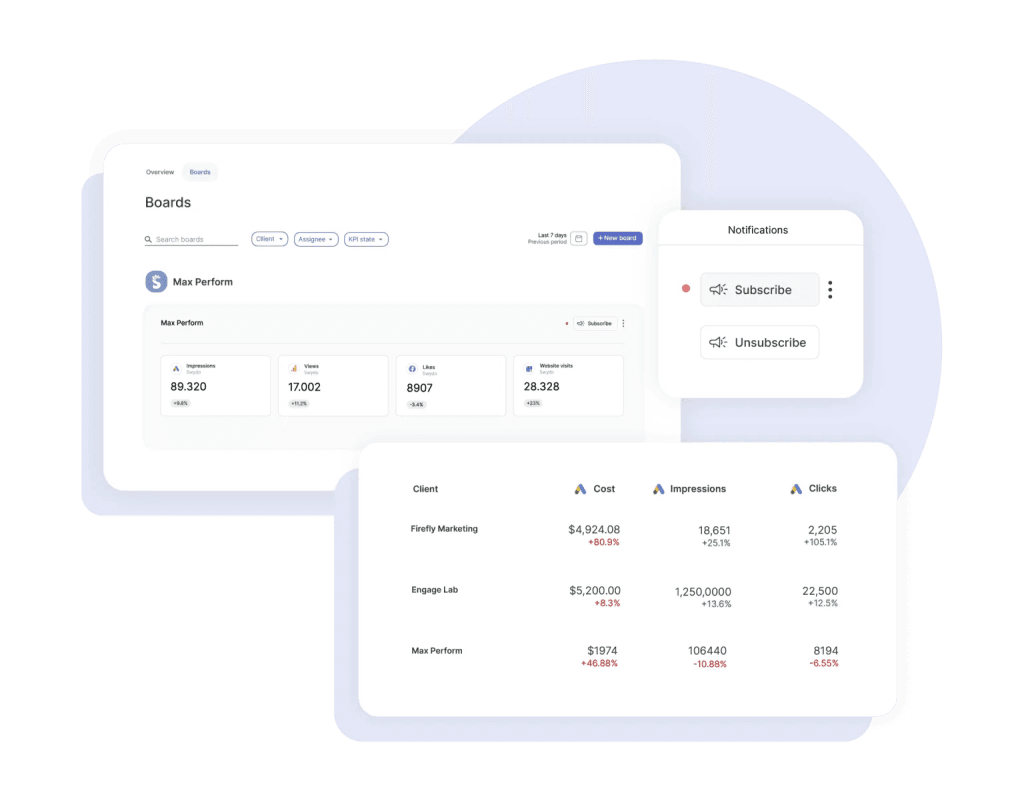
You’ll report these constantly, so how they look matters. Swydo’s KPI scorecards and table widgets show each number with its period-over-period change baked in. The client sees the figure and which way it’s moving, all at once.
Variability (Range, Variance, and Standard Deviation)
Variability is about spread — how far your data stretches. Range is the simplest. Highest value minus lowest. Variance and standard deviation go further and measure how far values sit from the mean on average. Standard deviation is the one you’ll actually use, because it’s in the same units as your data.
Here are the measures, side by side, for a sample.
| Measure | Formula | What it tells you |
|---|---|---|
| Mean (x̄) | x̄ = (Σxᵢ) / n | The average value |
| Median | The middle value when sorted | The typical value when outliers exist |
| Mode | The most frequent value | The most common choice |
| Range | max − min | The full span of values |
| Variance (s²) | s² = Σ(xᵢ − x̄)² / (n − 1) | Average squared distance from the mean |
| Standard deviation (s) | s = √s² | The spread, in your data’s own units |
Quick note on that n − 1. When your data’s a sample (which it almost always is), you divide by n − 1, not n. That tiny tweak stops the estimate from understating the real spread. A full population uses N instead.
So why bother with spread at all? Because consistency sells. A campaign that holds a steady 3% conversion rate every week is far easier to defend than one bouncing between 1% and 5% for the same average. High standard deviation is a warning light. It means risk, or an audience you haven’t cracked yet.
Common Inferential Statistics Tests (and What Each One Answers)
Inferential statistics run on a handful of named tests, each built for a specific question. The ones you’ll meet most in marketing are the t-test, z-test, ANOVA, chi-square test, correlation, and regression — plus the confidence intervals and p-values that tell you how sure to be.
Here’s the quick map of what each one’s for.
- t-test or z-test — is the gap between two groups, like two landing pages, real or just chance?
- ANOVA — same idea, but for three or more groups at once. Four ad variants, five audiences.
- Chi-square test — is there a link between two categories, like device type and whether someone converted?
- Correlation — do two things move together, like ad spend and revenue? And how tightly?
- Regression — can you model one thing from others, like predicting conversions from spend, season, and channel?
Underneath all of it sits sampling. Inferential stats only work if your sample actually reflects the population. Survey only your loyal customers and you’ll learn a lot about loyal customers — and almost nothing about the market you’re chasing.
Hypothesis Testing and P-Values
Hypothesis testing weighs the evidence against a “null hypothesis,” which is usually just the assumption that nothing’s going on. You start by assuming your new headline does nothing. Then you check whether the data is surprising enough to doubt that. It doesn’t prove anything. It tells you how hard the evidence pushes against “no effect.”
The p-value is where people trip. A p-value is the chance of seeing a result at least as extreme as yours if the null hypothesis were true. Small p-value — say, under 0.05 — and your data would be unlikely in a world where the change did nothing. So you’ve got grounds to act.
Here’s what a p-value is not. It’s not the probability your result was a fluke. And it says nothing about how big the effect is. A “statistically significant” win can still be too tiny to care about.
Confidence Intervals
A confidence interval is a range, built from your sample, designed to capture the true value most of the time. This one’s worth getting exactly right, because almost everyone says it wrong.
A 95% confidence interval does not mean there’s a 95% chance the true number lives in this particular range. The 95% is about the method, not this one interval. Run the sampling many times and roughly 95% of the intervals you’d build would contain the truth. The true value doesn’t move. The interval does.
In plain terms? “Conversion rate is 4%, 95% CI 3.2 to 4.8%” is a much stronger thing to tell a client than “conversion rate is 4%.” It shows the uncertainty instead of hiding it.
Correlation and Regression
Correlation measures how tightly two things move together, on a scale from −1 to 1. Regression takes it further and models the relationship, so you can estimate one variable from others. That’s the engine behind ROAS vs. ROI projections and budget models.
Both come with the single biggest warning in statistics. Correlation is not causation. A regression coefficient says ad spend and revenue are linked — not that the spend caused the revenue. Maybe a seasonal promo drove both. To actually claim cause, you need a controlled experiment or proper causal analysis, not a strong r value. Treat regression as an association engine. Only call it causal when your setup earns it.
A Worked Example — Is Your A/B Test Result Real?
Say you test two checkout pages and get this.
| Variant A (control) | Variant B (new) | |
|---|---|---|
| Visitors | 5,000 | 5,000 |
| Conversions | 250 | 300 |
| Conversion rate | 5.0% | 6.0% |
Variant B looks like a 20% lift. Real? Run a two-proportion z-test and you get z ≈ 2.19, p ≈ 0.03. Since 0.03 is under 0.05, the difference is statistically significant. Probably not noise.
But don’t stop at “significant.” The 95% confidence interval on the actual difference runs from about 0.1 to 1.9 percentage points. That’s wide. The lift is likely real, but it could be as small as a tenth of a point.
So “+20%!” oversells what you know. “A real lift, somewhere between roughly 0.1 and 1.9 points” is what you can actually stand behind. That gap — between “significant” and “big enough to matter” — is where a lot of agency credibility gets won or lost.
Parameter vs. Statistic (the Difference That Trips People Up)
A parameter describes a whole population. A statistic describes a sample. You almost never know the parameter, so you use the statistic to estimate it. That estimating is the entire job of inferential stats.
The notation shows up everywhere, so it’s worth a quick memorize.
- Population (parameter): mean μ, standard deviation σ, size N.
- Sample (statistic): mean x̄, standard deviation s, size n.
Survey 500 customers to gauge all 50,000, and that 500-person average is your statistic. The 50,000-person truth is the parameter you’re after. Mix the two up and you’ll report a sample quirk as a market fact. We’ve got a full breakdown on parameters vs. statistics if you want to go deeper.
Can You Use Descriptive and Inferential Statistics Together?
Yes. And you really should. They’re not rival camps — they’re back-to-back steps. Descriptive sums up the situation and flags what’s worth testing. Inferential tests it and tells you what’s likely true for everyone. Then you act, measure, and go again.
That loop has a name. The Describe–Test–Decide loop. It’s the simplest way to keep a reporting program honest.
- Describe. Sum up what happened with descriptive stats. Where are the gaps, the spikes, the weird outliers?
- Test. Form a hunch about why, then use inferential methods to see if it holds past your sample.
- Decide. Act on what passed, measure the result, and loop back to Describe.
The Describe–Test–Decide Loop
The describe step gets way easier when every channel lives in one place. That’s what Swydo’s Combined Data Sources widget is for. It blends up to five ad platforms — Google Ads, Meta, LinkedIn, TikTok, and more — into one view, so you can read total spend, blended ROAS, and cross-channel trends without exporting a thing.
That’s your descriptive baseline across channels. It’s also the groundwork for any honest data blending before you start testing.
One caveat, though. Custom metrics don’t work inside a combined widget. So if you need a custom blended figure — say, a weighted engagement score across your paid social — build it as a Manual KPI right next to the combined widget. Easy workaround, but worth knowing up front.
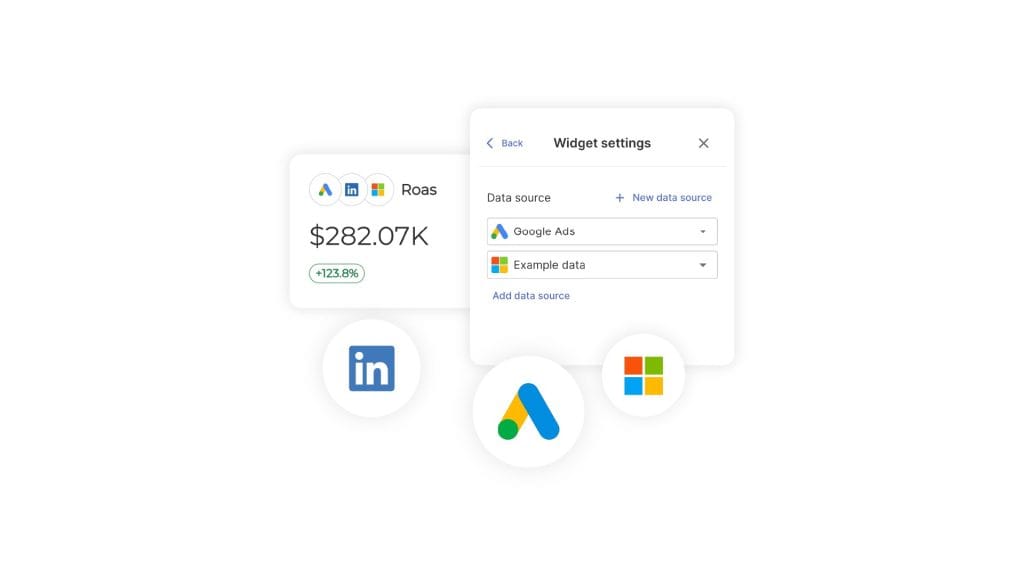
Multi-channel attribution is the classic place this loop earns its keep. Last-click attribution is descriptive only. It hands 100% of the credit to the final touchpoint and ignores everything that warmed the customer up first. A better approach describes the whole journey, forms a hypothesis about how channels assist each other, then uses an inferential method like Markov-chain modeling to estimate fair credit. The payoff is smarter budgets. If you’re rethinking how you split that credit, our guide to marketing attribution models digs in.
When to Use Descriptive vs. Inferential Statistics
Use descriptive when you’re summing up what already happened. Use inferential when you’re making a claim about something you haven’t fully measured. “What was our CPA last month?” is descriptive. “Will this audience convert better than that one?” is inferential. If the question points outward — to future traffic, a wider audience, a decision — you’re inferring.
Is your question about the data you have, or about a group you didn’t fully measure?
- What’s the typical value? Mean, median, mode
- How consistent is performance? Range, standard deviation
- How often does each outcome occur? Frequency distribution
- Are we pacing to target? Goal tracking / monitoring
- Did version B really beat version A? Two-proportion z-test / t-test
- Do 3+ variants differ? ANOVA
- Are two categories related? Chi-square test
- Can we model or forecast an outcome? Correlation, regression
A lot of agency reporting lives entirely in the descriptive half. And honestly, for monitoring, that’s fine. Set a Goal in Swydo to track a metric against a target, and watch it pace On Track or Off Track through the month. That’s descriptive monitoring doing its job — telling you the state of play, no inference needed.
The inferential work only kicks in when you want to claim a change is real, or predict where things are heading, like SEO forecasting for the next quarter. Match the method to the question and you’ll stop running heavyweight tests on things a simple average already answered.
Common Statistics Mistakes That Cost Agencies Clients
Most statistical slip-ups in marketing come down to a few repeat offenders. And they lose trust faster than a missed deadline. They split cleanly into descriptive mistakes and inferential ones.
Descriptive Mistakes — Averages, Distribution, and Correlation
These are sneaky, because the math is right. The interpretation isn’t.
- Outliers hijacking the average. A few huge orders inflate “average customer value” until it describes no real customer. When data’s skewed, report the median — or show both.
- A skipped distribution. Two campaigns with the same mean can behave completely differently. Look at the spread before you sum up.
- Correlation mistaken for cause. Engagement and sales rising together doesn’t mean one caused the other. Both might trace back to a seasonal push.
There’s a chart-craft version of this, too. A truncated y-axis that blows up a tiny difference. A chart type that flatters the data. Picking the honest visual is half the job, and we’ve covered how to choose the right data visualization for the point you’re making.
Let’s make it concrete. An agency reports a “200% jump in engagement” on a client’s Instagram. Sounds great — until you learn engagement went from 0.5% to 1.5%. So, is 1.5% good?
Across industries, Rival IQ’s 2025 social media benchmark report puts the median Instagram engagement rate near 0.36%, with strong brands closer to 1%. So 1.5% is actually solid. But “industry average” swings a lot by vertical, and that’s the real lesson. A percentage change with no benchmark behind it tells your client nothing. Pair every number with the context that makes it mean something — the same way you’d build the marketing KPIs your clients actually care about around outcomes, not vanity metrics.
Inferential Mistakes — Sample Size, Significance, and P-Hacking
These are where overconfidence does the real damage.
- Too small a sample. An A/B test with 50 visitors per variant can’t tell you much. Work out the sample size you need before you start.
- Significance mistaken for size. A significant result can still be trivial. Always report practical significance next to the p-value.
- P-hacking. Run enough tests and something turns up “significant” by luck. Pre-register your hypothesis and the analysis you’ll run.
- Overgeneralization. A finding from one demographic won’t automatically hold for all of them.
The sample-size one has a handy shortcut. A rough rule of thumb is n ≈ 16σ²/d² per variant, where σ² is the variance and d is the smallest effect you want to catch. It assumes 80% power at a 0.05 significance level. Want 90% power instead? Swap the 16 for 21.
And don’t skip the “per variant” part. That’s the count for each version, not the total. Skip it and you’ll quietly under-power your test by half. When the math gets fiddly, the sample-size calculators built into tools like Optimizely or VWO handle it for you.
| Mistake | What it looks like | The fix |
|---|---|---|
| Outlier-skewed averages | Reporting mean order value when a few big orders distort it | Use the median for skewed data; show both with a note |
| Cherry-picking metrics | Highlighting CTR while hiding conversion rate | Balanced scorecards that show related metrics together |
| No benchmark | A 5% conversion rate with nothing to compare it to | Add industry and historical context to every number |
| Under-powered tests | 50 visitors per variant, then a confident call | Size the test before launch; report the confidence interval |
| P-hacking | Running tests until one turns “significant” | Pre-register the hypothesis and the planned analysis |
One simple guardrail covers most of this. Check your sample before you conclude, and report ranges instead of flat numbers. Honesty about uncertainty reads as competence, not weakness — and it’s a big reason clients stick around. It matters most in channels where surface-level numbers dominate, like PPC tracking, where it’s easy to wave a CTR around without ever asking if it’s significant.
How to Present Both in Client Reports
The best client reporting stacks three things on one page. The descriptive numbers. The inferential read on what’s real. And a plain-English “so what.” Most clients don’t want a p-value. They want to know what happened, whether it’ll last, and what you’re doing about it.
A clean structure for any report looks like this.
- Show what happened. The descriptive metrics, with context and benchmarks.
- Say what’s real. The inferential read — which changes are significant, with confidence ranges.
- Recommend the next move. The action, with your confidence level attached.
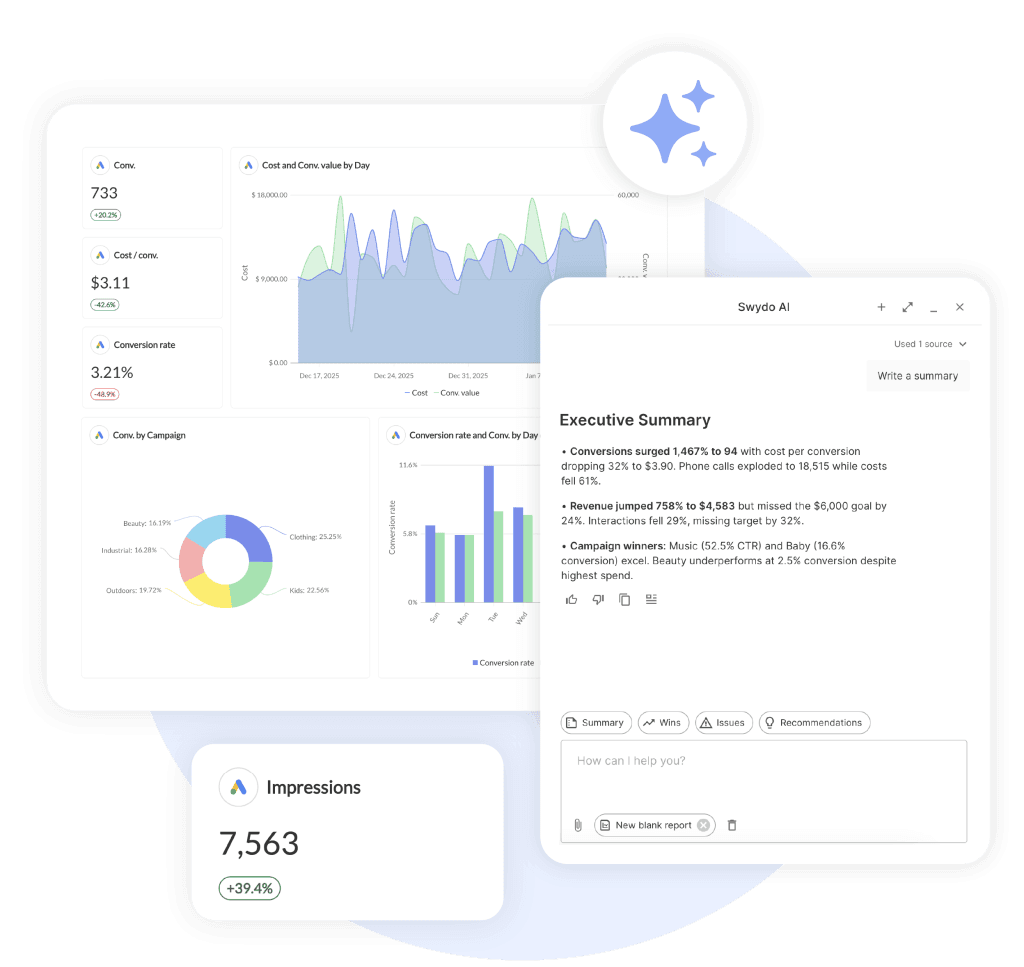
This is where Swydo AI earns its spot. Its Summary, Wins, Issues, and Recommendations prompts turn a wall of metrics into a client-ready story you can drop straight into the report. And for scheduled reports, an AI summary can auto-generate in every send — so the “so what” basically writes its own first draft. It’s the fastest way to put a data storytelling layer on top of the numbers without writing every summary by hand.
One honest limit, though. Swydo isn’t a stats package. It won’t run a t-test or fit a regression for you. You’ll do that in your A/B testing tool, or in R (now maintained by Posit, formerly RStudio) or Python, then bring the results back. What Swydo handles is everything around the math — pulling every channel into one place and turning the daily numbers into a report a client actually understands. The math happens outside the tool. The reporting and the story happen inside it.
You don’t need a 12-month overhaul to get going. Start by standardizing one report template, so every client gets the same context and the right measures. Add a variance indicator next to your headline metrics so spread is visible. Then bring in one inferential habit — sizing your A/B tests properly, or reporting confidence ranges — and let it spread across the team. Templates first, then one discipline at a time. That’s the order that sticks. For the template itself, our breakdown of what to include in a KPI report is a solid place to start.
Next Steps
Start with the descriptive layer. It’s the part you report every week, and the foundation everything else sits on. Standardize a template, make spread and benchmarks visible, then add one inferential habit at a time.
Get the reporting right and the statistical rigor becomes the thing that helps you win more clients, not just hold onto the ones you’ve got.
Descriptive vs. Inferential Statistics FAQ
Straight answers to the questions people ask most about statistics in marketing
Descriptive statistics summarize the data you actually have, while inferential statistics use that data as a sample to draw conclusions about a larger group you didn’t fully measure. In short, descriptive tells you what happened; inferential tells you what’s probably true beyond your data — with a margin of error attached.
Descriptive statistics are numbers that describe a set of data — averages, percentages, ranges, and how often values appear. They sum up what you already collected, like your average order value or last month’s conversion rate, without claiming anything about people outside that data.
Inferential statistics use a small sample to make an educated guess about a much larger group. Instead of measuring everyone, you measure some and estimate what’s true for all of them — always with a stated level of confidence, never as flat certainty.
“Our 5,000 visitors converted at 4% last month” is descriptive — it just reports what happened. “Our new page will likely convert better for all future visitors” is inferential — it uses a sample to predict something you haven’t fully measured. Same campaign, two very different kinds of claim.
A population is the entire group you care about — all your customers, every visitor. A sample is the smaller subset you actually measure. Numbers describing a full population are called parameters; numbers from a sample are called statistics, and you use the statistic to estimate the parameter you can’t measure directly.
| Measure | Population (parameter) | Sample (statistic) |
|---|---|---|
| Mean | μ | x̄ |
| Standard deviation | σ | s |
| Size | N | n |
Because you can almost never measure an entire population — every future visitor or potential customer. Inferential statistics let you test ideas and make predictions from a manageable sample, and tell you how confident to be, so you can decide without waiting for complete data.
The mean is descriptive — on its own it just summarizes the values you have. It only becomes inferential when you use a sample mean to estimate the mean of a larger population. The number is the same; what changes is whether you’re describing your data or generalizing from it.
Standard deviation is a descriptive statistic, because it measures the spread within the data you collected. It crosses into inferential use only when you apply it to estimate a population’s spread or to build a confidence interval.
A t-test is inferential. It uses sample data to decide whether the difference between two groups — say, two landing pages — is real or just chance, which is a claim about more than the data in front of you. The same is true of any hypothesis test, including z-tests, ANOVA, and chi-square.
It can be either. Calculating a correlation coefficient for your dataset is descriptive — it summarizes how two things moved together. Testing whether that relationship holds for a wider population, or reporting its statistical significance, makes it inferential.
Regression is usually inferential, because you fit it on a sample to predict or generalize beyond that data. The fitted line describes your dataset, but using it to forecast or claim a relationship holds in general is an inference — and a regression link is never proof of cause by itself.
Both, depending on the claim. Reporting that “62% of respondents said yes” is descriptive. Using those respondents to say “62% of all our customers think this” is inferential, because you’re generalizing from a sample to the whole population.
The three types are distribution (how often each value appears), central tendency (the typical value — mean, median, and mode), and variability (the spread — range, variance, and standard deviation). Together they show what’s typical and how spread out your data is; skip one and your summary can quietly mislead.
The mean is the average of all values, the median is the middle value when you sort them, and the mode is the value that appears most often. They can differ sharply — when a few large values skew the data, the mean climbs while the median stays put, which is why the median is often the more honest “typical” figure.
Use the median whenever your data is skewed or has outliers. A handful of large orders can inflate an average until it describes no real customer, while the median sits at the middle and ignores how extreme those outliers are. For lopsided figures like revenue or order value, report the median — or show both.
Both measure spread, but standard deviation is the square root of variance. That square root puts it back into your data’s own units — dollars, percentage points — which is why standard deviation is the one you actually report, while variance stays in harder-to-read squared units. A high value of either means inconsistent, volatile results.
The most common are hypothesis tests — t-test and z-test (two groups), ANOVA (three or more), and chi-square (links between categories) — plus correlation and regression for relationships between variables. Confidence intervals and p-values sit alongside them to show how sure you can be.
A p-value is the probability of seeing a result at least as extreme as yours if nothing were really going on. A small p-value — often under 0.05 — means your result would be unlikely by chance, so the effect is probably real. It does not tell you the odds your result is a fluke, and it says nothing about how big the effect is.
It means that if you repeated your sampling many times, about 95% of the intervals you built would contain the true value. It is not a 95% chance that this one interval holds the truth — the 95% describes the method, not the single range. In practice, it’s a way to show the uncertainty around an estimate instead of hiding it.
It means a result is unlikely to be due to random chance, usually marked by a p-value under 0.05. But significant doesn’t mean important — a difference can be statistically real and still far too small to matter for your business. Always check the size of the effect next to its significance.
No. Correlation only means two things move together; it doesn’t mean one causes the other. A third factor — like a seasonal promotion driving both ad spend and revenue — can create a strong correlation with no direct link. Proving cause needs a controlled experiment, not just a high correlation.
Sampling error is the natural gap between what your sample shows and the true value for the whole population, simply because you measured part of the group instead of all of it. A bigger, more representative sample shrinks it, but nothing removes it completely — which is why inferential results always carry a margin of error.
Yes — most solid analysis uses both, in sequence. You describe what happened with descriptive stats, test what’s likely true beyond your data with inferential stats, then decide and measure again. Describing alone reports the past; describing and then testing is what guides a decision.
Descriptive comes first. You summarize and explore your data to spot patterns, gaps, and outliers, then use inferential methods to test whether those patterns hold beyond your sample. Running a test before you’ve described the data usually means testing the wrong thing.
Match the test to your question and data type. Two groups → t-test or z-test. Three or more groups → ANOVA. A link between two categories, like device and conversion → chi-square. A relationship between numbers → correlation or regression. Nail down the question first, and the test usually picks itself.
It depends on how small a difference you want to detect — smaller effects need larger samples. A few dozen visitors per variant is almost never enough; meaningful tests usually need hundreds to thousands per variant. Calculate the number before you launch with a sample-size calculator, instead of stopping the moment results look good.
A point estimate is a single number, like “conversion rate = 4%.” An interval estimate gives a range with a confidence level, like “95% CI: 3.2% to 4.8%.” The interval is more honest because it shows the uncertainty around the guess instead of presenting one tidy number as fact.
Use both descriptive and inferential stats to deliver better results for your clients.
Start Your Free Trial Today