
For most agency clients, a monthly report is the right default. High-spend or fast-moving accounts usually need weekly or biweekly updates, and a quarterly strategic review sits on top for the bigger picture.
That’s the short answer. The longer one matters more, because frequency isn’t actually the lever that keeps clients. Visibility is. The cadence that holds a relationship together is the one that matches how the client makes decisions, backed by enough between-report visibility that they’re never left wondering what’s going on.
This guide gives you the default cadences by client type, the four factors that should shift them, and the reason “weekly or monthly?” is usually the wrong question to be asking in the first place.
The quick version:
- Monthly is the right default for most clients. Weekly or biweekly fits high-spend, fast-moving, or newly launched accounts.
- Layer a quarterly strategic review on top for executives and long-term direction.
- Frequency is not the same as communication. A weekly report nobody reads is worse than a monthly one they act on.
- The real goal is continuous visibility between reports, not more reports, and the daily monitoring workflow that delivers it has to hold up whether you run 5 clients or 50.
- Set the cadence with the client at the start, then adjust it based on how they actually engage.
The Short Answer, by Client Type
Match the default to the account, then adjust. Here’s a starting point that works for most agency portfolios.
| Client situation | Recommended cadence |
|---|---|
| Stable retainer, steady spend | Monthly report |
| High spend or fast-moving (large e-commerce, aggressive PPC) | Weekly or biweekly |
| Brand-new account or fresh campaign launch | Weekly for the first 4 to 6 weeks, then settle |
| Executive or C-level stakeholder | Quarterly strategic review on top of the regular cadence |
| Recovery after a rough patch | Biweekly until performance stabilizes |
| Crisis or major launch in flight | Daily snapshot or live dashboard, temporarily |
Notice that most rows still resolve to monthly or weekly. Daily reporting is rare and almost always temporary. If you’re sending daily reports as a standing habit, that’s usually a sign something else is off, which we’ll get to.
Why Getting the Cadence Right Actually Matters
Reporting cadence feels like an operational detail. It isn’t. It’s one of the main ways a client decides whether you’re worth keeping.
Why Reporting Cadence Matters
What the numbers say about visibility, communication, and keeping clients
#1
Dissatisfaction with delivery is the top reason clients end agency relationships — and delivery includes whether they can see the work.
40%
of clients surveyed said they expected to switch agency partners within six months.
96%
of people say it matters that they can find out the current status of their work at any time.
25–95%
potential profit increase from lifting client retention by just 5%.
Sources: Setup Marketing Relationship Survey (400+ brand and agency respondents) · Project.co business communication survey · Harvard Business Review
The numbers are blunt about this. In the Setup Marketing Relationship Survey of 400-plus brand and agency respondents, dissatisfaction with delivery was the number one reason clients end agency relationships, and 40% of clients said they expected to switch agency partners within six months. Delivery includes whether the client can see and feel the work, which is exactly what your reporting rhythm controls.
Clients also tell you plainly that they want to know where things stand. In a 2026 survey of business communication, 96% of people said it matters that they can find out the current status of their work, and 66% said they’d left a company for a competitor over poor communication. A reporting cadence is how you answer “where do things stand” before the client has to ask.
And the math rewards getting it right. Keeping a client is far cheaper than replacing one, since a 5% lift in retention can raise profits by 25% to 95%. The right cadence is a retention tool, not an admin chore.
The Real Question Isn’t Frequency. It’s Visibility.
Here’s the reframe that changes how you set cadence. Most agencies asking “should I report weekly or monthly?” are trying to fix a visibility problem with frequency. They feel the client slipping out of the loop, so they reach for more reports.
More reports rarely fix it. They often make it worse.
A report is a snapshot on a schedule. If the client only feels informed on the day a report lands, then no matter how often you send one, there are always gaps in between where they’re in the dark. Cranking the frequency from monthly to weekly just shortens the gaps. It doesn’t close them, and it quadruples your reporting workload to do it.
The agencies that feel “always on top of things” to their clients didn’t get there by reporting more often. They got there by making performance continuously visible, so the report becomes a periodic summary of a story the client has already been following, not the only time they hear from you.
That’s the difference between monitoring and reporting. A report is the monthly photograph. Monitoring is the client watching the needle move in close to real time. Once monitoring covers the gaps, the question “how often should I report?” gets a lot easier, because the report no longer has to carry all the visibility on its own.
What Continuous Visibility Looks Like at Scale
Continuous visibility sounds good in theory. The question every agency actually has is how to maintain it across a whole client roster without it eating the morning. This is where your tooling either does the work for you or quietly works against you.
Picture the daily reality. Before you send a single report, and ideally at the start of every day, someone has to make sure each client’s numbers are current and nothing is broken. A connection dropped overnight. A conversion metric is suddenly pulling zero. Spend spiked on one account while you were asleep. Miss any of it and you either send a client a report built on bad data or get caught flat-footed by a problem the client spots first.
Now picture doing that across a pile of separate dashboards. You open the first client’s Looker Studio, scan the numbers, notice something looks off, then dig to work out whether a connector broke or the campaign genuinely changed. Then the second client. Then the third. At five clients it’s a slow but manageable morning ritual. At twenty or fifty, it’s an hour or more of manual checking before the real work even starts, and it’s exactly the task that gets skipped when you’re busy, which is precisely when a broken connection ships a wrong report.
This is the workflow that quietly drives agencies off general-purpose dashboards, and it’s the workflow Swydo is built around. Instead of hunting through separate dashboards, you start the day from one place:
- Metrics Overview shows the key numbers across every client in a single view, so you scan the whole roster at a glance instead of opening dashboards one by one.
- Goals already show which clients are on track, off track, or ahead, so your eye goes straight to the accounts that need attention.
- Alerts have already run overnight and flagged anything that spiked or dropped, so problems come to you instead of you hunting for them.
- Data Source Health has already told you which connections are broken before you send anything, so you never email a report built on a dead feed.ntinuous visibility actually workable at scale. You’re not manually rebuilding the state of every account every morning. You start the day already knowing where to look.
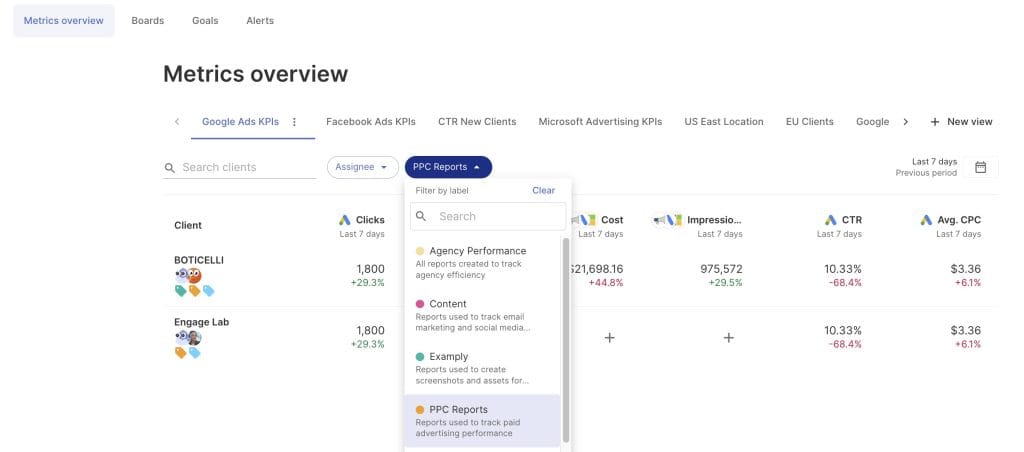
The difference isn’t a nicer interface. It’s that the daily “is everything okay?” check goes from an hour of opening dashboards to a two-minute glance, and it stays a two-minute glance whether you run five clients or fifty. That is what makes a sensible cadence plus continuous visibility actually workable at scale. You’re not manually rebuilding the state of every account every morning. You start the day already knowing where to look.
How to Choose the Right Cadence
When you do set the report frequency, four factors should move it up or down. The guiding principle, as one healthcare marketing agency puts it, is that reporting frequency should reflect how decisions actually get made, not how much data happens to be available.
Spend. The more money moving through an account each month, the more often the client wants eyes on it. A five-figure monthly ad budget justifies weekly checkpoints in a way a small local retainer doesn’t.
Campaign stage. Launches, migrations, and big tests need a tighter rhythm while things are in motion. A mature, stable campaign humming along on autopilot needs far less.
Stakeholder. A hands-on marketing manager who lives in the detail wants more frequent, granular updates. A CMO or owner wants a less frequent, higher-altitude view tied to business outcomes. Often the same account needs both, at different cadences.
Channel velocity. Paid channels change daily and reward a faster rhythm. SEO and content move over months, so weekly reporting on them mostly shows noise. Match the cadence to how fast the underlying numbers actually move.
Run the account through those four, and the right cadence usually picks itself.
Find the Right Reporting Cadence
Answer four quick questions about the account to get a recommended starting point
1Monthly spend on this account?
2What stage is the campaign in?
3What’s the main channel mix?
4Who mainly reads the report?
Answer all four questions to see the recommended cadence ↑
When to Report More Often, and When to Stop
More frequent isn’t automatically better, so it helps to know which direction to push.
Report more often when spend is high, a campaign just launched, results are volatile, you’re rebuilding trust after a rough stretch, or a senior stakeholder has gone quiet and needs reassurance. In those moments, a tighter rhythm signals control.
Report less often when the account is stable, the spend is modest, and the client is busy. Clients are not sitting around waiting for your report. Most are juggling your work on top of a full plate, and over-reporting adds to their load rather than easing it. When a client stops opening reports, stops asking questions, or says “just send me the summary,” that’s the signal to ease off, not to push harder.
If you want to know what to keep in each report regardless of how often you send it, the fundamentals of what to put in a marketing report hold at any cadence: lead with outcomes, keep the metric count tight, and say what the numbers mean.
Don’t Confuse the Report With the Update
The cleanest way to solve cadence is to stop treating it as one rhythm and start treating it as three layers.
The scheduled report. Your regular cadence, usually monthly, sometimes weekly. This is the formal summary with narrative and recommendations. In Swydo you set the schedule once and reports send automatically on the frequency you choose, so a weekly client and a monthly client take the same effort to maintain.
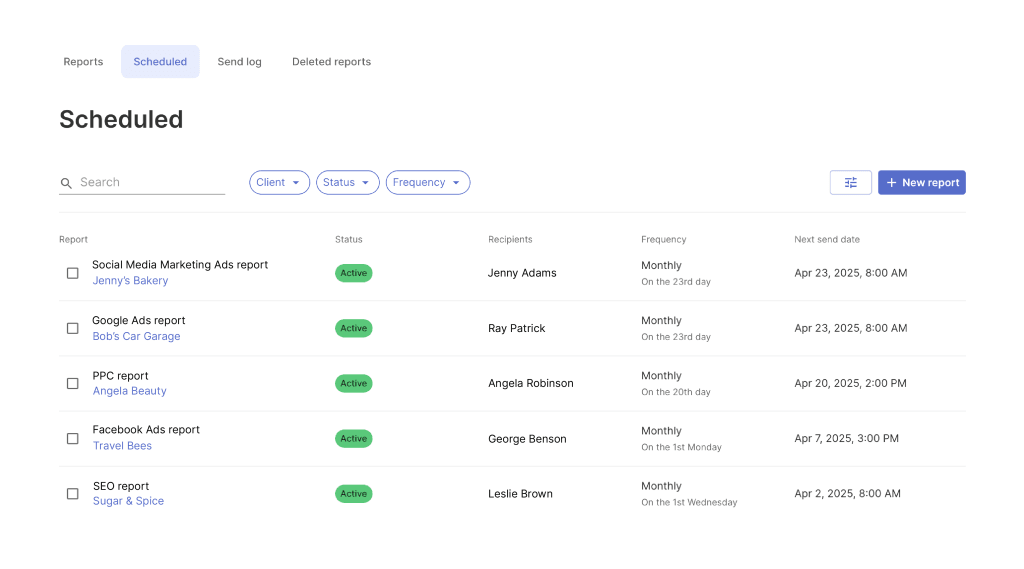
The proactive update. This is what fills the gaps between reports, and it’s the monitoring layer from earlier doing its job. The alerts you set reach you the moment something crosses a threshold, so you tell the client before they notice. One limit worth naming: a scheduled report runs on a fixed calendar, so it won’t auto-generate the instant a metric spikes. That real-time layer is what monitoring covers, and you send an ad-hoc report if the moment calls for one.
The strategic review. A quarterly, higher-altitude conversation about direction, tied to the goals you set with the client so they can track progress toward targets between reviews.
Layer those three and the frequency question mostly dissolves. The client gets real-time awareness from monitoring, a clean periodic summary from the scheduled report, and the big picture from the quarterly review. No single layer has to do everything, and you’re not buried producing reports.
One practical note on cost, since it shapes this decision for a lot of agencies: with Swydo, reporting frequency doesn’t change your bill. Sending a client weekly costs the same as monthly, so you can match the cadence to the client’s needs instead of your pricing tier.
One Quarter of Client Visibility
The three layers that keep a client in the loop — without you drowning in reports
Month 1
Month 2
Month 3
Monitoring & alerts
Always onScheduled report
MonthlyStrategic review
QuarterlyHow to read this: monitoring covers every single day and pushes alerts the moment something spikes, drops, or breaks. The scheduled report summarizes each month with narrative and recommendations. The quarterly review handles direction and goals. Because no single layer has to do everything, the client stays informed without the report count exploding.
Set the Cadence With the Client, Not for Them
The cadence works best when it’s agreed, not assumed. Decide it during onboarding, write it down, and frame it as a shared expectation: here’s what you’ll get, how often, and where to find it in between.
That up-front agreement does quiet work later. A client who knows the monthly report lands on the first Tuesday, and that you’ll flag anything urgent the moment it happens, doesn’t chase you for updates or read silence as neglect. You’ve replaced guesswork with a rhythm.
Then watch how they actually engage and adjust. Falling open rates or no questions for a couple of cycles means you can probably ease off. A client reaching out between reports asking “what’s happening with X?” means they need more visibility, which is usually a cue to turn on monitoring rather than just to report more. Reading those signals early is how you catch the first signs a client is drifting before it becomes a churn conversation. The same instinct applies when the numbers look bad: report early and often through a rough patch, never less.
Client Reporting Frequency FAQ
Direct answers to the questions agencies ask about how often to report to clients
Send most clients a monthly report. Move to weekly or biweekly for high-spend, fast-moving, or newly launched accounts, and add a quarterly strategic review for executives. The right cadence matches how often the client makes decisions about the work, not how much data you have.
| Client situation | Recommended cadence |
|---|---|
| Stable retainer, steady spend | Monthly |
| High spend or fast-moving account | Weekly or biweekly |
| New account or fresh campaign launch | Weekly for the first 4 to 6 weeks, then settle |
| Executive or C-level stakeholder | Quarterly review on top of the regular cadence |
| Recovery after a rough patch | Biweekly until performance stabilizes |
| Crisis or major launch in flight | Daily snapshot or live dashboard, temporarily |
Monthly is better for stable accounts, and weekly is better for active campaigns, big budgets, and launches. Neither wins universally. The deciding factor is how fast the numbers move and how often the client acts on them — if weekly data would only show noise, report monthly.
Yes. Over-reporting buries clients in updates they don’t have time to read and trains them to ignore your reports. A weekly report nobody opens is worse than a monthly one they act on.
When a client stops opening reports, stops asking questions, or says “just send me the summary,” reduce the frequency and use real-time alerts for anything urgent instead.
Four factors: spend, campaign stage, stakeholder, and channel velocity. High spend and active launches push the cadence up. Stable campaigns, executive audiences, and slow-moving channels like SEO push it down. Run any account through those four and the right cadence usually picks itself.
The guiding principle: reporting frequency should reflect how decisions actually get made, not how much data happens to be available.
Rarely, and only temporarily — during a crisis, a major launch, or a volatile stretch where decisions are being made day by day. Once things stabilize, step back to weekly or monthly.
If daily reporting has become a standing habit, you have a visibility problem, not a frequency problem. Real-time monitoring and alerts keep the client informed without you producing a report every morning.
Monthly. SEO and content move over months, so weekly SEO numbers mostly show normal fluctuation rather than real progress. A monthly report captures genuine movement in rankings, traffic, and conversions — anything more frequent invites questions about noise.
Weekly or biweekly for active accounts. Paid channels change daily — budgets, bids, and performance can shift meaningfully within a week, so clients spending real money on ads want regular eyes on the numbers.
Pair the report with automated alerts on spend and conversions so a sudden spike or drop surfaces the moment it happens, not at the next scheduled report.
Generally yes. More spend means more at stake and more reason for the client to want regular eyes on the account. A five-figure monthly ad budget justifies weekly checkpoints in a way a small local retainer doesn’t.
Often, yes. A hands-on marketing manager wants a frequent, granular view. A CMO or owner wants a less frequent, higher-altitude summary tied to business outcomes. Sending one report to both usually underserves one of them.
Matching format and cadence to each stakeholder is one of the clearest ways to make a client feel understood.
Quarterly. The strategic review sits on top of the regular reporting cadence and covers direction, goals, and the bigger picture rather than month-to-month numbers. It’s also where expansion opportunities surface, so treat it as a business conversation, not a longer report.
Tie the review to the goals you set with the client so they can track progress toward targets between sessions.
A report is a snapshot on a schedule — the monthly photograph. Monitoring is watching the numbers move in close to real time. Reports summarize and interpret; monitoring catches spikes, drops, and broken data the moment they happen.
Agencies that feel “always on top of things” to clients get there through monitoring, not more reports. Once monitoring covers the gaps, the report becomes a periodic summary of a story the client has already been following.
No — a live dashboard complements scheduled reports, it doesn’t replace them. Dashboard access answers “where do things stand right now” between reports, which can let you dial the formal report back to monthly. But most clients still want the report that interprets the numbers and says what you did and what comes next. A raw dashboard rarely tells that story on its own.
Three layers: automated alerts that flag anything that spikes or drops so you tell the client before they notice, self-serve dashboard access for the “where do things stand” question, and a quick proactive message when something urgent happens. The formal report then summarizes; it doesn’t carry all the visibility alone.
One limit worth knowing: a scheduled report runs on a fixed calendar, so it won’t auto-generate the instant a metric spikes. That real-time layer is what monitoring covers — and you send an ad-hoc report if the moment calls for one.
Check data source health before anything goes out. Connections break overnight, conversion metrics suddenly pull zero, and spend can spike while you sleep — send a report built on a dead feed and the client loses trust in every number you’ve ever shown them.
Do this daily, not just on report day. Automated connection checks and alerts turn it from an hour of opening dashboards one client at a time into a two-minute glance across the whole roster — and it’s exactly the task that gets skipped manually when you’re busy, which is when a broken connection ships a wrong report.
Yes — reporting is one of the main ways a client decides whether you’re worth keeping. In a survey of 400-plus brand and agency respondents, dissatisfaction with delivery was the number one reason clients ended agency relationships, and delivery includes whether the client can see and feel the work.
The math rewards getting it right: a 5% lift in retention can raise profits by 25% to 95%, which makes cadence a retention tool, not an admin chore. Nearly all clients say it matters that they can find out the current status of their work — a reporting rhythm answers “where do things stand” before they have to ask.
More — never less. Report early and often through a rough patch, because silence during a dip reads as hiding. A biweekly rhythm while you rebuild performance signals control and keeps the client’s trust while the numbers recover.
Going quiet when things look bad is how a performance problem turns into a churn conversation.
Watch how they engage. Falling open rates or no questions for a couple of cycles means you can ease off. A client reaching out between reports asking “what’s happening with X?” needs more visibility — which is usually a cue to turn on monitoring or share a dashboard, not just to report more often.
Reading those signals early is also how you catch a client who’s drifting before it becomes a cancellation call.
Agree the cadence during onboarding and write it down: what they’ll receive, how often, and how you’ll flag urgent issues in between. A client who knows the report lands on the first Tuesday, and that you’ll flag anything urgent immediately, doesn’t chase you for updates or read silence as neglect.
Start a little more frequent in the first month or two while you learn their rhythm, then settle into a steady cadence based on how they actually engage.
Three things at any cadence: lead with outcomes the client cares about, keep the metric count tight, and say what the numbers mean. A report that interprets — what happened, why, and what you’ll do next — beats a longer one that just displays data.
Next Steps
Pick one client and sort their visibility into three layers. Set the scheduled report to a cadence that matches their spend and channel mix. Turn on alerts for the two or three metrics where a sudden change would matter. Then put a quarterly review on the calendar for the strategic picture.
Once that’s in place for one account, you’ll notice the cadence question stops feeling urgent. The client is always in the loop, the report does its job without carrying all the weight, and you’re not drowning in reporting work to keep everyone informed.
That’s the real answer to how often you should report: often enough to keep the client genuinely in the loop, and no more often than that.
Give clients real visibility between reports, not just on the day one lands.
Start Your Free Trial Today