
Whatagraph’s cheapest plan used to cost $229 a month. It now costs $812, and it’s the only standard plan they sell.
The choice between Swydo and Whatagraph comes down to two questions. What you’ll pay per client report, and what the tool does after it builds one.
Whatagraph makes great-looking reports. It’s also now one of the most expensive tools in the category, with no cheap way in. The entry point is Max, from $812/month billed annually, with a custom-quoted Prime tier above it for anything enterprise. Swydo runs the same core workflow at $69/month with everything on one plan, then adds daily monitoring on top.
This is a decision guide, not a sales pitch. I work at Swydo, so you know where the bias sits. I’ll still tell you exactly when Whatagraph is the better buy, and when neither is.
Here’s the order. Pricing math at your agency size, then the four features that separate the two tools, then a five-question test that takes about twenty minutes.
The Short Version, by Agency Type
Find the row that sounds like you.
| If you’re… | Pick |
|---|---|
| Solo or 1 to 5 simple clients | Swydo. 10 sources included. Real trial. Whatagraph’s $812/month entry point isn’t close. |
| 5 to 20 clients, standard channels | Swydo, by a wide margin. $69 plus a few dollars per source against an $812 flat starting price. |
| 20+ clients, heavy blending | Swydo on price. You’ll run out of Whatagraph credits, and past that you’re buying extra credits or moving to a custom quote. |
| Reporting on HubSpot | Swydo. It’s on the $69 base plan. Whatagraph gates HubSpot to Prime. |
| Reporting on Shopify or WooCommerce | Whatagraph, at Prime pricing. Swydo doesn’t connect to store platforms at all. |
| Pitching AI chatbots inside client reports | Whatagraph’s IQ+ does it, but only on Prime, its custom-quoted top tier. |
| Need a real warehouse pipeline | Neither. Supermetrics or Funnel are purpose-built for it. |
| Want alerts when campaigns break | Swydo. Monitoring is built in. |
The math behind those picks is below.
| Swydo | Whatagraph | |
|---|---|---|
| Starting price | $69/mo | $812/mo, billed annually (Max), one standard plan |
| What’s in the entry plan | All features. 10 data sources. Unlimited clients & users. AI, white-label, custom domain, goals, alerts, Slack. | 50+ source credits, blending, custom metrics, white-label, goals & alerts, Google-login SSO. Custom domain, BigQuery, Looker Studio, SAML, API, and IQ+ all require Prime (custom quote). |
| Free trial | 14 days, full access, no credit card | 14-day trial of Max. No permanent free plan. |
| Monitoring & alerts | Built in. Daily checks, goals, email + Slack alerts | Included on Max, but Max itself is $812/mo |
| Data source health | Daily connection checks; red-dot alert + email the moment a token expires | Sync status visible in-app |
| AI | 4,000 credits/mo on every plan. Report building, summaries, client-facing dashboard chat | IQ report creation, summaries, and team chat on Max. Client-facing IQ+ chat on Prime |
| Client access | Client Portal. One secure link per client covering Reports, Boards, and Goals, with an optional password | Shared report links. Client-facing chat requires Prime |
| Cancellation | Self-serve, anytime | Annual billing, 30 days’ notice, non-refundable |
| Migration help | Free, human-assisted | Manual rebuild |
How the Two Tools Are Built Differently
Swydo is a reporting tool with monitoring on top. Whatagraph is a reporting tool built around visual polish and credit-based pricing, pricing that just moved sharply upmarket.
Both build branded, automated client reports well. The split is what each one adds around the report, and what it charges to get there.
Whatagraph calls itself a marketing intelligence platform. In practice, agencies use it for one thing. Turning marketing data into client-ready reports that look sharp. Reviewers back that up, though most of those reviews were written under the old, cheaper pricing.
Swydo does the same reporting job, then keeps watching. Build the report. Schedule it. White-label it. Then set goals, get daily alerts when something breaks, and see every client’s KPIs on one screen.
Both make a good-looking report, so price and mid-month behavior are what you’re really choosing between. What happens at your agency on a Tuesday morning when a client’s ROAS tanks?
What You’ll Actually Pay
Your cost depends on your client count and how many sources each client runs, not on the sticker price.
A data source is one connected account. A client on Google Ads, Meta, and GA4 is three sources.
Swydo’s pricing:
- $69/month, or $62 billed annually
- 10 data sources included
- Unlimited clients and users
- $4.50 per source from 11 to 100, then $3.00, then $2.00
- Reporting frequency doesn’t change the price
- Every feature on one plan
Whatagraph’s pricing:
| Plan | Price (annual) | Source credits |
|---|---|---|
| Max | $812/mo | From 50 |
| Prime | Custom | Custom |
Whatagraph cut its three plans down to two. The free plan, the $229 Start plan, and the $463 Boost plan are all gone. Max is now the only standard plan, and it opens at $812/month, more than Boost cost outright, for roughly the same feature set Boost used to unlock.
One thing worth knowing before you sign. One credit equals one connected data account. You can buy extra credits on Max, but only until you reach the next plan threshold, and past that point you’re into a Prime conversation rather than a published next tier. Moving between plans runs through a call with their team either way.
The feature-gating gap is the real story. Here’s what unlocks where.
| Feature | Starts at |
|---|---|
| Basic reporting, advanced integrations | Max |
| White-label and custom branding | Max |
| Data blending, custom transformations | Max |
| Goals and alerts | Max |
| Linked report templates | Max |
| Google-login SSO | Max |
| Premium integrations (22 of them) | Prime |
| Custom report domain | Prime (add-on) |
| BigQuery transfer | Prime (add-on) |
| Looker Studio transfer | Prime |
| SAML SSO | Prime (add-on) |
| Public API | Prime (add-on) |
| IQ+ (client-facing AI chat) | Prime |
| Tailored onboarding, priority support, SLA | Prime |
$812 buys you reporting and blending. Everything past that sits behind Prime, a custom quote with no published number.
Two of those are worth checking against Swydo directly. HubSpot and AdRoll are both on Swydo’s $69 base plan. The ecommerce platforms run the other way. Swydo dropped Shopify support in 2025 and doesn’t connect to WooCommerce, BigCommerce, or Magento at all, so if store data belongs in your reports, Whatagraph at Prime pricing is a real answer and Swydo isn’t. Same for Salesforce, Adobe Analytics, and the DSPs.
What you’ll pay at your agency size
Monthly billing, assuming three data sources per client (GA4 + Google Ads + Meta).
| Agency size | Swydo | Whatagraph |
|---|---|---|
| 5 clients | $92/mo | $812/mo (Max) |
| 15 clients | $227/mo | $812/mo (Max, still inside the 50-credit range) |
| 30 clients | $429/mo | $812/mo plus credits (90 sources exceeds Max) |
| 50 clients | $624/mo | Custom (Prime) |
Whatagraph cut its three plans down to one $812/mo standard plan. One credit equals one connected account, and extra credits only stretch you to the next threshold before an upgrade conversation starts.
At 5 clients, Whatagraph now costs roughly 8 to 9 times what Swydo does for the same reporting job. That gap didn’t exist under the old $229 Start plan. It’s new, and it’s the direct result of the repricing.
The Flat-Fee Trap. Whatagraph used to scale you up gradually. $229, then $463, then a custom quote. Now there’s one number, $812, until you outgrow it, at which point you fall straight into “call us.” There’s no middle rung anymore. An agency that would have comfortably fit on the old Start plan now has to justify an $812 bill from day one, or walk.
Want to plug in your own numbers? The Swydo pricing page has a live calculator, and our breakdown of selecting a report automation tool walks through the math in more depth.
The Features That Actually Decide It
Four things separate these tools in practice. Monitoring, how the report gets built, how it reaches the client, and warehouse capability. Everything else, scheduling, white-label, custom domains, both do well once you’re on the right plan.
Does It Watch Your Campaigns, or Just Report on Them?
Swydo’s clearest edge. Most reporting tools hand you a report and stop. Swydo keeps watching.
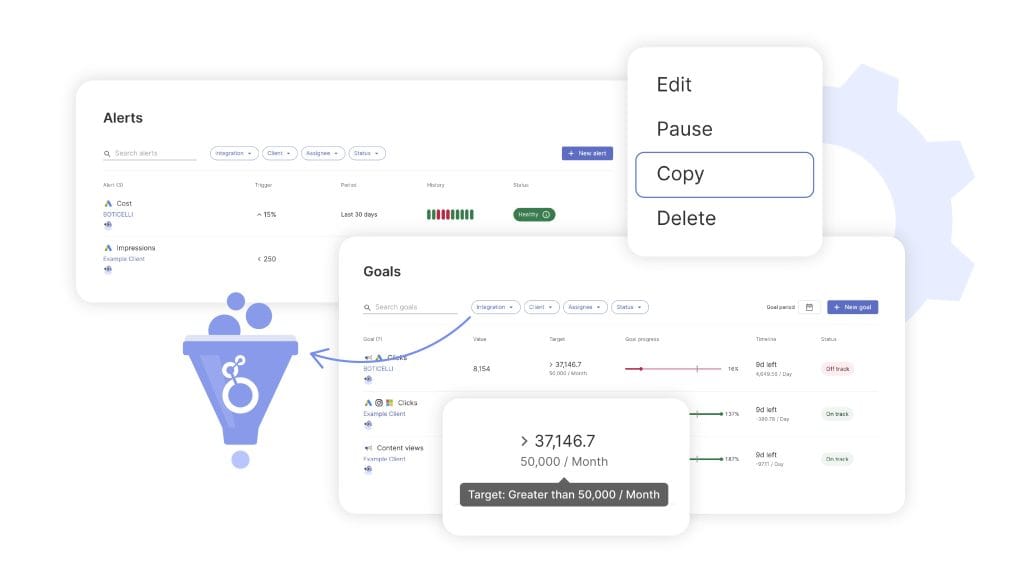
Open Monitoring → Alerts → +New Alert. Pick the client. Pick the metric. Set the trigger window: 1, 7, 30, or 90 days. Done.
Now you’ll know a client’s cost-per-lead doubled before they email you about it.
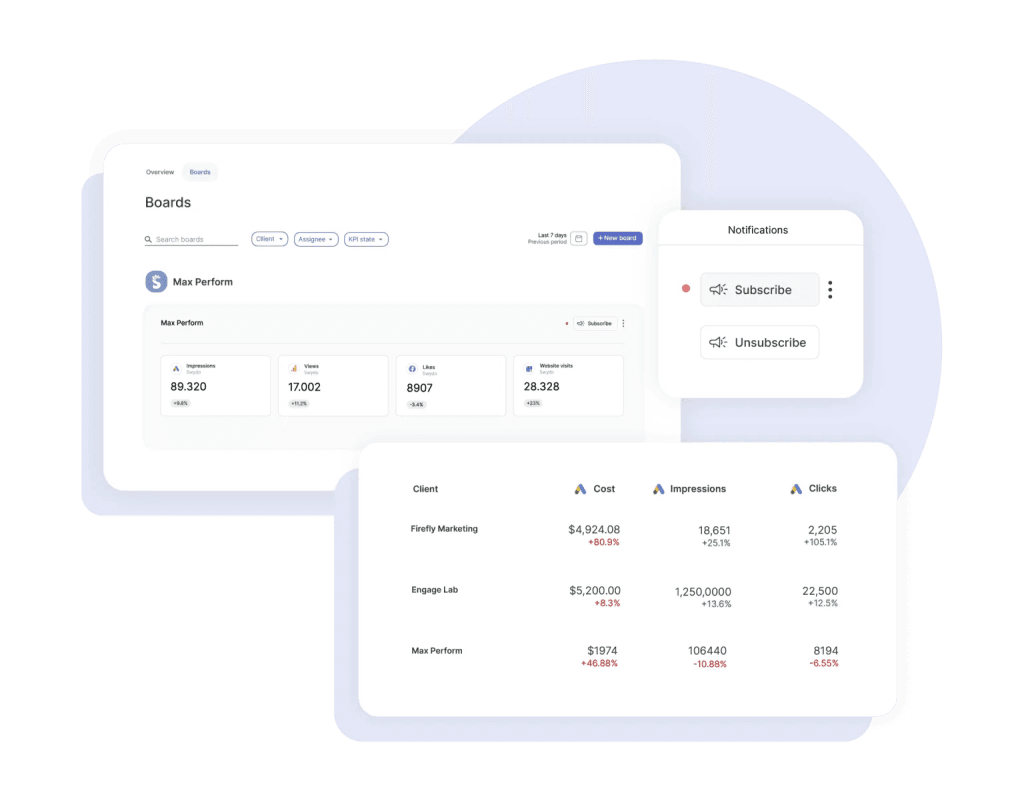
Pair Alerts with Goals and you get pacing too. On Track, Off Track, or Achieved, with a notification at the end of each period. Slack-first team? Alerts post to your channel alongside the email.
Data Source Health Check Alerts are the second layer, and for most agencies they fire more often than campaign alerts. Swydo monitors every connection daily. The moment a Google Ads token expires, a Meta auth breaks, or a GA4 property goes quiet, you get a red-dot alert in-app and an email, usually before the next report is due to send. The client never sees the blank widget. You fix it first.
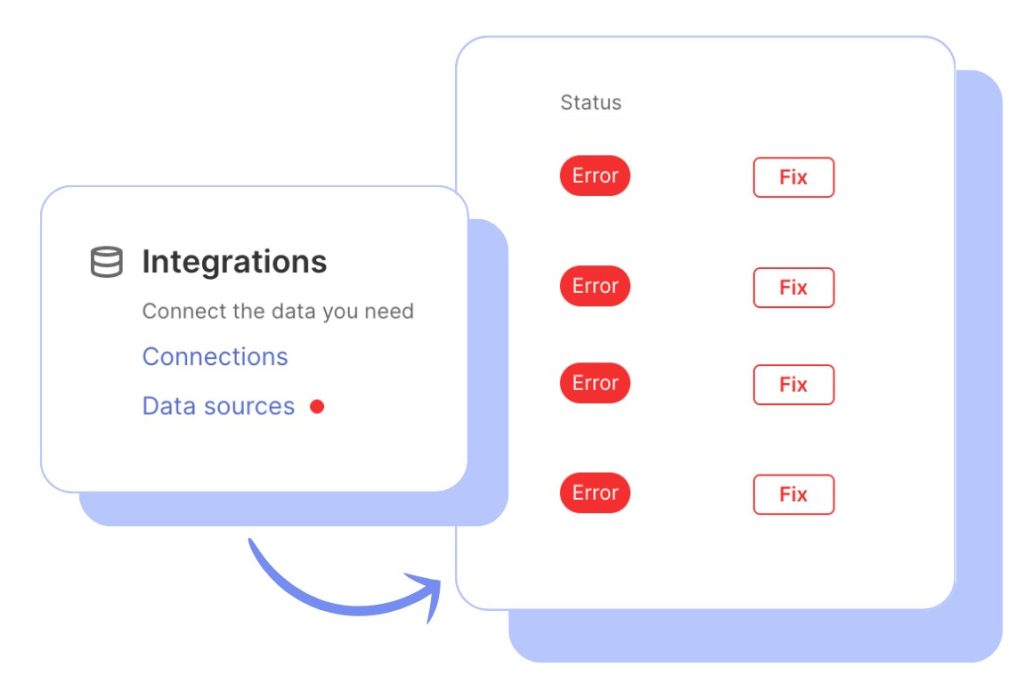
Campaign alerts catch a metric going sideways. Health-check alerts catch the broken connection that would have made the whole report wrong, which is the failure most alerting features don’t cover.
Whatagraph’s goals and alerts now ship on Max, the same tier that costs $812 a month. For agencies whose retention depends on catching problems mid-month, that’s still a real feature. It just comes at a very different price than it used to.
Report-and-done vs. report-and-watch
Step 1
Connect dataStep 2
Build reportStep 3
Schedule & sendSwydo adds
Watch & alert dailyBoth tools do steps 1 to 3 well. The fourth step is the difference. Swydo’s monitoring layer runs daily checks and alerts you by email or Slack the moment a metric crosses a line you set, so you catch problems while you can still fix them. Whatagraph bundles the same idea into its one standard plan, at its one standard price of $812/month.
Where the AI Shows Up
Both tools build reports from a prompt, write the commentary, and answer questions about the data. Capability is close to even now. What separates them is price, and which of those jobs your client is allowed to touch.
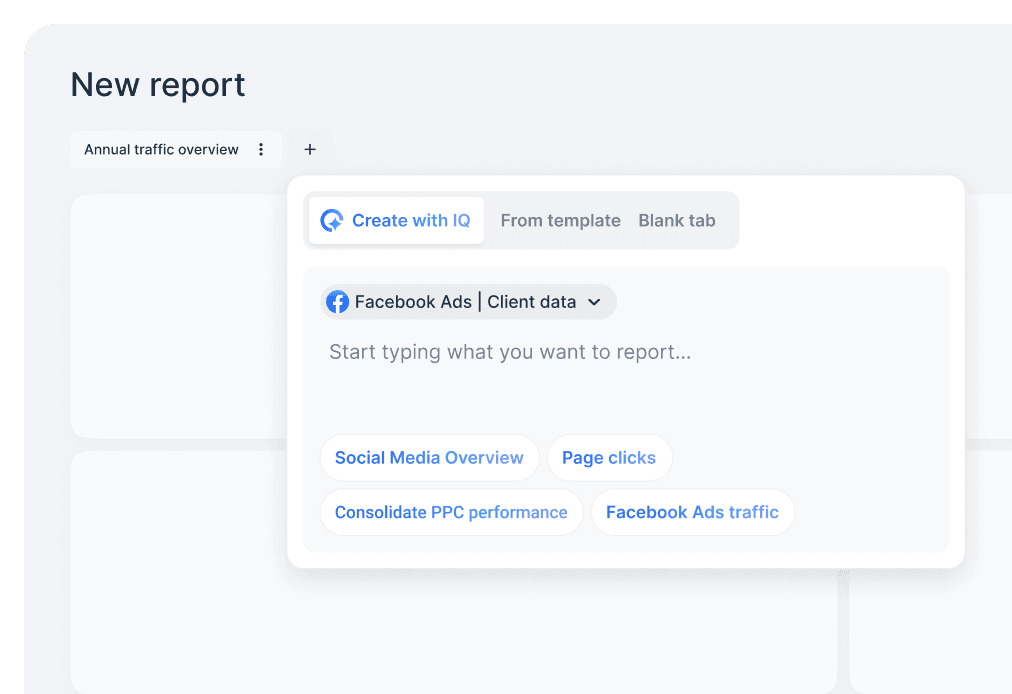
Start with building. Whatagraph’s IQ report creation turns a prompt into a finished report, and it ships on both plans. Swydo’s Agentic Reporting does the same job from inside the report you’re already in.
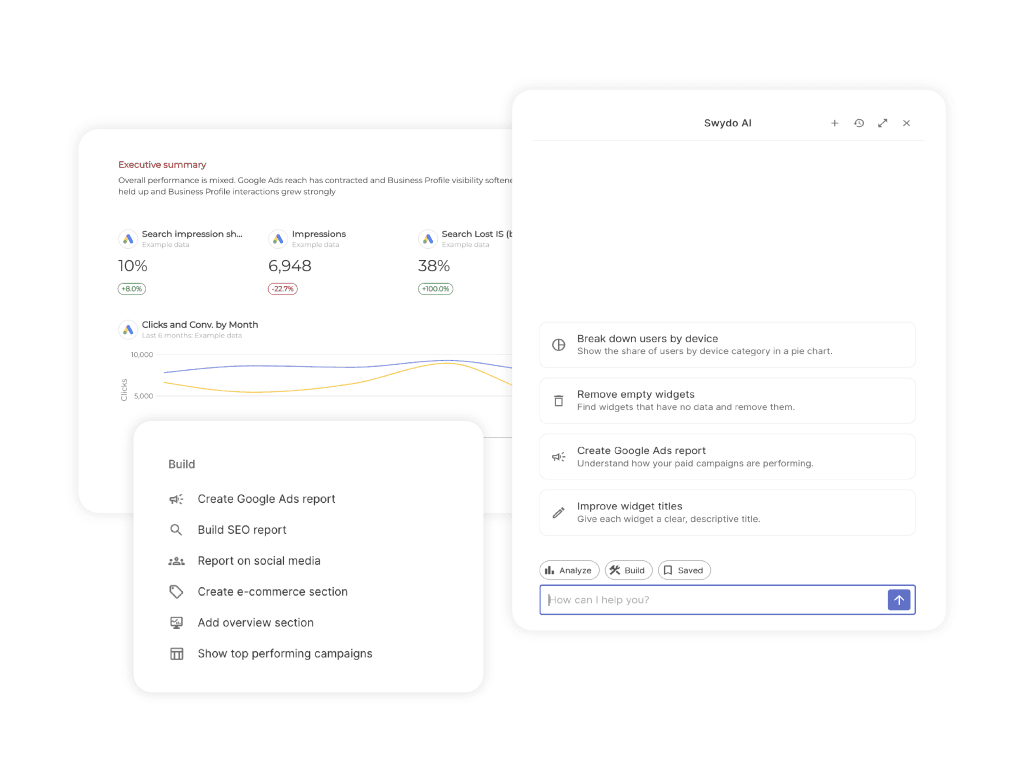
Describe what you need and it builds the sections and widgets, then edits them on request. Change a date range or swap a chart type by describing the change. Save the prompts that work and hand them to a new hire so their first client report comes out looking like everyone else’s.
Then the writing. Swydo AI drafts summaries, wins, issues, and recommendations in whatever language you ask it in, and drops a fresh summary into every scheduled report email automatically.
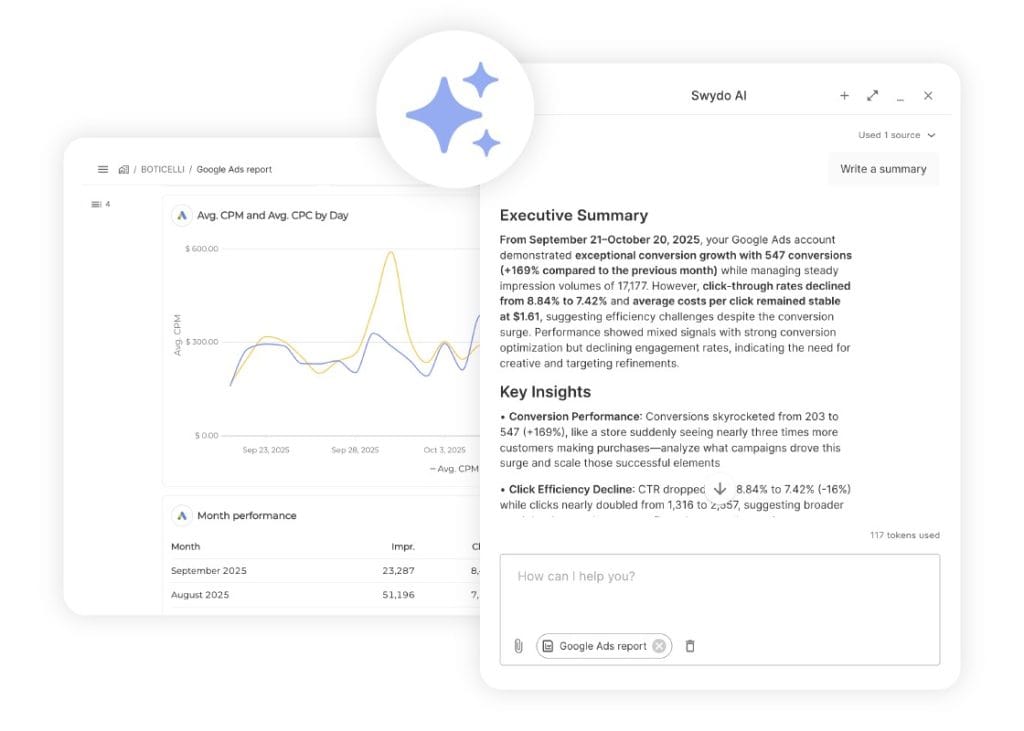
Add the summary block once and every future send carries current commentary in the body before the client opens anything. Whatagraph’s IQ summary handles the explaining half well too.
Then the asking. This is where the plans actually split. IQ chat sits on both Whatagraph plans, so your team can query the data. IQ+, the version your clients can use inside a shared report, is Prime only. Not included on the $812/month Max plan. Swydo runs client-facing chat inside dashboards, switched on per team in Settings.
One honest limit. Swydo’s 4,000 monthly AI credits are a shared pool, and every use draws from it, including report building and any chat you open up to clients. A summary runs about 95 credits, so the allowance is comfortable for writing and tighter once you’re building. Set a spending limit if you’d rather cap it than watch it.
Both tools have AI, so the real question is whether client-facing chat is part of what you’re selling, and whether it’s worth a custom quote on top of an already premium plan.
How the Report Reaches the Client
Most clients want to look at their numbers between sends, and every time they can’t, you get an email asking you to pull one.
Swydo’s Client Portal answers that. Open the client’s account, go to the Portal tab, and pick what they see. Reports for the detail, Boards for a quick KPI view, Goals so they can watch progress against their own targets. All of it lands behind one link instead of three. Preview it before you send, so you know exactly what’s on the other side.
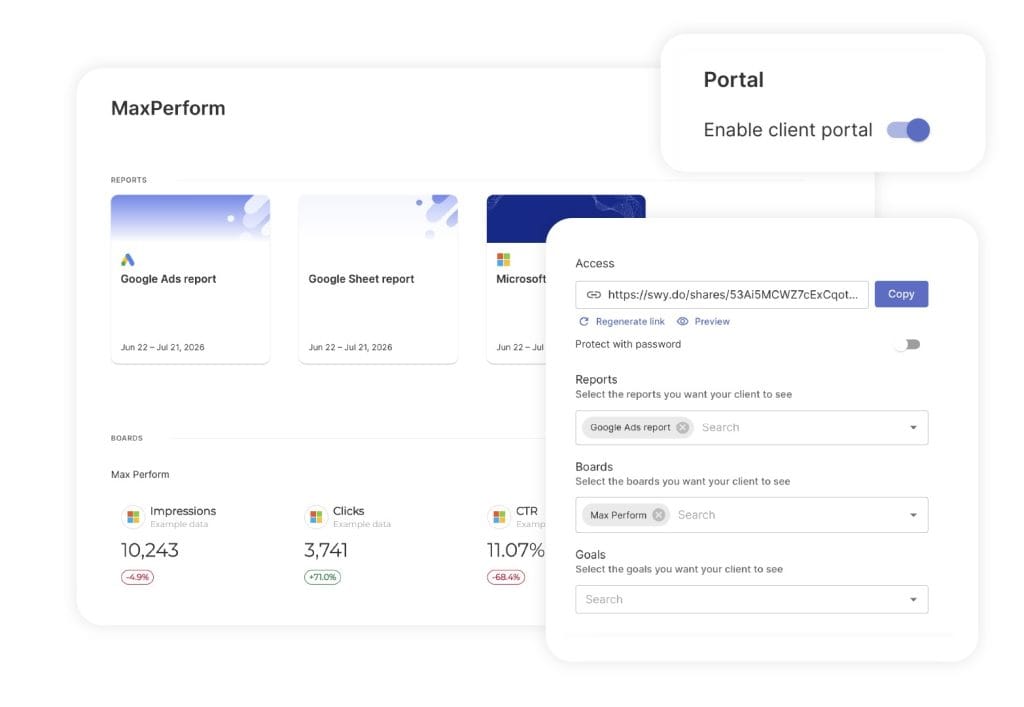
Access is yours to control. Add a password when the data is sensitive. Regenerate the link whenever you want and the old one dies immediately, which matters more than it sounds when a client’s marketing manager leaves halfway through a contract.
Whatagraph shares reports by link too, and those reports look excellent. The difference is scope. A shared report covers one report, where a portal gives your client somewhere to come back to, and the chat that would make Whatagraph’s version interactive is a Prime feature.
If your clients currently email you on the 18th asking for a number, a portal is what stops that.
When You Actually Need a Data Warehouse
Whatagraph can push data to BigQuery, but only as a Prime add-on, the custom-quoted tier above Max. Looker Studio transfer sits on Prime as well. Real capabilities, but not where Whatagraph is strongest, and an expensive way to buy them.
Supermetrics and Funnel are purpose-built for warehouse pipelines. They cost less and do more for that specific job.
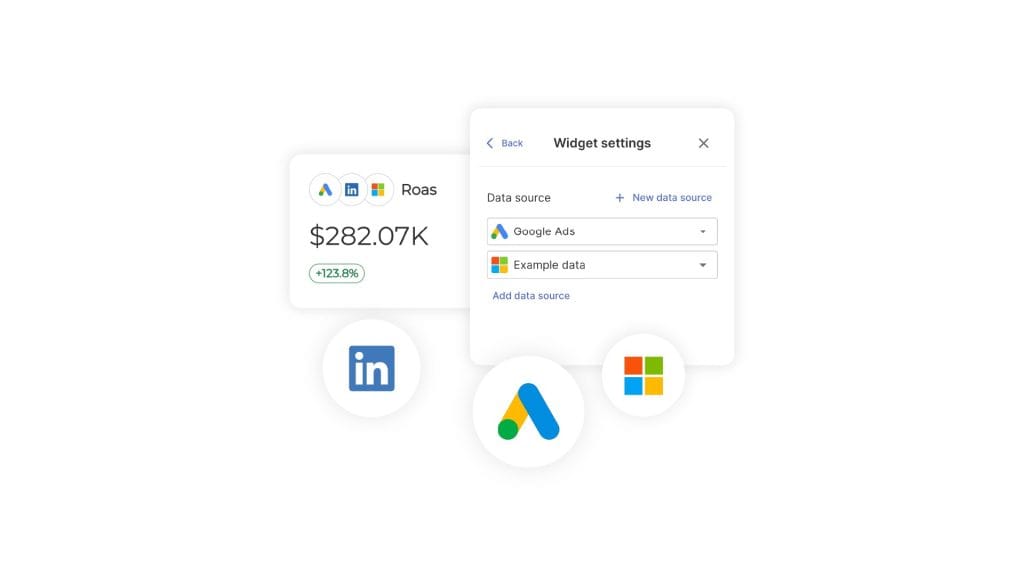
For everyday cross-channel reporting, Swydo’s Combined Data Sources widget blends up to five ad platforms into a single metric. Total ROAS across Google, Meta, LinkedIn, Microsoft, and TikTok in one number, across reports, boards, goals, and alerts.
What to Watch Before You Sign With Whatagraph
AA few things in Whatagraph’s terms surprise agencies after they’ve committed. None makes it a bad tool. They’re worth knowing up front.
- The entry price jumped hard. What used to cost $229 (Start) or $463 (Boost) is now a single $812/month plan. There’s no budget-tier alternative anymore. Max is the floor.
- Paid plans bill annually. No monthly option on either plan. Minimum commitment on Max is roughly $9,744 for the year, before you’ve connected a single extra source.
- Twenty-two integrations aren’t on Max. Check your client roster against the Prime list before you sign, because ecommerce, CRM, programmatic, and the Google Marketing Platform stack are all on the wrong side of it.
- Cancellation runs on 30 days’ notice, and payments aren’t refundable. This shows up in the angriest reviews. One Capterra reviewer described asking to cancel days before the bill was due and being told they still owed another 30 days under the policy.
- The free plan is gone. What’s left is a 14-day trial of Max. There’s no permanent low-credit tier to test on indefinitely anymore. After two weeks, it’s the full $812 bill or nothing.
- Plan changes go through sales. Upgrading to Max or Prime means booking a call. Extra credits stretch you to the next threshold, then the conversation starts.
For contrast, Swydo is a 14-day full-access trial with no credit card, self-serve cancel anytime, and a pause-subscription option for seasonal agencies. Build live reports on your own client data before you pay anything.
What Reviewers Say
Whatagraph’s reviews are solid overall. 4.5 out of 5 across roughly 283 G2 reviews, and 4.4 across 84 on Capterra. People like how the reports look. They praise the support team. A Director of Performance Marketing on G2 called it the best in the market, “especially for the price,” a line written back when the price was a fraction of what it is now.
So this isn’t a hit piece. But read enough reviews and the same note keeps sounding: it’s worth it, and it’s expensive. That second half only gets louder at $812 a month.
A Legal Researcher on Capterra put it in one line: nothing to dislike, “it is expensive but worth it.” A content writer on G2 loved the white-label custom domain and the billable hours it saved her, then admitted that as a solopreneur she can’t afford it long-term. At the current price, that math is even less forgiving.
The tool earns praise and a wince in the same breath.
Swydo sits at 4.7 out of 5 on G2 across 114 reviews, with 90% giving five stars, and 4.6 on Capterra. The thing reviewers raise most isn’t a feature. It’s the support. Fast answers. Helpful follow-ups. Real humans during onboarding.
For a tool you’ll lean on every month, that’s the part that quietly matters.
How to Make the Call in 20 Minutes
Five questions settle it. Answer about your agency as it runs today, not the one you hope to be in two years.
- How many clients, and how many platforms each? Light clients strongly favor Swydo’s per-source model. Then check whether any of those platforms are ecommerce, CRM, or programmatic, because on Whatagraph those are all Prime. Biggest factor, start here.
- Do you need alerts mid-month, or just the monthly report? Active monitoring points to Swydo. Whatagraph now bundles alerts into its one plan, but that plan costs $812.
- Is beautiful-out-of-the-box the thing you’re buying on? If visual polish is the whole decision and you have an enterprise-size budget, Whatagraph is a fair call. If not, the gap is hard to justify.
- Do your clients need to log in, or just receive a file? Self-serve access is included on Swydo’s base plan. On Whatagraph, the interactive version of it is a Prime feature.
- How easily can you test it and leave it? Swydo has a no-card trial and self-serve cancel. Whatagraph has annual billing, 30 days’ notice, and a call with sales to activate either plan. Factor in the entry and the exit.
The honest answer is that plenty of agencies would do fine on either, if budget weren’t a factor. At $812 a month with no cheaper tier, budget is a factor for almost everyone.
Two numbers settle it. Multiply your clients by the platforms each one runs, then compare that against $812. Under about 30 clients on standard channels, Swydo wins on price by a margin that isn’t close. Above that, run the credit math before you assume a flat fee is simpler.
The other half is what you want the tool doing when nobody’s looking at it. If a monthly PDF is the whole job, either tool works. If you want to hear about a broken Google Ads connection before your client does, that’s on Swydo’s base plan, and it’s why most people who switch say they switched.
Run both on your own client data before you commit to either. You’ll know inside an afternoon.
Still weighing the field? Our Whatagraph alternatives roundup covers more, and the best client reporting software guide zooms all the way out.
Swydo vs Whatagraph FAQ
Direct answers to what agencies actually ask before they switch
Both build automated, white-label client reports. The difference is what each one adds around the report, and what it charges. Whatagraph is built for out-of-the-box visual polish and now prices as a single premium plan, from $812/month. Swydo runs the same reporting workflow at a fraction of that starting price, then keeps watching your campaigns with built-in goals and alerts. So one is report-and-done with a premium look and a premium bill. The other reports, then monitors, for less.
For most standard agency reporting, Swydo is the better value. Same core workflow, a much lower price, and monitoring built into the base plan. Whatagraph is the better pick if a beautiful report straight out of the box is what you’re selling on and $812 a month isn’t a stretch, or if your clients run on ecommerce platforms Swydo doesn’t connect to. Neither is “better” in the abstract. It comes down to your client-count math and whether you want a tool that watches campaigns or one that only reports on them.
Yes, and it’s where the price gap is now widest. Swydo starts at $69/month with 10 data sources plus unlimited clients and users, so a solo operator or a five-client shop isn’t paying enterprise rates. Whatagraph’s only standard plan, Max, starts around $812/month billed annually, a price built for larger teams. If you’re small and your channels are standard, Swydo is the easy call.
Whatagraph, out of the box. Its reports are the showpiece, and that polish is most of what its price buys. Swydo’s reports are clean, fully white-labeled, and more customizable than people expect. 1,000+ Google Fonts, your own colors, landscape or portrait layouts, and brand templates you can vary widget by widget when a report covers more than one business unit. They look professional. They just need a few minutes of your taste applied.
The honest question is what that extra gloss is worth to you each month, especially now that the gloss costs $812 of it.
Swydo starts at $69/month ($62 billed annually) and includes 10 data sources, with unlimited clients and users. A data source is one connected account, so a client on Google Ads, Meta, and GA4 uses three. Past the first 10, each source costs a few dollars, and the per-source rate drops as you scale. Reporting frequency doesn’t change the price.
Whatagraph cut its three plans down to two. Max is now the only standard plan, from $812/month billed annually, with 50+ source credits, blending, custom metrics, and goals and alerts included. Prime sits above it at custom pricing, with custom credits, 22 premium integrations, and add-ons for custom report domains, BigQuery, SAML, and a public API, plus Looker Studio transfer and the IQ+ client-facing AI chat. There’s no cheap entry point left. Max is the floor, and it’s a steep one.
One source credit equals one connected data account, so a client on GA4, Google Ads, and Meta uses three. Max includes 50 or more, which covers a meaningful chunk of a mid-size client book. You can buy extra credits beyond that, but only up to the next plan threshold. Past it, you’re into a custom Prime quote rather than a published next tier, and the upgrade runs through a call with their team.
Twenty-two of them, and the grouping matters more than the number. Every ecommerce platform is Prime, meaning Shopify, WooCommerce, BigCommerce, Magento, and bol.com. So are both major CRMs, HubSpot and Salesforce. So is all programmatic and DSP inventory, including The Trade Desk, StackAdapt, Criteo, Taboola, Adform, Basis Technologies, and Simpli.fi. So is the whole Google Marketing Platform stack, Display & Video 360, Campaign Manager 360, and Search Ads 360. So are BigQuery, Snowflake, Adobe Analytics, AdRoll, and GoHighLevel.
Everything else, including Google Ads, Meta, GA4, LinkedIn, TikTok, Microsoft Ads, Semrush, and OpenAI Ads, is available on Max. The practical test is simple. If one client runs a Shopify store or lives in HubSpot, the $812 plan doesn’t cover you and Prime is a custom quote with no published price.
Yes, dramatically, for standard setups. Swydo delivers the same core reporting workflow at a fraction of Whatagraph’s entry price, and that gap is now wider than it’s ever been. Here’s the monthly cost at three data sources per client (GA4 + Google Ads + Meta).
| Agency size | Swydo | Whatagraph |
|---|---|---|
| 5 clients | $92/mo | $812/mo (Max) |
| 15 clients | $227/mo | $812/mo (Max) |
| 30 clients | $429/mo | $812/mo plus credits |
| 50 clients | $624/mo | Custom (Prime) |
Whatagraph no longer offers a permanent free plan. It’s a 14-day trial of Max, and then the $812 bill starts. Swydo has no permanent free plan either, but it does offer a 14-day full-access trial with no credit card. You build live reports on your own client data before paying anything, and there’s no premium plan waiting behind the trial.
Not month-to-month. Whatagraph’s paid plans bill annually, need 30 days’ notice to cancel, and payments aren’t refundable, the source of some of its most frustrated reviews. At $812/month, that’s roughly a $9,744 annual commitment before extra credits. Swydo is self-serve cancel anytime, with a pause-subscription option for agencies that run on seasonal clients. No annual lock-in to get started.
For everyday use they’re about even, and both go further than summaries now. Both can build a report structure from a prompt, write the commentary, and answer questions about the data. Swydo includes 4,000 AI credits a month on every plan, works in whatever language you write to it in, and auto-drops a fresh summary into every scheduled report email. Whatagraph’s IQ ships on both its plans too.
The split is at the client-facing end. Swydo’s dashboard chat is on the base plan, while Whatagraph’s IQ+ chat is locked to Prime, not included even on the $812/month Max plan.
Yes. Describe the report you want and Swydo AI creates the sections and widgets, then edits them when you describe a change, whether that’s a different date range, a different chart type, or a different sort order. It suggests widgets you might have missed, and you can save a prompt and reuse it on the next client so your reports come out consistent instead of improvised.
It works inside reports and dashboards, not on templates, so build with it first and link your clients to the finished master afterward.
Yes, through Swydo’s Client Portal. You pick which Reports, Boards, and Goals each client can see, and they all sit behind one secure link instead of a handful of separate URLs. Add a password if the data warrants it, preview the portal before you share it, and regenerate the link at any point to cut off access to the old one.
Whatagraph shares reports by link as well, but the interactive, ask-your-own-questions version of that experience is IQ+, which requires Prime.
Yes, and it’s Swydo’s clearest edge over Whatagraph. Set an alert on any client metric, pick a window of 1, 7, 30, or 90 days, and get pinged by email or Slack the moment it crosses your threshold. Pair it with goals for pacing. On Track, Off Track, or Achieved. You’ll know a client’s cost-per-lead doubled before they email you. Whatagraph bundles goals and alerts into Max now too, but Max is an $812/month plan to get them.
Yes. That’s the Data Source Health Check, and it often matters more than campaign alerts. Swydo checks every connection daily, so the moment a Google Ads token expires or a Meta or GA4 connection drops, you get a red-dot alert in the app and an email, usually before the next report is due to send. The client never sees a blank widget. Campaign alerts catch a metric going sideways. Health-check alerts catch the upstream break that would’ve made the whole report wrong.
Yes. Swydo’s Combined Data Sources widget blends up to five ad platforms, Google, Meta, LinkedIn, Microsoft, TikTok, and more, into one metric like total ROAS, and it works across reports, dashboards, goals, and alerts, not just reports. One honest limit. Custom metrics don’t work inside a combined widget. For most cross-channel client reporting, it covers the job.
Whatagraph can export to BigQuery, but only as an add-on on Prime, its custom-quoted top tier, above the $812/month Max plan. Looker Studio transfer, Snowflake, and Adobe Analytics sit on Prime as well. An expensive way to buy any of them, on top of an already-expensive plan. Swydo doesn’t push to a warehouse. Its Combined Data Sources handle cross-channel blending inside the tool instead.
If a real warehouse pipeline is your actual need, neither is the best fit. Purpose-built tools like Supermetrics or Funnel cost less and do more for that one job.
Swydo connects to 38 data sources and adds more regularly. All the platforms agencies report on daily are covered. Google Ads, Meta, GA4, Google Search Console, Microsoft Ads, LinkedIn, TikTok, Reddit, Pinterest, Snapchat, X, plus Semrush, SE Ranking and AccuRanker for SEO, CallRail and CallTrackingMetrics for calls, and HubSpot, Mailchimp, Klaviyo and ActiveCampaign on the CRM and email side. ChatGPT Ads is there too, through the OpenAI Advertising connection.
Everything on that list is on the $69 base plan. That’s the part worth comparing, because Whatagraph gates HubSpot and AdRoll to Prime while Swydo includes both at entry.
Where Swydo falls short is ecommerce and enterprise. No Shopify, WooCommerce, or Salesforce, and no warehouse destinations. If those belong in your reports, Swydo isn’t the fit. For anything else unsupported, a Google Sheets or Microsoft Excel connection fills the gap. Excel is in beta and works with Microsoft Business accounts only.
No public REST API, a real gap if you’re planning custom data pipelines. The workaround is a spreadsheet connection paired with Zapier or Make, which covers most custom-data needs. Worth knowing up front. Whatagraph offers a public API, but only as a Prime add-on, so neither tool gives you API access on its standard plan.
Yes. Swydo’s team rebuilds your reports for you as part of onboarding, so you’re not staring at a blank screen. Migration help is free and human-assisted. The safest move is to test the fit during the 14-day full-access trial first, on your own client data, no credit card needed. Confirm it works the way you need, then switch.
Choose Swydo’s affordable efficiency over Whatagraph’s premium pricing.
Start Your Free Swydo Trial